 Pyeongye
All tours · American Painters · Room 2
Notes on this room's painting
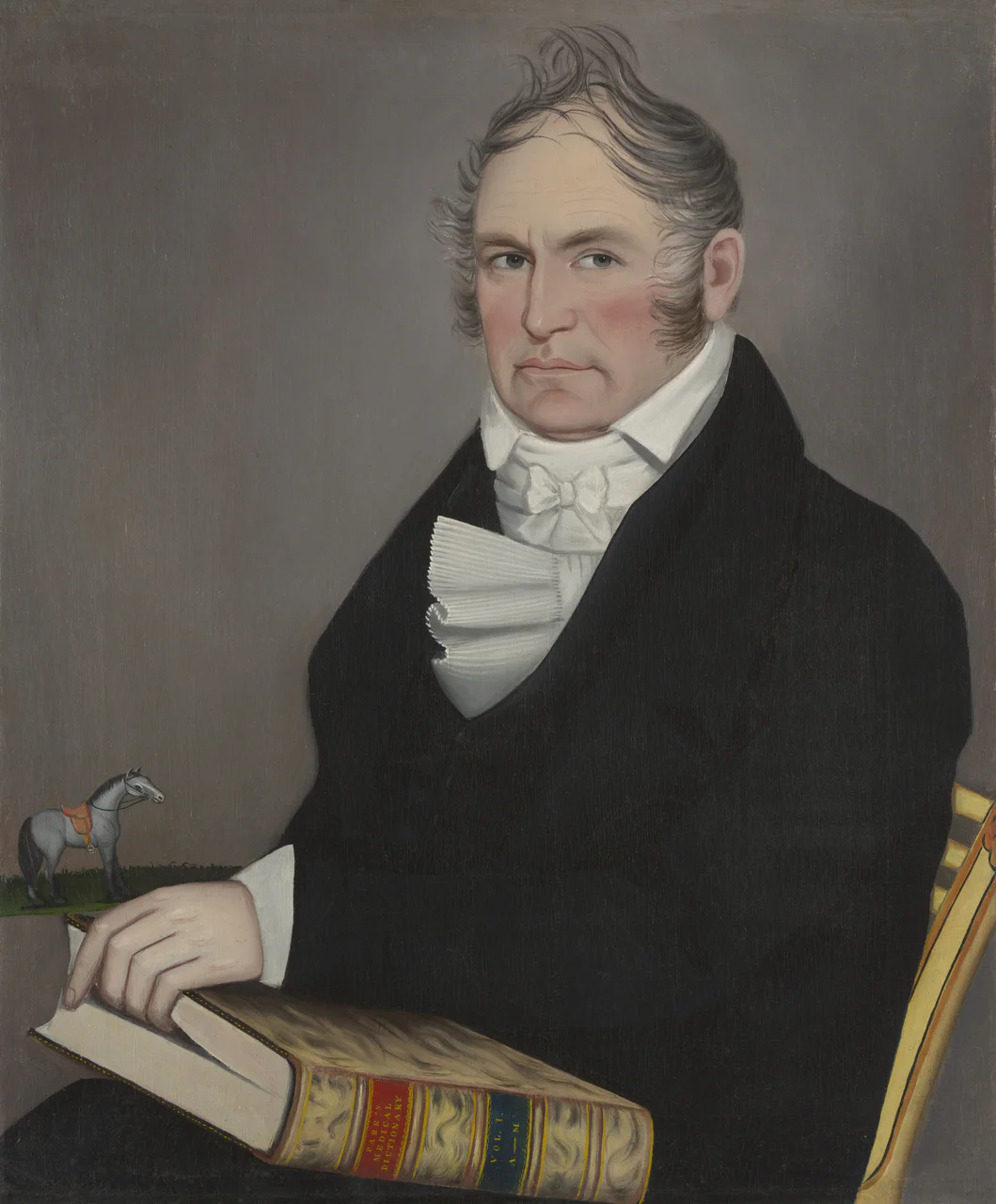
- Dr. Cornelius Allerton, in a black coat and a ruffled white shirt, sits in a yellow painted chair holding a thick medical dictionary.
- Ammi Phillips, a traveling portrait painter in rural New England and New York, painted him in 1821–22.
- A book title and a tiny horse in the corner quietly tell us who this man was.
Reading the picture
5 places to look closer
Tap a number on the painting to jump to its note, or a close-up to see that spot in the whole picture.
Zoom in on the face. Grayish curls rise above the forehead, and the cheeks are flushed pink. His eyes slide to one side, as if glancing at us. The museum notes that the face is fairly flat, yet the careful details capture a real individual.
Look just below his chin. A white cloth is tied in a bow, and beneath it a finely pleated ruffle fans out. Each pleat is a thin white line. Against the deep black coat, this ruffle is the first thing you notice.
Zoom in on the lower left corner. A gray horse with a saddle stands on a strip of grass. It is smaller than the doctor's hand, yet you can see the reins and the stirrup. The museum suggests this tiny horse may hint at his wealth.
Look at his hand. His thick fingers slip between the pages, as if holding his place. The knuckles are drawn with just a few reddish-brown lines. A dotted gold border runs along the edge of the book.
Zoom in on the spine. Gold letters on a red label read PARR'S MEDICAL DICTIONARY, and a blue label reads VOL. I, A to M. The museum explains that the book announces Allerton's profession. Phillips even painted the brown marbled pattern of the cover.
When it was painted
Around 1821 Ammi Phillips was about thirty-three. He came from Connecticut and had no formal art training. He started out with a sign painter's skills and taught himself to paint portraits. By about 1811 he had picked up techniques from other Connecticut portrait painters.
Western New England was growing richer and more crowded. Families who were doing well wanted their faces, and their relatives' faces, preserved for the future. Phillips traveled through Connecticut, Massachusetts and New York, going from house to house to paint them.
Traveling painters often portrayed several members of one family on a single visit. Phillips painted Allerton's mother and his mother-in-law as well. The mother's portrait is at the Art Institute of Chicago alongside this one, and the mother-in-law's is at the Connecticut Historical Society in Hartford.
Phillips kept painting for decades, yet for a long time his name was forgotten. In the twentieth century, researchers showed that groups of pictures credited to separate unknown painters were all the work of this one man.
The portrait was given to the Art Institute in 1946 by Robert Allerton, the sitter's great-nephew and a major supporter of the museum.
Look again at the little horse in the corner. Beside the doctor and his heavy dictionary, it has stood on the same patch of grass for two hundred years.
Questions to think about
- Look for itWhich word on the book's spine tells you this man was a doctor?
- Why?Why do you think Phillips painted the horse so small, almost like a toy?
- What about you?Allerton showed who he was with a dictionary and a horse. What things or pictures do we put next to our profile photos today to show who we are?