 Pyeongye
Artwork · 19th century · Vincent van Gogh
LeoTurn on Magnifier at the lower right and move slowly across the painting.
Full screen opens it edge to edge.Tap the painting to fill the screen.
Spread two fingers to look closer.
At a glance
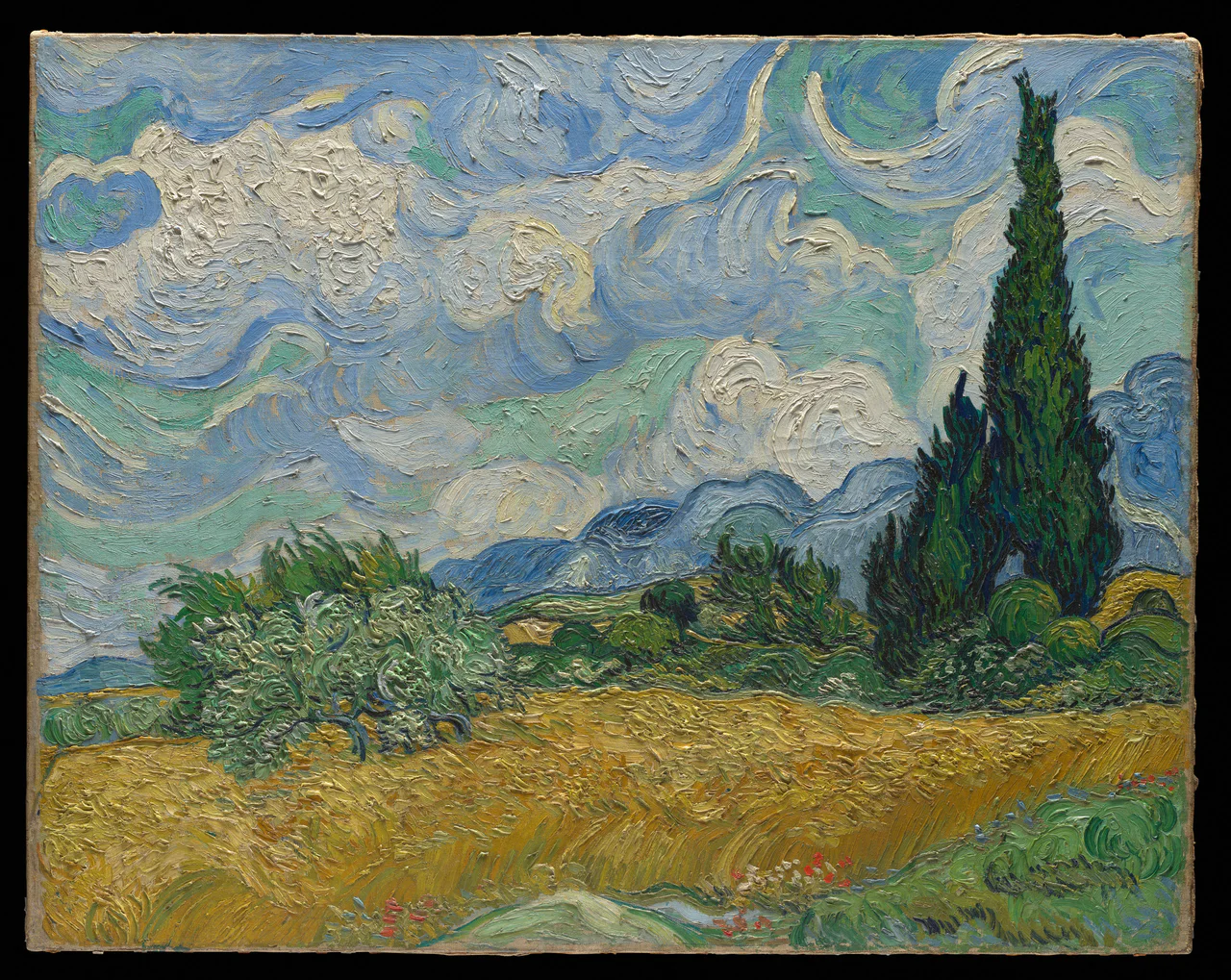
- A ripe yellow wheat field on a windy summer day, with a dark cypress shooting up into a restless sky.
- Vincent van Gogh painted it in oil on canvas in 1889, near Saint-Rémy in the south of France.
- The paint sits thick on the surface, so up close you can follow every stroke the wind seems to push around.
Reading the picture
5 places to look closer
Tap a number on the painting to jump to its note, or a close-up to see that spot in the whole picture.
Start with the tall tree on the right. It is a cypress, and it is not painted in one green. Short strokes of deep green, bright green and blue-black are stacked on top of each other. They all twist upward, so the tree looks almost like a flame.
Now zoom into the white cloud in the middle of the sky. The paint is so thick that you can see the ridges and grooves left by the brush. The cloud curls in on itself like a wave. Even the sky refuses to sit still.
Move to the bushy trees on the left. Their leaves are a silvery pale green, bent in every direction. A few dark blue lines pick out crooked branches and trunks. The grassy tufts along the top all lean the same way, which tells you where the wind is coming from.
Look along the bottom edge of the field. Those little red dabs are poppies, with a few white flowers mixed in. Van Gogh set them down as small blobs of paint. In a picture made mostly of yellow and green, your eye goes straight to the red.
Behind the wheat, a line of blue hills rolls across the picture. They are drawn with the same wavy strokes as the clouds. Dark blue and white sit side by side instead of being blended, and that makes the folds of the hills. Land and sky are painted the same way, so the whole picture seems to move together.
When it was painted
On July 2, 1889, Vincent van Gogh wrote to his brother Theo from the asylum at Saint-Rémy. He was thirty-six. With the letter he sent a batch of reed-pen drawings copied from the paintings he was working on, and one of them showed this wheat field. In the letter he listed what was on the canvas: cypresses, ears of wheat, poppies, and a blue sky he compared to a piece of Scotch plaid.
Two months earlier, in May, he had checked himself into the asylum of Saint-Paul-de-Mausole after a string of breakdowns and hospital stays in Arles. Theo paid for his care. The director let him use a spare room as a studio. At first he painted only inside the walled garden. By June he was allowed out into the fields and olive groves.
This picture was made out there, in front of the wheat. When conservators at the Met studied it, they found a wheat husk caught in the paint. A bit of chaff landed on the wet surface and has stayed there ever since.
In mid-July a severe attack struck while he was working outdoors, and for weeks he could not paint. When he recovered in September, he went back to this composition in his studio and painted it twice more. One of those versions now hangs in the National Gallery in London. A smaller one was made for his mother and sister.
The first version, the one painted in the field, came to the Metropolitan Museum in 1993, bought with a gift from the Annenberg Foundation. Look at the sky again. Can you see the plaid he described, with blues, whites and greens laid side by side instead of blended?
The painter
Vincent van Gogh
1853–1890
When painting this, the artist was about 36 years old
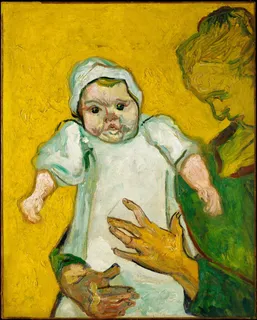
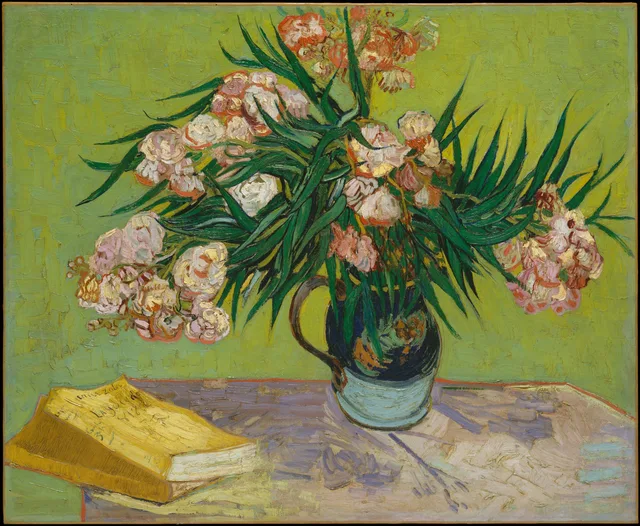
All paintings by Vincent van Gogh →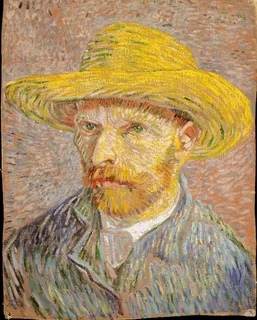
Questions to think about
- Look for itCan you zoom in and find where the paint is piled up the thickest: in the sky, the hills, the trees or the wheat?
- Why?Why do you think Van Gogh chose a windy day, when everything bends, instead of a calm and still one?
- What about you?He kept going outside to paint every day during a hard time in his health. What do you think helps people today who are going through something similar?
Same period
Painted around the same time,
somewhere else
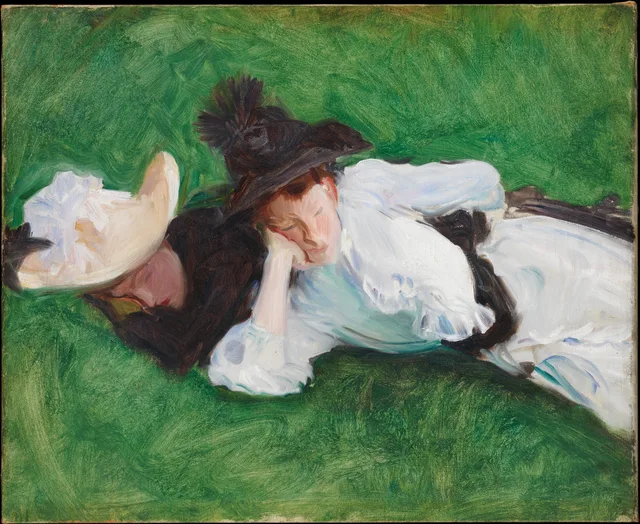 Two Girls on a LawnJohn Singer Sargentca. 1889
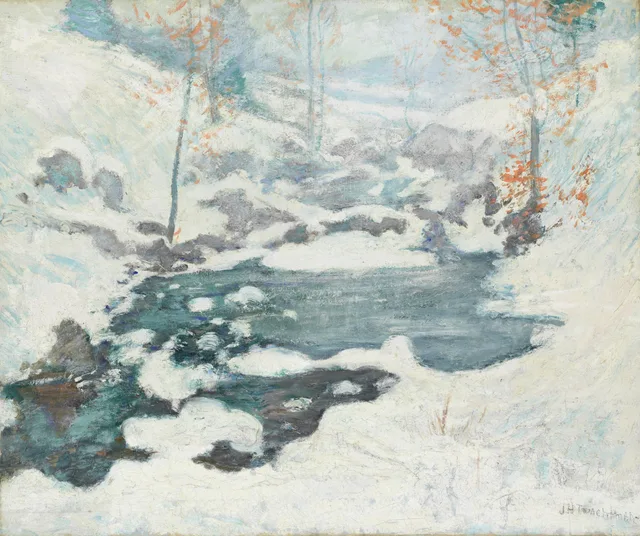 IceboundJohn Henry Twachtmanc. 1889
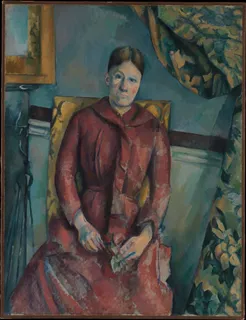 Madame Cézanne (Hortense Fiquet, 1850–1922) in a Red DressPaul Cézanne1888–90
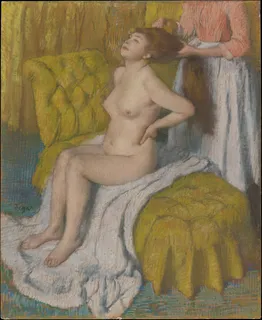 Woman Having Her Hair CombedEdgar Degasca. 1886–88
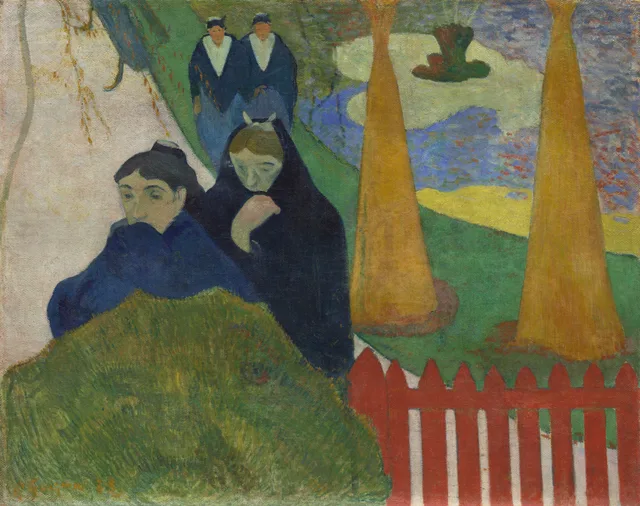 Arlésiennes (Mistral)Paul Gauguin1888
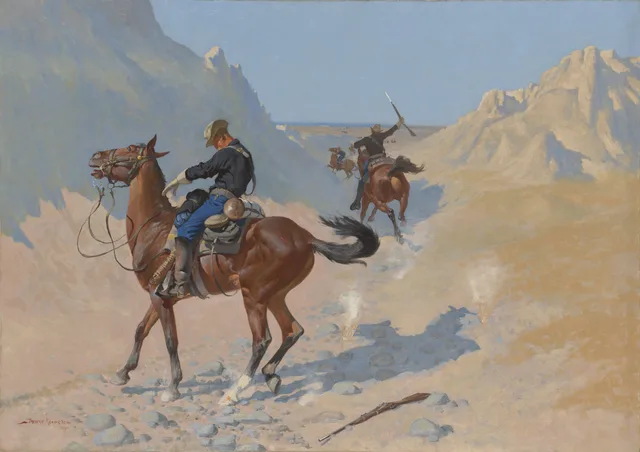 The Advance-Guard, or The Military Sacrifice (The Ambush)Frederic Remington1890
Too good to keep to yourself
This painting,
for someone who comes to mind
They open it at full size
and see every brushstroke.
About this work
- Artist
- Vincent van Gogh · 1853–1890
- Date
- 1889
- Medium
- Oil on canvas
- Size
- 73.2 × 93.4 cm
- Collection
- The Metropolitan Museum of Art
- Image
- Original long edge 4000px · shown at 2560px
- Original
- View on the museum's website ↗