 Pyeongye
Artwork · 19th century · Katsushika Hokusai
LeoTurn on Magnifier at the lower right and move slowly across the painting.
Full screen opens it edge to edge.Tap the painting to fill the screen.
Spread two fingers to look closer.
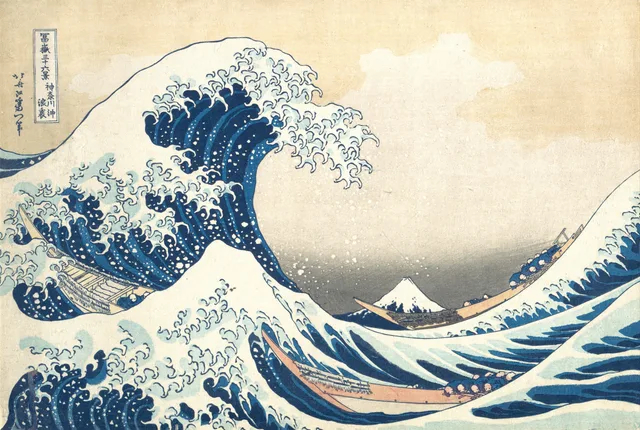
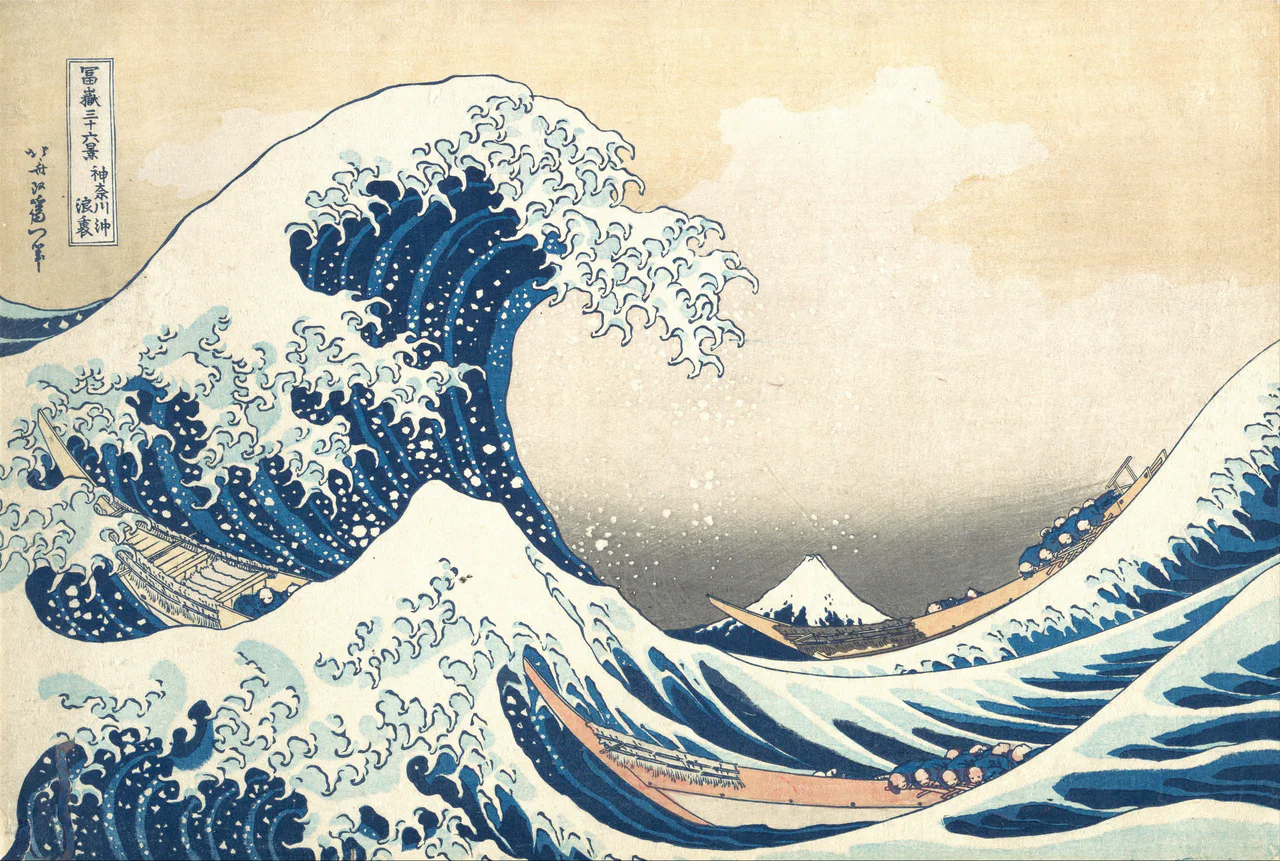
Under the Wave off Kanagawa (Kanagawa oki nami ura), also known as The Great Wave, from the series Thirty-six Views of Mount Fuji (Fugaku sanjūrokkei)
Katsushika Hokusaica. 1830–32Woodblock print; ink and color on paper25.7 × 37.9 cm
At a glance
- A huge wave about to crash down on three boats, with a tiny Mount Fuji in the distance below it.
- A woodblock print by Katsushika Hokusai, made around 1830 to 1832, when he was about seventy, for his series Thirty-six Views of Mount Fuji.
- Prints like this were made in many copies from the same blocks, which is why museums around the world each own an impression.
Reading the picture
5 places to look closer
Tap a number on the painting to jump to its note, or a close-up to see that spot in the whole picture.
Zoom in on the top of the wave. The white foam curls into hooks, almost like fingers. It looks ready to grab the boats at any moment. White specks are scattered over the deep blue like flying spray.
Now look down into the trough between the waves. There sits Mount Fuji, snow-capped and very small. The whole series is about Fuji, yet here the mountain is no bigger than a fingernail, half hidden by water. Notice how the curve of the near wave and the triangle of the far peak echo each other.
Zoom in on the boat on the right. People in blue clothes press themselves flat against the boat, heads bowed. Not a single face is visible. They huddle low, as if waiting for the wave to pass.
In the square box at the top left, the name of the series and the title of this print are written in Chinese characters. The brushed writing beside it is the artist's signature. It says that Hokusai has changed his name to Iitsu. He changed his art name many times over his long life.
Look at the lower boat too. Its long hull tilts along the slope of the wave. A group of people crouch together at its right end. The white foam touches the pale wooden boat, as if the sea is about to swallow it.
When it was painted
Around 1830, in Edo, the city we now call Tokyo, Katsushika Hokusai was past seventy. Up to then he was best known for book illustrations and drawing manuals. His Hokusai Manga, a picture handbook whose first volume came out in 1814, kept growing volume after volume and sold widely.
Then an Edo publisher, Nishimuraya Yohachi, launched a new series with him: views of Mount Fuji seen from many places. The publisher advertised the prints as pictures printed in blue. Behind that blue was Prussian blue, a pigment that had only recently arrived from Europe.
The series sold well, and ten more prints were added, for forty-six in all. Until then, the stars of ukiyo-e prints had mostly been kabuki actors and beautiful women. After this series, landscape became a major subject, and a few years later Utagawa Hiroshige followed with his Fifty-three Stations of the Tokaido.
Hokusai himself was in no mood to stop. At the end of his 1834 picture book One Hundred Views of Mount Fuji, he wrote that he had been drawing since the age of six, but that nothing he made before seventy was worth much. He hoped that by one hundred and ten, every dot and line he drew would be alive. He died in 1849, at eighty-eight.
The wave, meanwhile, crossed the sea. In 1888 Vincent van Gogh wrote to his brother Theo comparing these waves to claws, with the boat caught in their grip. In 1905 the wave appeared on the cover of the score of Claude Debussy's orchestral work La Mer. The Met's own impression came to the museum in 1929, as a bequest from Mrs. H. O. Havemeyer.
Look again at the layers of deep and pale blue. A wave printed with a color that had come from Europe went on, a few decades later, to catch the eye of European artists.
Questions to think about
- Look for itHow many boats can you find, and roughly how many people?
- Why?Why do you think Hokusai made Mount Fuji, the star of the series, so small, and the wave so large?
- What about you?Prints like this let many people own the same picture; what would it take today for good art and music to be shared by everyone, not just a few?
Same period
Painted around the same time,
somewhere else
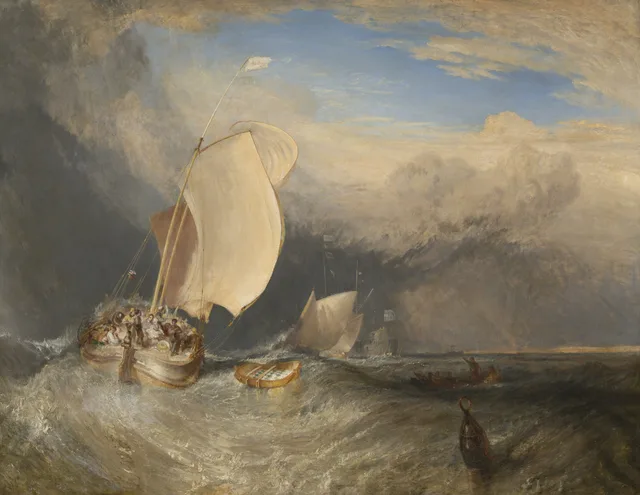 Fishing Boats with Hucksters Bargaining for FishJoseph Mallord William Turner1837–38
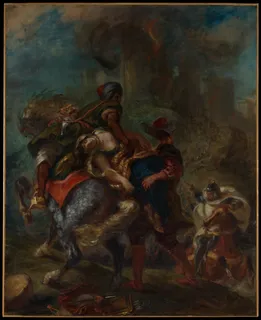 The Abduction of RebeccaEugène Delacroix1846
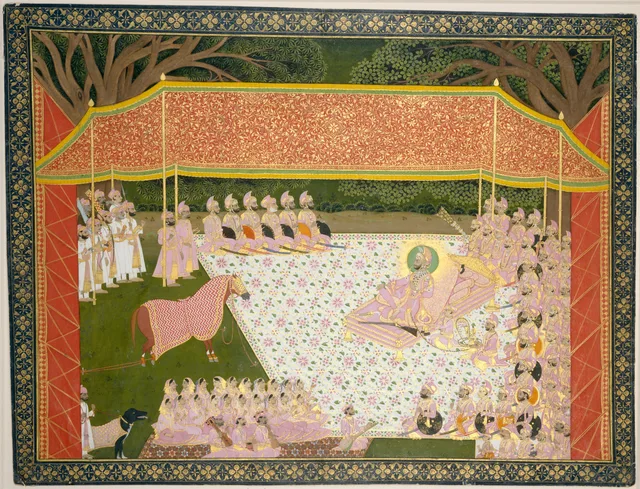 Maharana Sarup Singh Inspects a Prize StallionTara1845–46
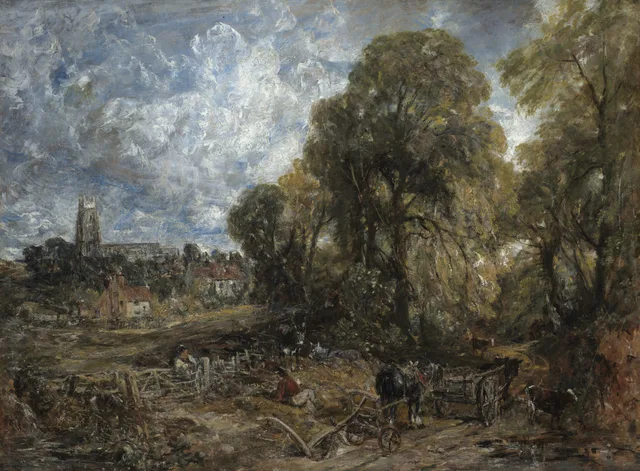 Stoke-by-NaylandJohn Constable1836
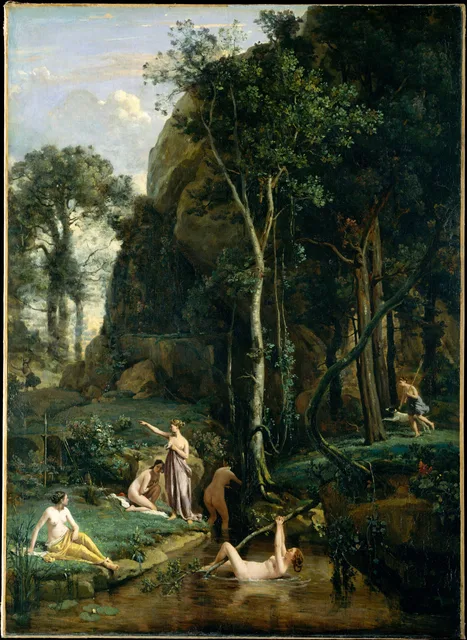 Diana and Actaeon (Diana Surprised in Her Bath)Camille Corot1836
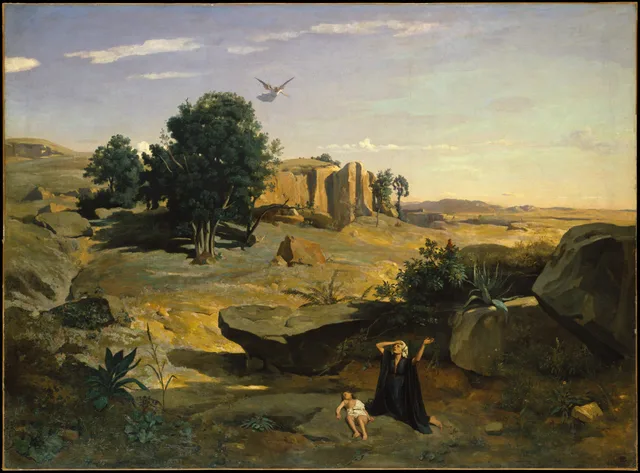 Hagar in the WildernessCamille Corot1835
Too good to keep to yourself
This painting,
for someone who comes to mind
They open it at full size
and see every brushstroke.
About this work
- Artist
- Katsushika Hokusai · 1760–1849
- Date
- ca. 1830–32
- Medium
- Woodblock print; ink and color on paper
- Size
- 25.7 × 37.9 cm
- Culture
- Japan
- Collection
- The Metropolitan Museum of Art
- Image
- Original long edge 3859px · shown at 2560px
- Original
- View on the museum's website ↗