 Pyeongye
Artwork · 17th century · Johannes Vermeer
LeoTurn on Magnifier at the lower right and move slowly across the painting.
Full screen opens it edge to edge.Tap the painting to fill the screen.
Spread two fingers to look closer.
At a glance
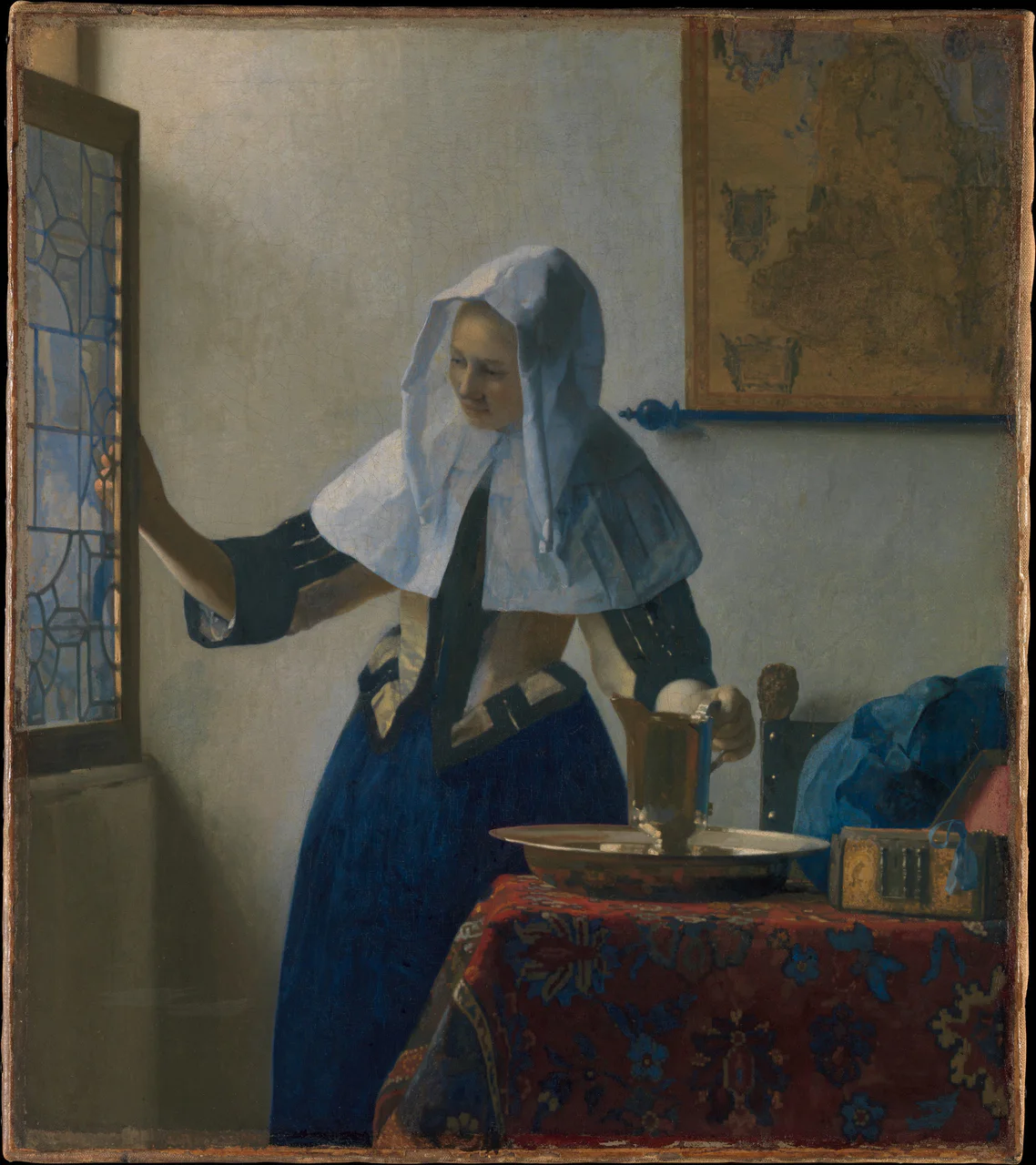
- A young woman opens a window with one hand and holds a pitcher resting in a basin with the other.
- Painted by Johannes Vermeer around 1662 in Delft, in the Netherlands.
- The canvas is only 18 by 16 inches, yet the light from the window travels across a white headcloth, a gleaming pitcher and a red table rug.
Reading the picture
5 places to look closer
Tap a number on the painting to jump to its note, or a close-up to see that spot in the whole picture.
Start with the window on the left. Pale blue sky shows through the panes, held together by lead strips. The woman's fingertips just touch the edge of the frame. Is she opening it or closing it? The painting holds that tiny moment still.
Zoom in on the white cloth covering her head. It is white, but in the shadows it turns blue. Vermeer did not paint white cloth with plain white.
Look at the pitcher and basin on the table. Small beads of light sparkle near the base of the pitcher. The curved side of the basin faintly reflects the red and blue of the rug below. A few dots of paint are all it takes to make the metal shine.
At the far right, a blue ribbon hangs over a golden box. The front of the box is decorated with a row of little columns. Behind it lies a deep blue cloth. Whose things are these? The painting lets you wonder.
Get close to the patterned rug covering the table. Blue flowers spread across a deep red ground. In Dutch homes of this period, rugs like this were often laid over tables rather than on the floor. Its heavy colors make the clear white light above look even brighter.
When it was painted
Around 1662, Vermeer was about thirty. He was born in Delft and spent his whole life there. His father ran an inn and also dealt in paintings, a business Vermeer later took over.
In 1653 he married Catharina Bolnes, and the same year he joined Delft's painters' guild. The couple lived in the house of her mother, Maria Thins. When Vermeer died, eleven of their children were still living, so the painter of these silent rooms lived in a very crowded one.
In 1662, around the time of this picture, his fellow painters chose him as one of the guild's leaders. The next year a French traveler, Balthasar de Monconys, came to Delft to see him. Vermeer had no paintings on hand to show. Monconys wrote in his travel journal that he saw a Vermeer at a baker's house instead.
His last years were hard. When French armies invaded the Dutch Republic in 1672, the market for paintings collapsed. Vermeer died in 1675, only forty-three, leaving his family in debt. After that his name faded for a long time, until critics rediscovered him in the nineteenth century.
In 1887 the New York collector Henry G. Marquand bought this picture in Paris, and in 1889 he gave it to the Met. It was the first Vermeer to enter an American museum. Now look at the large map hanging on the wall behind her. The wide world outside rests quietly on the wall of this small room.
More by the same painter
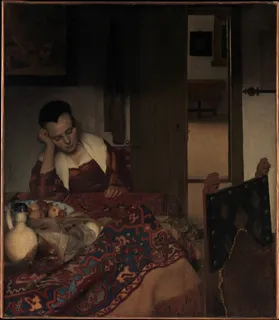
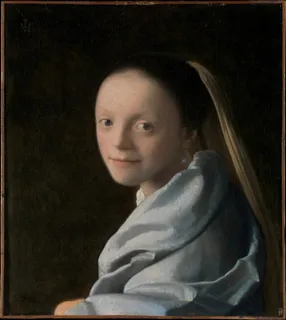
Questions to think about
- Look for itHow many places can you find where Vermeer used blue?
- Why?Why do you think Vermeer chose this in-between moment, hand on the window and hand on the pitcher, instead of showing clearly what she is doing?
- What about you?A small household task became a painting; which ordinary moment in your own day would look beautiful if you stopped to really see it?
Same period
Painted around the same time,
somewhere else
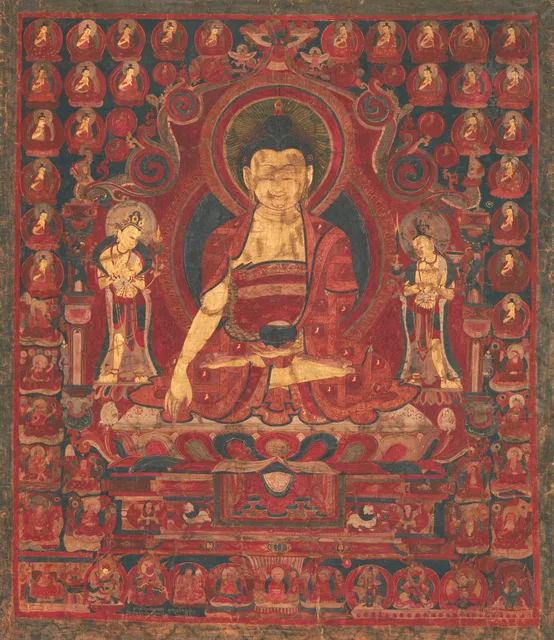 Buddha Shakyamuni as "Lord of the Munis"Unknown artist · Western Tibet, Gugemid-17th century
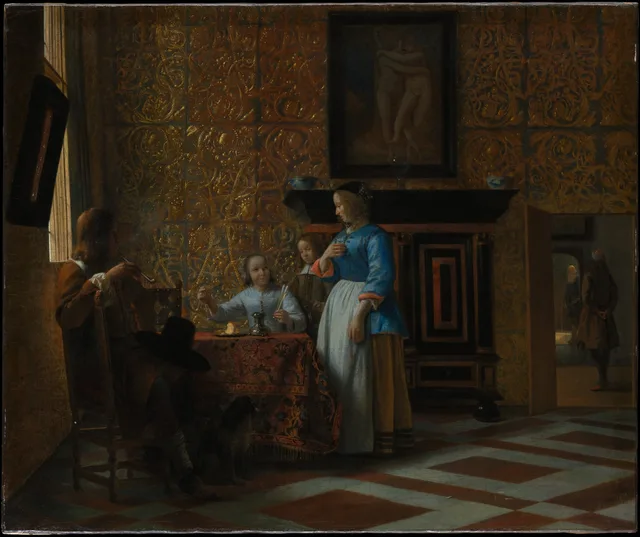 Leisure Time in an Elegant SettingPieter de Hoochca. 1663–65
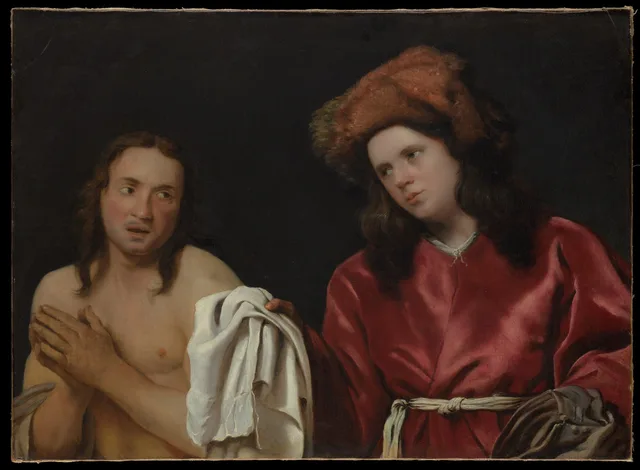 Clothing the NakedMichiel Sweertsca. 1661
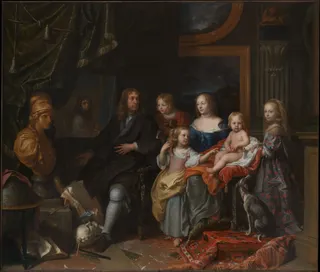 The Jabach FamilyCharles Le Brunca. 1660
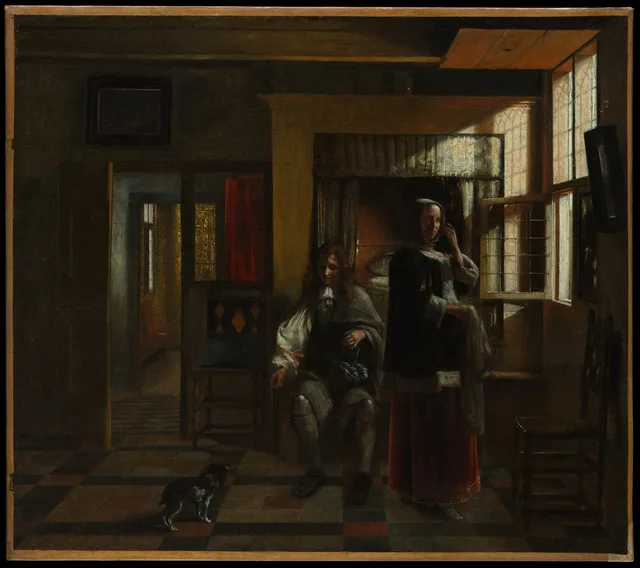 Interior with a Young CouplePieter de Hoochprobably ca. 1662–65
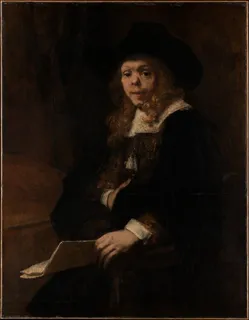 Portrait of Gerard de LairesseRembrandt1665–67
Too good to keep to yourself
This painting,
for someone who comes to mind
They open it at full size
and see every brushstroke.
About this work
- Artist
- Johannes Vermeer · 1632–1675
- Date
- ca. 1662
- Medium
- Oil on canvas
- Size
- 45.7 × 40.6 cm
- Collection
- The Metropolitan Museum of Art
- Image
- Original long edge 3866px · shown at 2560px
- Original
- View on the museum's website ↗