 Pyeongye
Artwork · 15th century · Jan van Eyck
LeoTurn on Magnifier at the lower right and move slowly across the painting.
Full screen opens it edge to edge.Tap the painting to fill the screen.
Spread two fingers to look closer.
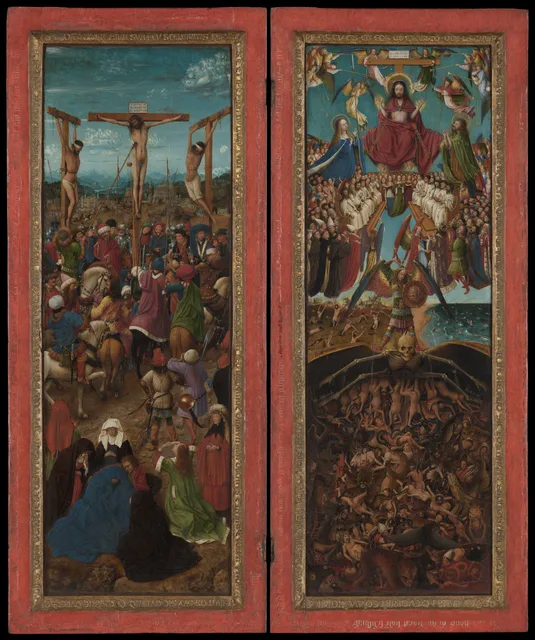
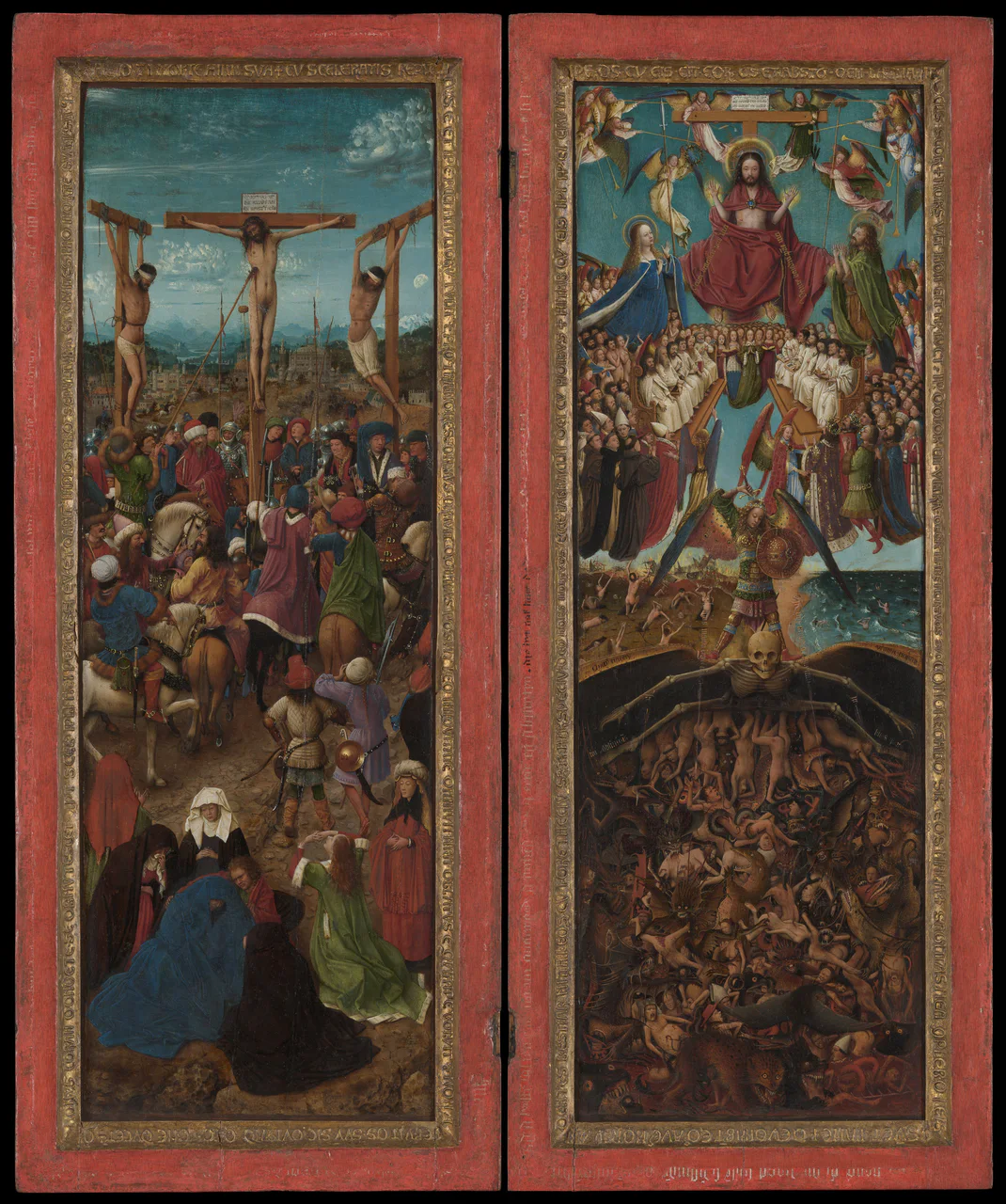
The Crucifixion; The Last Judgment
Jan van Eyckca. 1436–38Oil on canvas, transferred from wood56.5 × 19.7 cm
At a glance
- Two tall, narrow panels: Christ on the cross on the left, the end of the world and the Last Judgment on the right.
- Painted by Jan van Eyck and his workshop around 1436 to 1438.
- Each panel is only about 22 inches high and under 8 inches wide, yet it holds crowds of people and snowy mountains far away.
Reading the picture
5 places to look closer
Tap a number on the painting to jump to its note, or a close-up to see that spot in the whole picture.
Look at the right edge of the sky in the left panel, just beside a cross. A pale moon hangs there in daylight. Below it, a line of snow-capped peaks fades into blue. Down on the hill there is shouting and confusion, but up here the sky is perfectly calm.
At the bottom of the left panel, the mourners gather. The figure collapsed in a deep blue cloak, face hidden, is the Virgin Mary. The young man in red holding her up is shown as Saint John. To the right, a woman in green kneels with her hands locked together above her head. You cannot see her face, and you still feel her grief.
At the top of the right panel, Christ sits in a red mantle and shows his open palms. Golden rays shine from the wounds in his hands and feet. Lines of gold letters run down the red mantle. On either side, the Virgin in blue and John the Baptist in green raise their hands in prayer.
In the middle of the panel, a skeleton spreads huge, bat-like wings. An angel in armor stands on top of it. Painted on one wing are the Latin words VMBRA MORTIS, the shadow of death. Beneath the wings, people tumble head first into a pit full of monsters.
Now zoom in on the sea at the far right. Small figures rise out of the waves with their arms in the air. This is the biblical idea that on the last day even the sea gives back its dead. Carved into the gold frame right next to it is the word MORTVOS, the dead.
When it was painted
Picture Bruges in the mid-1430s, a busy trading city in Flanders. Jan van Eyck had been court painter to Philip the Good, Duke of Burgundy, for more than ten years. The duke trusted him with more than pictures. In 1428 Van Eyck sailed with a ducal embassy to Portugal to paint Princess Isabella, the woman Philip was hoping to marry.
By the time these panels were made, he was in great demand. He had finished the huge altarpiece in Ghent in 1432 and painted the Arnolfini Portrait in 1434. He also loved writing on his frames. He often added his name, the date, and his motto, ALS ICH CAN, which means roughly as best I can.
The Met presents this pair as the work of Van Eyck and his workshop. Exactly whose hand painted what has been argued over by scholars for a long time. They also disagree about whether the panels began as a diptych or as the two wings of a triptych. Van Eyck died in Bruges in 1441.
After that, the panels traveled far. In the nineteenth century a Russian diplomat, Dmitry Tatishchev, bought them in Spain, and his collection passed to Tsar Nicholas I. From 1845 they hung in the Hermitage in Saint Petersburg. Then, in 1933, when the Soviet government was selling paintings from the Hermitage, the Met bought them.
Somewhere along the way the paint was moved from its wooden panels onto canvas. The gilded frames, though, are the originals. They carry Bible verses in Latin, and conservators also rediscovered faded translations in Middle Dutch. Trace the frames slowly with your eyes. Those letters have stayed with the paintings for almost six hundred years.
Questions to think about
- Look for itBesides the daytime moon, what else can you find where the sky meets the land in the left panel?
- Why?Why do you think the painter gave every face in these tiny crowds its own features?
- What about you?Above a shouting crowd, the sky stays quiet; in the middle of big news today, what would it take for us to notice one person's grief beside us?
Same period
Painted around the same time,
somewhere else
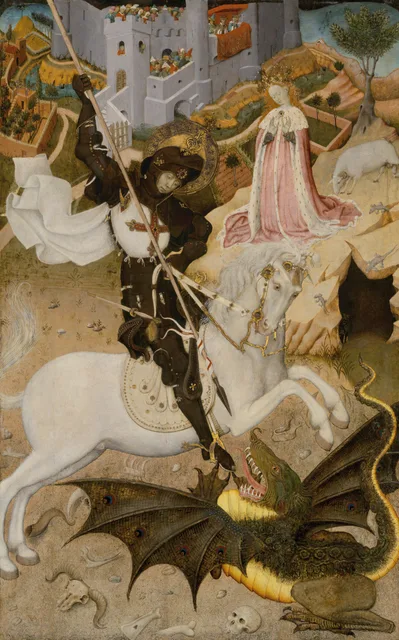 Saint George and the DragonBernat Martorell1434–35
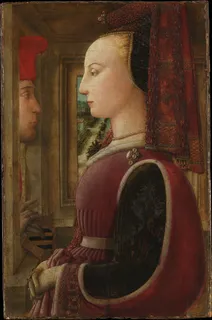 Portrait of a Woman with a Man at a CasementFra Filippo Lippica. 1440
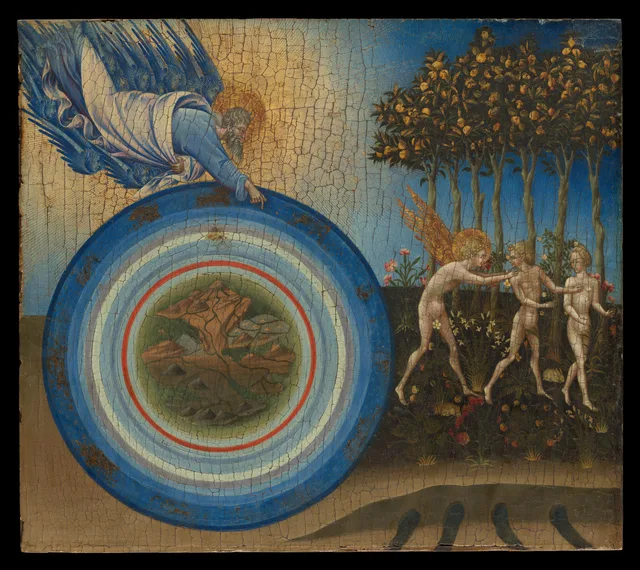 The Creation of the World and the Expulsion from ParadiseGiovanni di Paolo1445
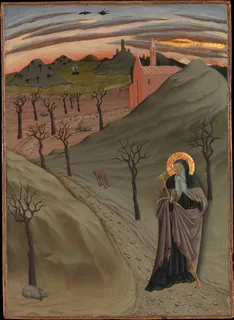 Saint Anthony the Abbot in the WildernessSano di Pietroca. 1440
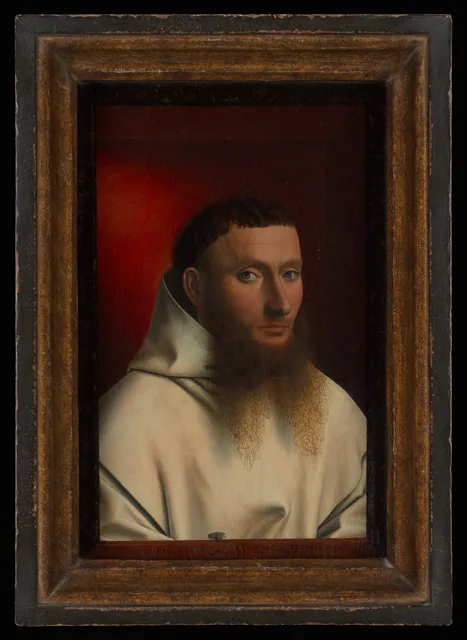 Portrait of a CarthusianPetrus Christus1446
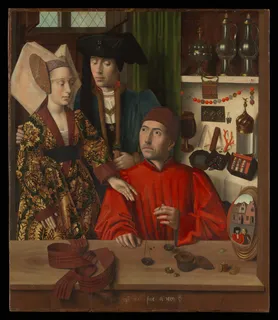 A Goldsmith in his ShopPetrus Christus1449
Too good to keep to yourself
This painting,
for someone who comes to mind
They open it at full size
and see every brushstroke.
About this work
- Artist
- Jan van Eyck · 1390–1441
- Date
- ca. 1436–38
- Medium
- Oil on canvas, transferred from wood
- Size
- 56.5 × 19.7 cm
- Collection
- The Metropolitan Museum of Art
- Image
- Original long edge 4000px · shown at 2560px
- Original
- View on the museum's website ↗