 Pyeongye
All tours · Flowers and Gardens · Room 1
Notes on this room's painting
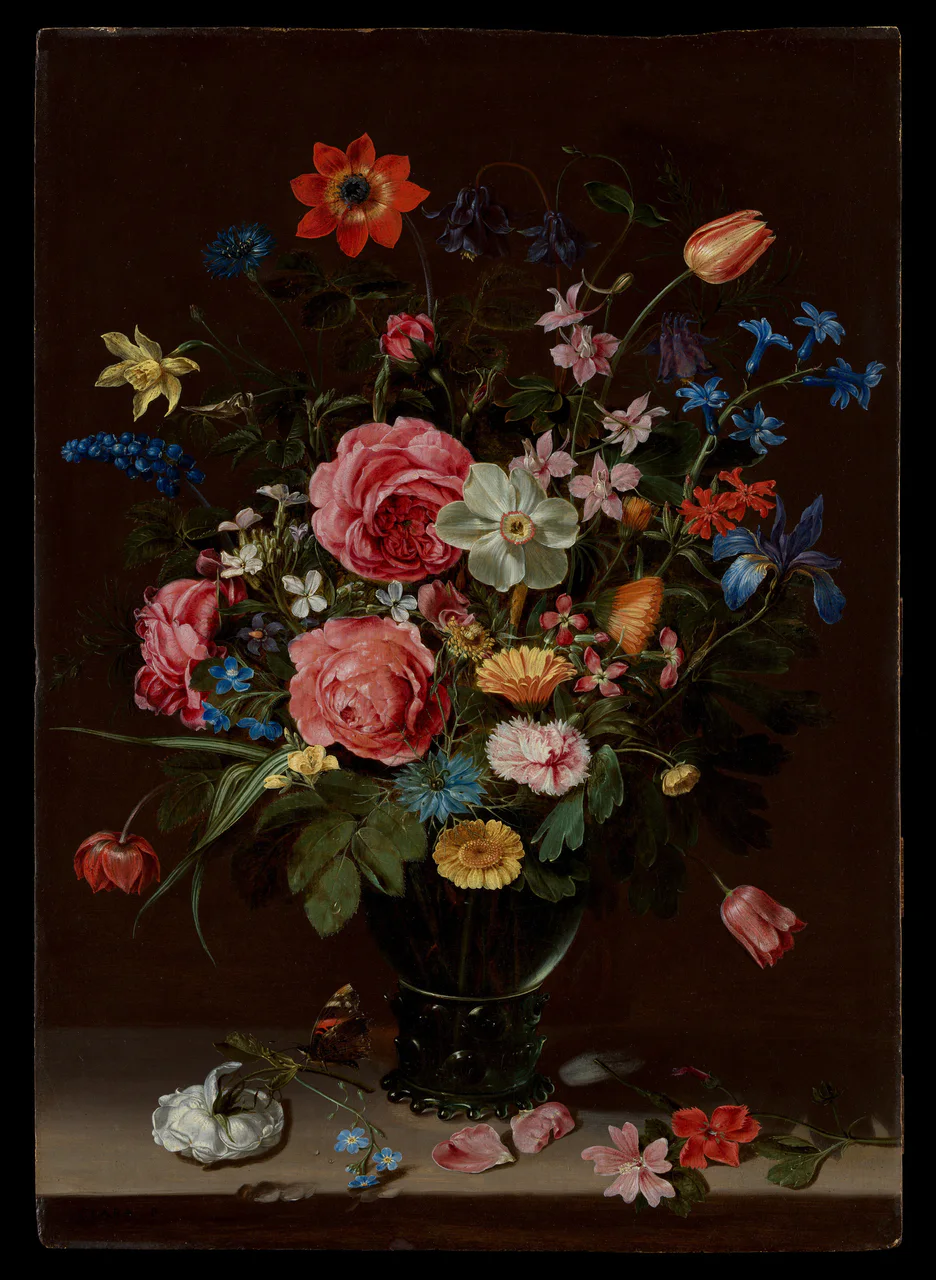
- Against a dark background, a green glass holds a crowded bouquet of roses, tulips, irises, and more, with fallen flowers, loose petals, and a butterfly on the table.
- Clara Peeters, a painter working in Antwerp, painted it around 1612 in oil on wood.
- The panel is only about eighteen inches tall, yet every stripe on a petal and every bead of glass is there, laid in with a fine brush.
Reading the picture
5 places to look closer
Tap a number on the painting to jump to its note, or a close-up to see that spot in the whole picture.
Zoom in on the tulip at upper right. Yellow stripes run through the red petals, each one drawn with the tip of the brush. The petals are just starting to open at the top. Striped tulips like this were costly flowers in Europe at the time.
Look at the blue spike sticking out to the left. Tiny bell-shaped flowers are packed together like a bunch of grapes. Peeters put one white dot on each bell so it seems to catch the light. This is grape hyacinth, a spring flower.
Zoom in on the base of the glass that holds the flowers. Round glass beads are stuck all around the dark green glass. Each bead has its own spot of white light. To paint clear glass, Peeters left only the places where light hits it bright.
Find the butterfly resting with closed wings to the left of the glass. The underside of its wings is brown, with a red band across the middle. You can see white spots near the tips and a ragged edge. It almost melts into the dark, so you have to look a while to notice it.
Look at the left end of the table. A white rose lies upside down, and a stem of blue forget-me-nots reaches all the way to the table's edge. The rose casts a shadow on the tabletop.
When it was painted
Picture Antwerp, the busy Flemish port, around 1612. A woman sits at a small wooden panel, laying stripes onto tulip petals one hair-thin line at a time. Her name is Clara Peeters, and almost everything else about her is a mystery. We are not even sure when she was born.
What we do have are her paintings. She often signed them and added the year, and the earliest dated one is from 1607. In a few still lifes she slipped in a tiny reflection of her own face on a shiny metal cup. It is a self-portrait hidden in plain sight.
Flowers were not her usual subject. Most of her surviving pictures show tables laid with food: fish, cheese, bread, sweets. Around the same time in Antwerp, painters such as Jan Brueghel the Elder were making their names with flower pictures too.
For centuries afterward, Peeters was largely forgotten. In 2016 the Prado in Madrid gave her an exhibition, the first it had ever devoted to a woman painter. In 2020 The Met bought this panel from a private collection in Britain. At the time, the museum owned only one other painting by an early modern Dutch or Flemish woman, and it was also a flower piece.
Now look again. The roses, tulips, narcissi, carnations, and irises are late spring and early summer flowers. The paper trail is thin, but every carefully brushed petal is a record of the hours she spent at this panel four hundred years ago.
Questions to think about
- Look for itCan you find the two flowers in the bouquet that hang their heads straight down?
- Why?Why do you think Peeters painted fallen petals and a small butterfly next to such a showy bouquet?
- What about you?Four hundred years ago, a single striped tulip could cost a lot of money. What do we pay a lot for today that might be ordinary a few decades from now?