 Pyeongye
All tours · Gold Altarpieces of Siena and Florence · Room 1
Room 1
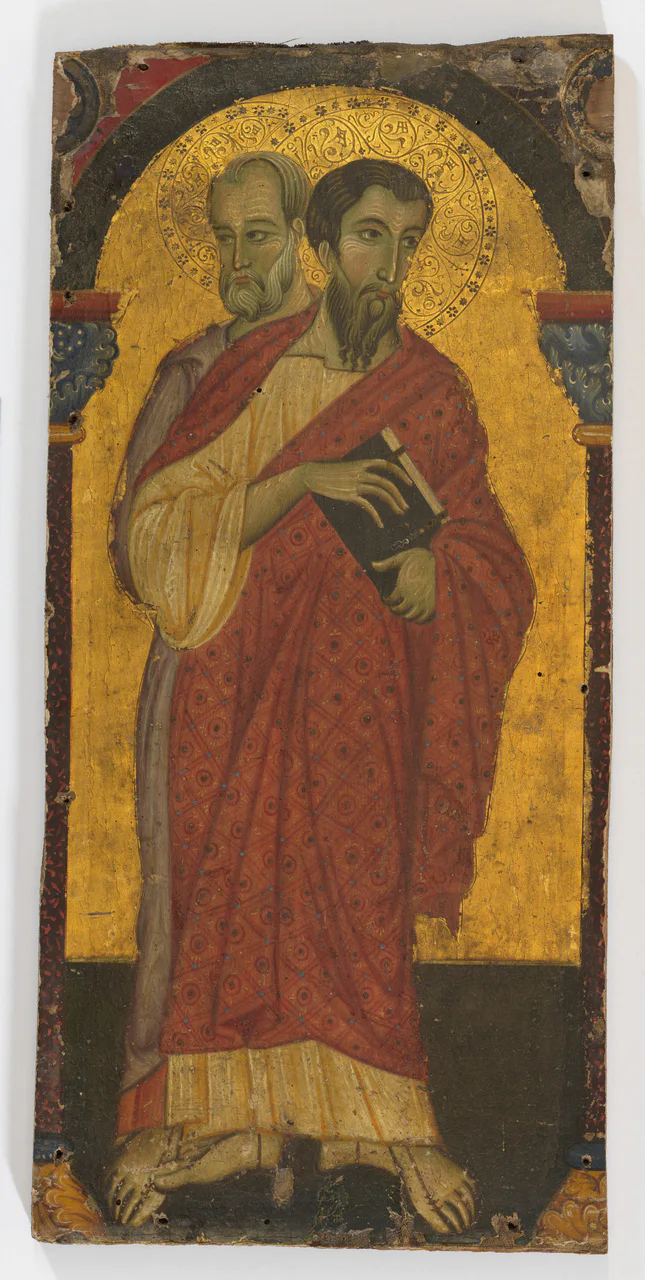
Saints Bartholomew and Simon
Master of Saint Francisca. 1272Tempera on wood, gold ground47.6 × 22.9 cm
Notes on this room's painting
- Two of Jesus's twelve apostles, Saint Bartholomew and Saint Simon, stand one behind the other under a golden arch.
- A painter whose real name is lost, known as the Master of Saint Francis, made it around 1272 in tempera and gold leaf on a wooden panel.
- The panel is only about 47 centimeters tall, yet after more than 750 years the patterns cut into its gold are still crisp.
Reading the picture
5 places to look closer
Tap a number on the painting to jump to its note, or a close-up to see that spot in the whole picture.
Begin with the golden disk behind the two heads, the halo. From a distance it looks like smooth metal. Up close, curling vines wind around it and tiny flower shapes are stamped in a row along the edge. The painter scratched and punched these into the gold leaf with pointed tools, so they would glitter when candlelight moved across them.
Now compare the two faces. The man behind is balding, with a grizzled gray beard. The man in front has thick dark hair and a long black beard. Both faces look slightly green. That is the green underlayer painted beneath the skin tones, showing through now that the pink paint on top has worn thin.
Zoom in on the front apostle's hands. He holds a heavy book with a dark cover and a pale edge, bracing it with both hands. His fingers are long and thin, almost like carved wood. Apostles are often shown holding books like this, a sign of the teaching they carried to the world.
His red cloak is covered with ring-shaped dots, scattered with blue specks and small yellow leaf marks. The pattern sits flat on the surface instead of bending into deep folds around the body.
Drop down to the feet. Both apostles wear simple sandals made of thin straps. Along the bottom edge, the paint has flaked off, and you can see the rough cloth and wood beneath. Those scars are part of the panel's long life.
When it was painted
Picture Perugia, a hill city in central Italy, around 1272. Saint Francis had died less than fifty years before. The friars who followed him needed a large painting for the altar of their church, San Francesco al Prato. The painter who took on the job left no name behind.
Scholars call him the Master of Saint Francis, after his painting of the saint in Assisi. Wall paintings in the Lower Church of the Basilica of San Francesco in Assisi are also credited to him. Only one of his works carries a date: a huge painted crucifix from the same church in Perugia, inscribed 1272.
This small panel was once part of a big altarpiece painted on both sides, front and back. The Metropolitan Museum places it on the left side of one face. The same church held an early Christian stone coffin containing the body of Blessed Giles, one of Francis's first companions. Some scholars think the altarpiece was made to go with that tomb, while others doubt it.
Later the altarpiece was taken apart and scattered. In 1921 a religious brotherhood in Rome sold four of its panels, this one included. The New York banker Philip Lehman bought it, and in 1975 it came to the Met with the collection of his son, Robert Lehman. Other pieces of the same altarpiece are now in Perugia, Assisi, and Washington.
Look again at the arch over the two apostles' heads. Today it hangs alone, but it was once one bay of a much larger picture, with other apostles standing beside these two.
Questions to think about
- Look for itHow many tiny stamped flowers can you count inside the halo?
- Why?Why do you think the painter overlapped the two men, so that one is half hidden, instead of standing them side by side?
- What about you?This artist's name was forgotten, but his work survived for centuries. Which of the things you make today do you think might outlast your name?