 Pyeongye
All tours · Paintings of India and the Himalayas · Room 1
Notes on this room's painting
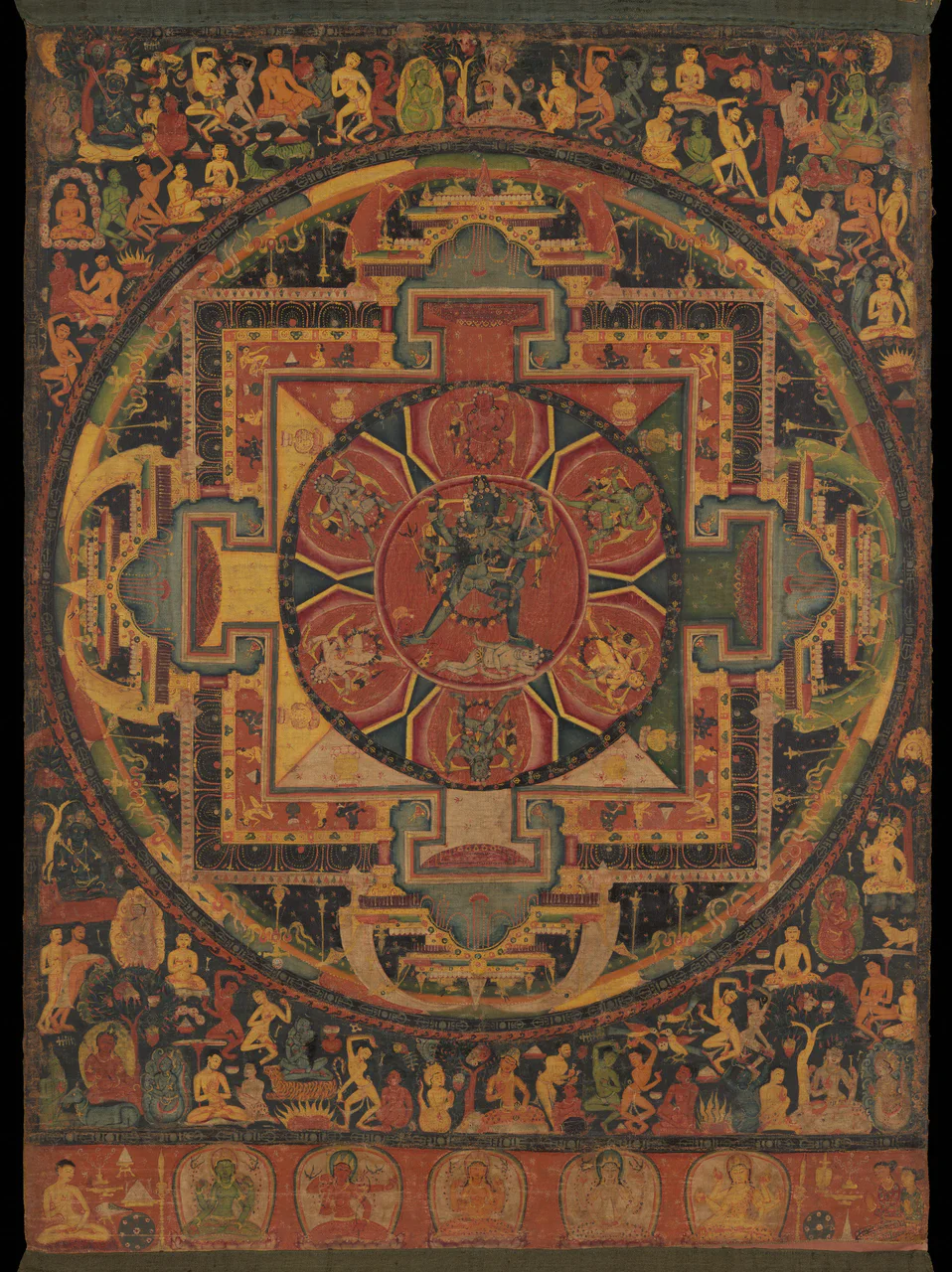
- Inside a great circle sits a square palace. At its heart, on a lotus, the many-armed blue god Chakrasamvara stands embracing his female partner.
- An unnamed painter made it in Nepal around 1100, using distemper on cloth.
- Roughly nine hundred years old, it packs a palace seen from above and the cremation grounds around it into one tightly filled cloth.
Reading the picture
5 places to look closer
Tap a number on the painting to jump to its note, or a close-up to see that spot in the whole picture.
Zoom into the red circle at the very center. A blue god stands with his legs spread wide and his arms flung out in every direction. He wears a crown of white skulls, and one hand holds a staff that splits into three prongs at the top. Under his feet, a pale body lies flat on its back.
Look at the lotus petals around the center. In the right-hand petal, a green goddess dances with one leg lifted. The other petals hold small figures too, each in a different color.
Now travel up to the top gate. Strings of beads hang in loops under the arch. On the roof, two deer sit facing a wheel between them. The sign recalls the story of the Buddha first teaching in a deer park.
Step outside the circle to the lower left. A tiger skin is spread over leaping flames, and a blue couple sits on top of it. Around them, nearly naked figures dance with their arms raised, and white bones lie scattered. This is a cremation ground, spread out beyond the walls of the mandala.
Go to the far bottom left corner. A man with close-cropped hair sits there, and smoke curls up from an incense burner beside him. Next to it are what looks like a conch shell and a small stupa on a stand. He appears to be performing a ritual.
When it was painted
Around 1100, in the Kathmandu Valley of Nepal, someone paid for a large cloth showing the palace of Chakrasamvara. So where are those people now? Look at the far right end of the bottom band.
Two figures with their hair tied up sit there in finely patterned clothes, palms pressed together. The museum identifies them as donors, the people who gave the painting. Sadly, no inscription naming them survives.
The museum counts this as one of the earliest large paintings to survive from Nepal. Most Nepalese painting that survives from this time is small: pictures inside palm-leaf manuscripts, or on the wooden covers that protected them. The museum links this mandala's style to those covers and to twelfth-century palm-leaf painting from eastern India.
About a century later, the great Buddhist monasteries of northeastern India were destroyed. In the Kathmandu Valley, though, the Newar community kept tantric Buddhist ritual alive, including the worship of Chakrasamvara. That tradition continues today.
The cloth lasted nearly nine hundred years before entering The Metropolitan Museum of Art in 1995. In 2024 it hung in the museum's exhibition of mandalas.
Now go back to the two figures at the lower right. Past the god's palace at the center and the cremation grounds around it, these two quiet faces are waiting at the very end.
Questions to think about
- Look for itHow many gates does the square palace have, and what decorates each one?
- Why?Why would someone paint cremation grounds and bones right outside a god's palace?
- What about you?If you had a quiet palace of your own to sit in when your mind is noisy, what would you leave at the gate before going in?