 Pyeongye
All tours · Lines: Drawings and Prints · Room 1
Room 1
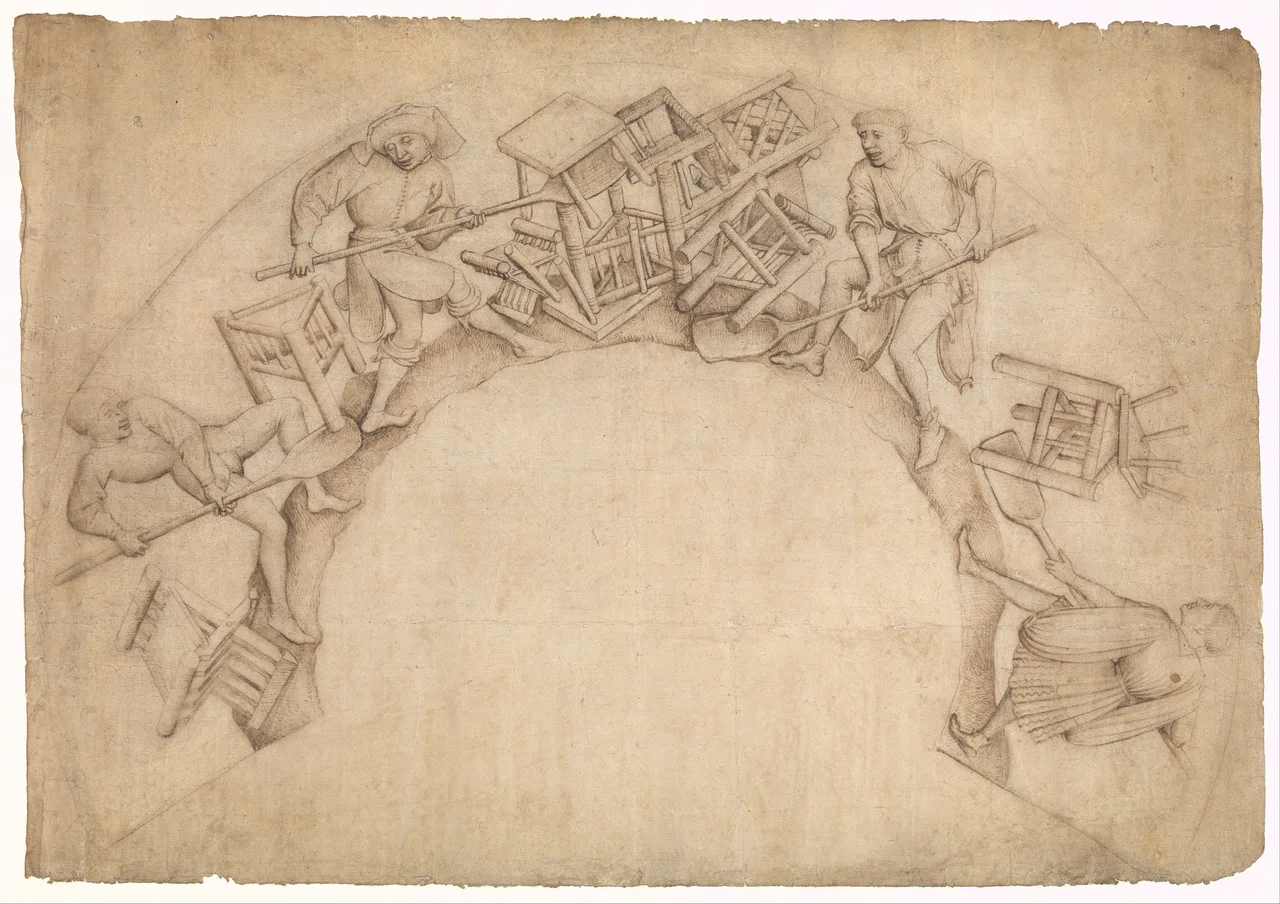
Men Shoveling Chairs (Scupstoel)
Vranke van der Stockt1444–50Pen and brown ink over traces of black chalk.30.0 × 42.6 cm
Notes on this room's painting
- Men standing along an arch-shaped band scoop up chairs with long shovels and heap them in a wild pile at the top.
- Vranke van der Stockt, a painter working in Brussels, drew it around 1444–50 in pen and brown ink.
- The drawing is so careful that you can count the legs and rungs of every upside-down chair.
Reading the picture
5 places to look closer
Tap a number on the painting to jump to its note, or a close-up to see that spot in the whole picture.
Zoom in on the pile of chairs at the top. Square stools, chairs with close-set slats, and chairs with round turned legs are jumbled upside down and sideways. Each leg gets a little curved shading in fine pen lines, so the wooden rods look truly round. The drawing never tells us why so many chairs ended up here.
Look at the man at the upper left. He wears a broad-brimmed hat, bows his head, and grips a long shovel handle with both hands. A row of buttons runs down the front of his jacket. His mouth hangs a little open, as if he is out of breath from the effort.
Zoom in on the face of the man at the upper right. He has a bowl haircut with straight bangs, wide eyes, and bared teeth. He looks tense and strained. Even his ear and upper teeth are drawn one by one, so he seems sketched from a real worker.
Go down to the lower left. This man is turned almost on his side, still clinging to his shovel. That is because the figures tilt to follow the arch. Near the top they stand upright, and the lower they go, the more they lie down.
Now look at the man at the lower right. He wears a tunic gathered into many pleats, with puffed sleeves and a hem finished in a wavy edge. He is dressed more finely than the workers. He leans far back with his face turned upward.
When it was painted
Picture Brussels in the 1440s. On the great square at the heart of the city, a new town hall was going up. Work had begun in 1401, and in 1449 the tall tower was started. This sheet was drawn for the stone decoration of that building.
The Met identifies it as a study for one of three narrative capitals, the carved tops of columns, made for the town hall between 1444 and 1450. The whole scene is fitted inside an arched border that looks as if it were drawn with a compass.
The puzzle is in the title. Scupstoel means "shovel chair." Why anyone wanted such a scene on the town hall columns is still not clear.
Who drew it has been a question, too. For a long time the sheet was linked to the circle of Rogier van der Weyden, then the official painter of the city of Brussels. More recently it has been given to Vranke van der Stockt, who took over that post after Van der Weyden died in 1464.
Hard times came for the building later. In 1695 French guns bombarded the city, fire swept the square, and the justice paintings Van der Weyden had made for the town hall were lost. Today the arcade holds a nineteenth-century reconstruction of the capital, and this drawing came to The Met in 1975 with the Robert Lehman Collection.
Look again at the heap of chairs at the top. Every leg was counted out in ink, ready to be cut in stone and to look down on the square from a column.
Questions to think about
- Look for itIn the pile at the top, how many chairs can you find with close-set slats in their backs?
- Why?Why do you think the artist tilted the figures to follow the curve of the arch?
- What about you?The chairs look almost like junk being shoveled into a heap. When we buy things easily and throw them away just as easily, where do they end up?