 Pyeongye
All tours · The Northern Renaissance · Room 1
Notes on this room's painting
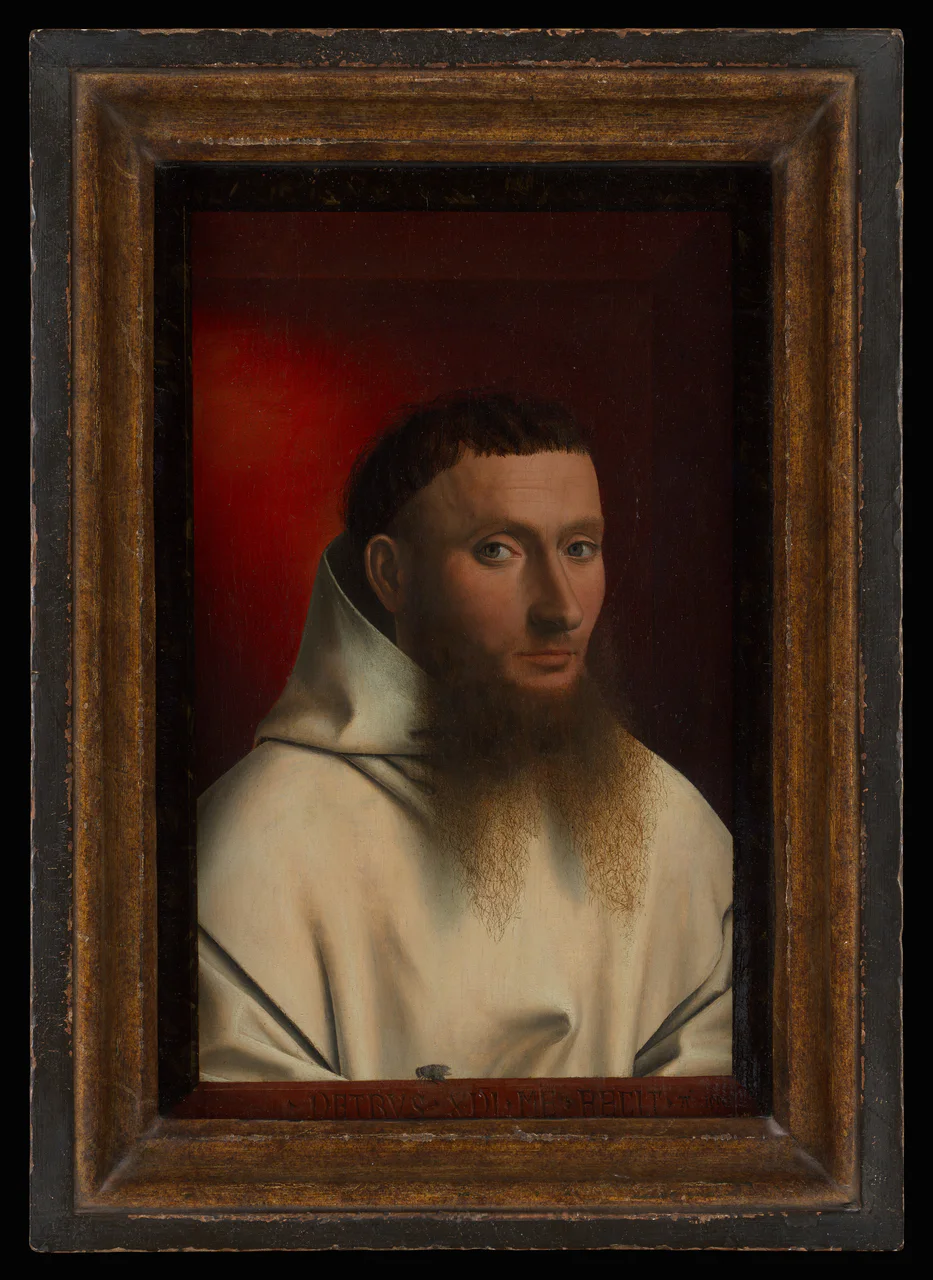
- A bearded lay brother of the Carthusian order, dressed in a white habit, seen from the chest up against a red wall.
- Petrus Christus, a painter working in Bruges, painted it in oil on oak in 1446.
- The panel is less than a foot tall, and a tiny fly has landed on the red ledge at the bottom.
Reading the picture
4 places to look closer
Tap a number on the painting to jump to its note, or a close-up to see that spot in the whole picture.
Meet his eyes first. His face turns slightly to the right, but his gray eyes slide back toward us. The reddish rims of the lids, the light along the nose, the shadow between the lips are all built up with very fine brushwork. His expression is calm, yet his gaze holds you.
Zoom in on the beard. Each hair is painted on its own, spilling down over the white cloth. The strands thin out toward the ends, and a few curl and tangle. This is the patient, layered oil technique that Netherlandish painters of the time were known for.
Now look at the red ledge painted along the bottom, like part of a frame. Just in front of his robe sits a fly. You can make out its legs and its see-through wings. It is a trick of the eye, meant to look as if a real fly had landed on the painting.
Beside the fly, letters seem to be carved into the ledge. In Latin they say that Petrus Christus made me, and the date 1446 follows at the far right. The XPI in the middle is an old abbreviation for Christ, used here to spell the painter's name. It is a signature in which the painting itself does the talking.
When it was painted
In 1444 Petrus Christus bought citizenship in Bruges, the busy trading city of Flanders. He had been born outside the city, and he needed that status to work there as a painter. Jan van Eyck had died in Bruges three years before. Christus is known as the painter who carried on van Eyck's careful way of working in oil.
This portrait came two years later. A painter newly settled in town lettered his name and the year boldly on the red ledge. He did it again in 1449 on A Goldsmith in His Shop, and that picture now belongs to the same museum, the Metropolitan Museum of Art.
For a long time, this panel had an uninvited guest. Long after Christus finished it, someone painted a saint's halo around the man's head. Before the museum's 1994 Christus exhibition, specialists in early Netherlandish painting examined it and judged the halo to be a later addition. Since the artist had not painted it, the museum's conservators removed it.
The sitter's name has never come down to us. The panel entered the collection of the American banker Jules Bache, and it came to the Met with his collection in 1949.
So the head you see now is once again as Christus painted it. Look at the man against the red wall, with no halo. He is not a saint, just a man living in 1446, glancing at us sideways.
Questions to think about
- Look for itLook at the red wall behind him. Where is it brightest, and where does it sink into shadow?
- Why?Why would Christus put a fly into the portrait of a quiet, praying Carthusian?
- What about you?The Carthusians chose silence and solitude. With phones buzzing all day, how much quiet time do we actually protect for ourselves?