 Pyeongye
Artwork · 12th century · Emperor Huizong
LeoTurn on Magnifier at the lower right and move slowly across the painting.
Full screen opens it edge to edge.Tap the painting to fill the screen.
Spread two fingers to look closer.
At a glance
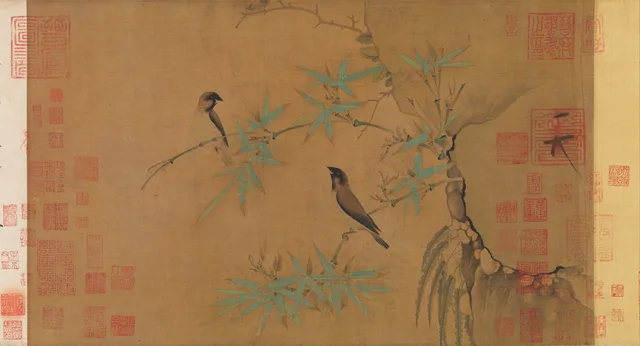
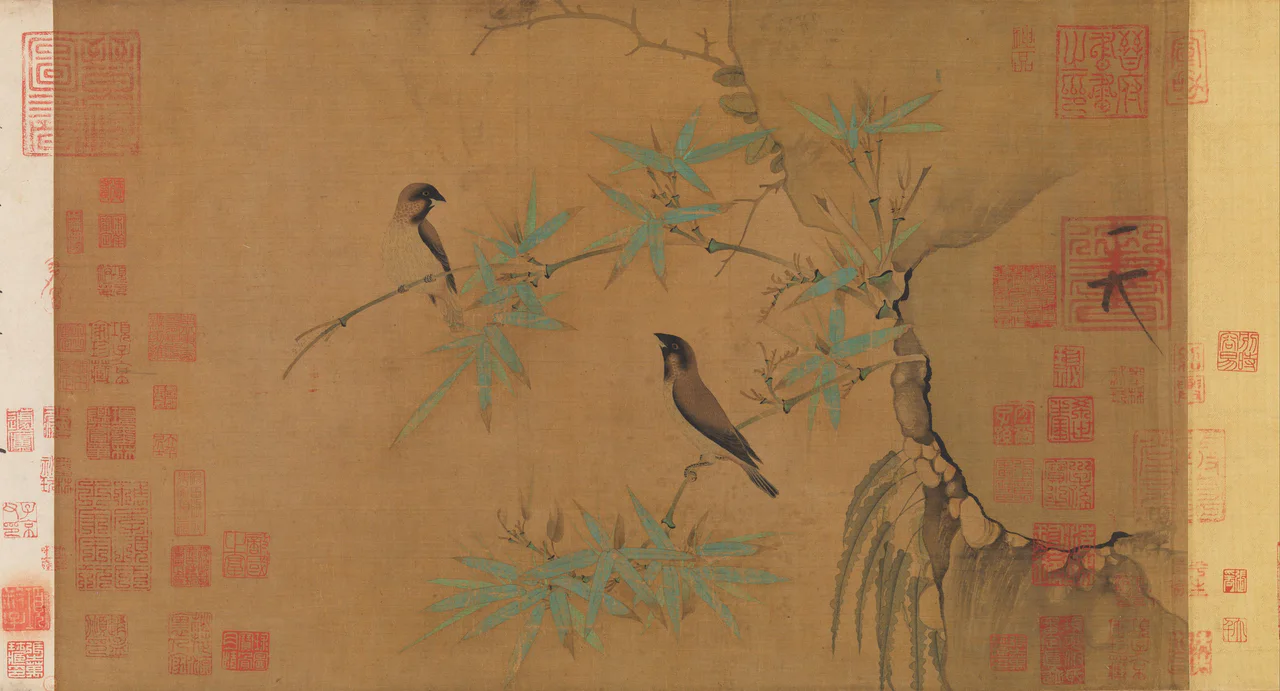
- Two small finches perch on bamboo beside a rock, each looking a different way.
- Emperor Huizong of the Northern Song dynasty in China painted it in ink and color on silk in the early 12th century.
- The emperor's own signature sits on the right, surrounded by dozens of red seals left by later owners.
Reading the picture
5 places to look closer
Tap a number on the painting to jump to its note, or a close-up to see that spot in the whole picture.
Start with the upper bird. Its toes clamp a thin bamboo stem, and its head turns to the right. Look at the throat: tiny brown speckles, set close together. The pale chest is built from countless fine strokes, layered like real down.
Now drop to the second bird. It does the opposite. It lifts its head and looks up and away. The back and wing are washed in a soft, deep brown, and the tail feathers are split apart one by one at the tips. Its toes curl tightly around a bamboo stalk.
Zoom into the bamboo leaves at the bottom. Each leaf is filled with a blue-green color that follows its exact shape. Over nine centuries, some of that paint has flaked away, and the silk shows through. Between the leaves, a few new shoots still poke up, tightly rolled.
Look at the rock on the right. It is made of rounded lumps stacked one on another, with a heavy ink line running down its edge. In front of it hang long leaves with wavy, rippling edges. Against the light birds and bamboo, the rock feels solid and heavy.
To the right of the rock, a bold ink mark sits over a large red seal. This is Huizong's cipher, the stylized signature he used. It is known to be built from four characters meaning "the one man under heaven." The smaller seals around it were stamped, one by one, by people who owned the scroll after him.
When it was painted
In 1100 a seventeen-year-old prince became emperor of the Northern Song. His elder brother had died without a son, so the throne came to him almost by accident. What Huizong loved most was not government but calligraphy, painting, gardens and antiques.
He built up the court painting academy and watched over its artists like a teacher. A Song writer, Deng Chun, recorded a famous story in his book Huaji. When the academy painters presented pictures of a peacock, Huizong told them they had all got it wrong: a peacock climbing to a high perch always lifts its left foot first. His demand was simple. Paint what you actually see.
His empire, though, was losing ground to the Jin in the north. As Jin armies advanced, Huizong handed the throne to his son. In 1127 the capital, Kaifeng, fell. Father and son were carried off as prisoners, and Huizong died in the north in 1135.
The painting survived and passed from hand to hand. Under the Yuan dynasty, Zhao Mengfu, a painter and calligrapher descended from the Song imperial family, added a colophon praising Huizong's skill. Later owners added their own marks, among them the famous Ming collector Xiang Yuanbian and, in 1954, the painter Zhang Daqian. In 1981 the scroll came to the Metropolitan Museum from the collection of John M. Crawford Jr.
The picture itself is only about 55 centimeters wide, but with everything mounted after it, the handscroll stretches past eight meters. Look again at the upper bird's toes gripping that thin stem. They come from the same sharp eye that checked which foot a peacock lifts first.
Questions to think about
- Look for itCompare the feet of the two birds. What is each one holding, and how?
- Why?Why might Huizong have turned the two birds to face opposite ways?
- What about you?Owners stamped their seals right onto this painting. Today, when we love an artwork or a place, how far is it fair to leave our own mark on it?
Same period
Painted around the same time,
somewhere else
Too good to keep to yourself
This painting,
for someone who comes to mind
They open it at full size
and see every brushstroke.
About this work
- Artist
- Emperor Huizong · 1082–1135
- Date
- early 12th century
- Medium
- Handscroll; ink and color on silk
- Size
- 33.7 × 55.4 cm
- Culture
- China
- Collection
- The Metropolitan Museum of Art
- Image
- Original long edge 3824px · shown at 2560px
- Original
- View on the museum's website ↗