Pyeongye
Painters · 12th century
Emperor Huizong
1082–1135
A Song dynasty emperor who cherished painting, calligraphy, gardens and old things, and who died a prisoner in the far north after his empire fell.
Scenes from a life
The life of Emperor Huizong,
scene by scene
- 1100Kaifeng
Early in 1100, Emperor Zhezong of Song dies without a son. The court has to choose who comes next. The Empress Dowager Xiang backed his younger brother Zhao Ji, the Prince of Duan. The chief minister Zhang Dun objected that the prince was frivolous and not fit to rule the realm.
The empress dowager and the councilors had their way. Zhao Ji, only seventeen, took the throne. History knows him as Huizong, and he would rule for almost twenty-six years.
- 1104Kaifeng
Huizong adds a school of painting to the state school system. Painters were admitted by examination and ranked much like officials. The test was often a single line of poetry, and candidates had to turn its meaning into a picture.
The emperor looked closely at the results. The twelfth-century writer Deng Chun tells a story about the newly built Longde Palace. Huizong walked past its painted walls without a word until he saw a spray of monthly roses between two pillars. He asked who had painted it. It was a young newcomer, and the emperor gave him a red robe of honor. Monthly roses, he explained, change their flowers and leaves with every season and every hour, and this one was spring at midday, without the slightest error.
- 1112Kaifeng
On the evening after the Lantern Festival in 1112, clouds sink low over the main gate of the palace. Then a flock of cranes arrives, circling above the gate, and two of them settle facing each other on the ornaments at the ends of the roof. Huizong wrote that people passing by bowed and gazed up for a long time.
He took it as a good omen. He painted the scene and added his own account of the day and a poem. The scroll, Auspicious Cranes, is now in the Liaoning Provincial Museum in China. Under a blue sky, twenty white cranes circle the roof or perch on its ends.
- 1120Kaifeng
In 1120 a catalogue of the paintings in the palace collection is completed. It later became known as the Xuanhe Catalogue of Paintings, after Huizong's reign name. It lists 6,396 works by 231 painters, arranged by subject.
Scholars still argue about how much of it was the emperor's own work. A recent English translator argues that a powerful palace eunuch, Liang Shicheng, was in charge of it. Either way, it tells us what filled the walls and storerooms of the Song palace.
- 1123Kaifeng
In early 1123, Huizong's great garden, the Genyue, is finished at the northeast corner of the capital. Workers had heaped up an artificial mountain and filled it with strange rocks and rare trees brought from the south. Gathering and hauling those stones weighed heavily on the people made to do it.
The garden did not last long. In the winter of 1126 to 1127, with Jin armies around the city, the people of Kaifeng tore it apart.
- 1126Kaifeng
Jin armies from the north push south toward the capital. In January 1126, Huizong hurriedly hands the throne to his eldest son, who becomes Emperor Qinzong. It does not save the city.
Kaifeng fell early the next year. The Jin carried both emperors north, along with the imperial family, much of the court and the treasures of the palace. In 1128 the Jin emperor gave Huizong a mocking title, Duke of Muddled Virtue.
- 1135Wuguocheng
In 1135 Huizong dies at Wuguocheng, at the northern edge of the Jin lands, in what is now Heilongjiang province. He had been a prisoner for about eight years and was fifty-two. His remains came back south only in 1142, after Song and Jin made peace, and were buried near present-day Shaoxing.
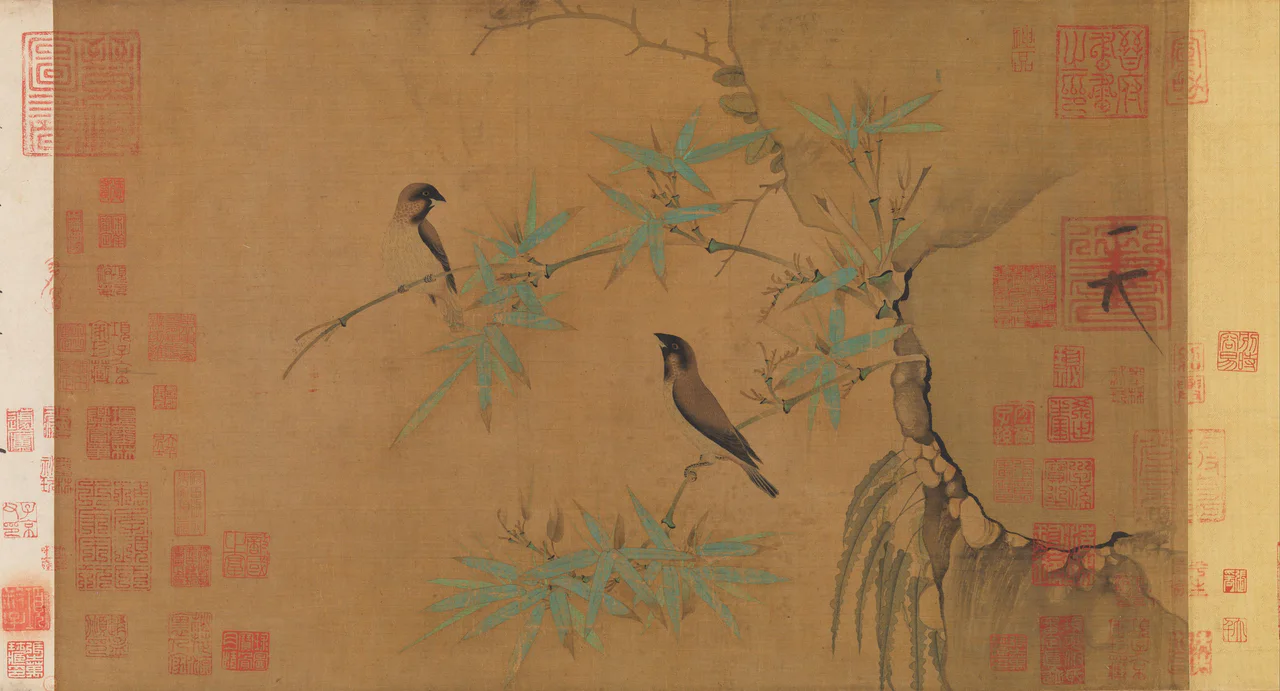
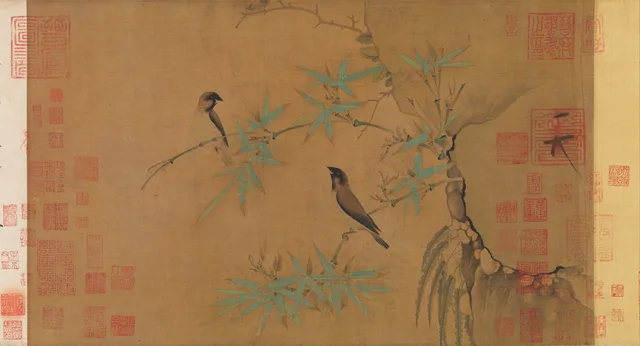
A few of his paintings survived the wars. In Finches and Bamboo, two small birds still grip thin bamboo stems with their toes. One turns its head to the side; the other looks up. The scroll passed through many collectors before it reached the Metropolitan Museum in New York in 1981.
 Painted around this timeFinches and bamboo
People around them
- Zhezonghis older brother, whose death without a son opened the way to the throne.
- Empress Dowager Xiangthe widow of his father Shenzong, who chose him as emperor in 1100.
- Zhang Dunthe chief minister who argued against making him emperor.
- Cai Jingthe minister Huizong relied on for much of his reign.
- Qinzonghis eldest son, who took the throne in 1126 and was carried north with him.
Works
Paintings by
Emperor Huizong on Pyeongye
More paintings by this artist will be added.