 Pyeongye
Artwork · 17th century · Studio of Kano Takanobu
LeoTurn on Magnifier at the lower right and move slowly across the painting.
Full screen opens it edge to edge.Tap the painting to fill the screen.
Spread two fingers to look closer.
The Thirty-Six Poetic Immortals
Studio of Kano Takanobuearly 17th centuryPair of six-panel folding screens; ink, color, gold, and silver on paper165.4 × 360.7 cm
At a glance
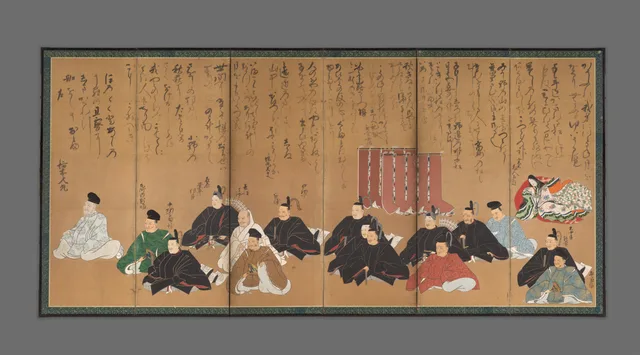
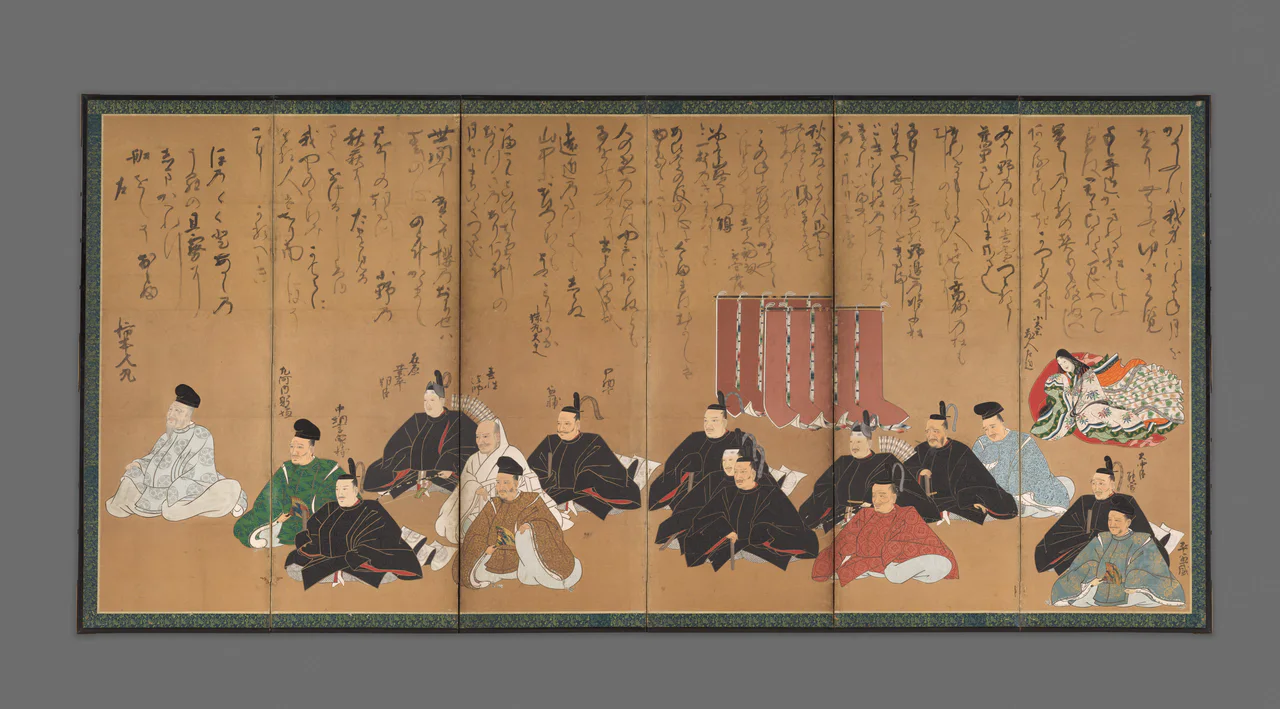
- Thirty-six celebrated poets of old Japan's imperial court, seated across a pair of six-panel folding screens, each with one of their poems written above them. You are looking at one screen of the pair.
- In the early seventeenth century the studio of Kano Takanobu painted the figures, and the court noble Konoe Nobutada wrote the poems.
- Every poet has a different robe, face, and pose, so it feels like dropping in on a gathering of poets from a thousand years ago.
Reading the picture
5 places to look closer
Tap a number on the painting to jump to its note, or a close-up to see that spot in the whole picture.
Zoom into the old man in white at the far left. He wears a black cap and a long white beard. One hand rests on his knee as he lifts his face toward something far away. The name beside him is Kakinomoto no Hitomaro, honored for centuries as a founding master of Japanese poetry.
Look at the writing above him. Brush-written kana flow from top to bottom and from right to left. Thick and thin strokes run together as if dancing. Above each poet, one of their poems is written out in the same way.
Find the woman at the upper right. She sits on a red mat with layer upon layer of robes fanned out around her. Her outer robe is scattered with blue, green, and red leaves, and bands of color stack up at each sleeve. Of the thirty-six poets, five are women.
Zoom into the red hanging at the top center. Several long panels of cloth hang side by side, with colorful cords dangling between them. This kind of standing curtain was used at court to divide a room or screen a person from view. Among all the dark robes, this red cloth brightens the scene.
Look at the man in red at the lower right. His robe is packed with round flower patterns, and his eyes crinkle in a smile. He stands out from the crowd of men in black. That grin among so many serious faces makes the gathering feel friendlier.
When it was painted
The idea of the Thirty-Six Poetic Immortals goes back to the early eleventh century, when the court noble Fujiwara no Kintō chose thirty-six earlier poets and gathered their poems. For centuries afterward, Japanese artists imagined these poets' faces and painted them alongside their verses.
Kano Takanobu, whose studio painted this screen, was born in 1571. His father was Kano Eitoku, the painter who had decorated castles for the warlords Oda Nobunaga and Toyotomi Hideyoshi. After Eitoku died in 1590, Takanobu worked in Kyoto as a painter of the Kano family.
The calligrapher, Konoe Nobutada, came from the Konoe family, one of the five noble houses that supplied the emperor's regents. As a young man he angered Hideyoshi and was sent away to Satsuma in the far south. He later returned to Kyoto and in 1605 became kampaku, the emperor's chief adviser. His bold, sweeping brushwork made him famous, and he came to be counted among the Three Brushes of the Kan'ei era. He died in 1614.
Takanobu died in 1618. A year earlier, in 1617, his eldest son, Kano Tan'yū, had become a painter to the Tokugawa shogunate while still a teenager. Tan'yū went on to lead the Kano family in the new Edo period.
These screens entered The Metropolitan Museum of Art in 2024. Look once more at the writing above Hitomaro. The brush of a court noble and the brush of a painting family meet on one surface to call up poets who lived a thousand years ago.
Questions to think about
- Look for itCan you find anyone on this screen holding a fan or a flat ceremonial baton?
- Why?Why do you think the painter scattered the poets in different poses instead of lining them up in rows?
- What about you?A thousand years ago, people collected their favorite poets in pictures like this. How is that like the way we collect our favorite writers or singers today?
Same period
Painted around the same time,
somewhere else
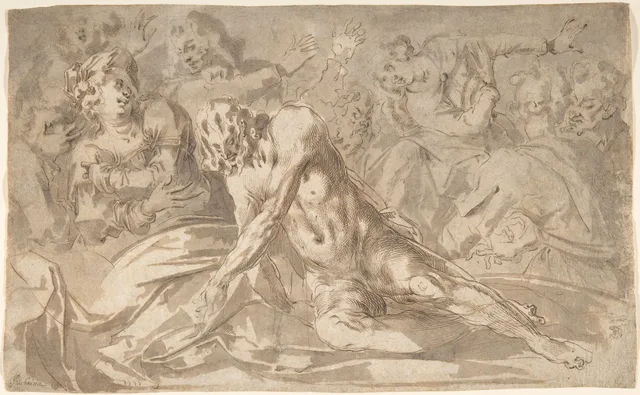 The Raising of LazarusJacques Bellangeca. 1606–8
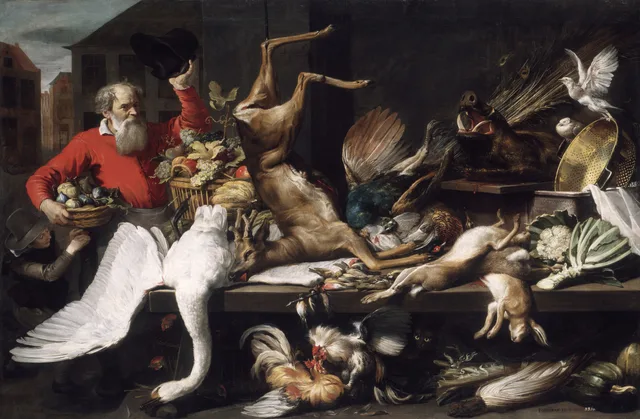 Still Life with Dead Game, Fruits, and Vegetables in a MarketFrans Snyders1614
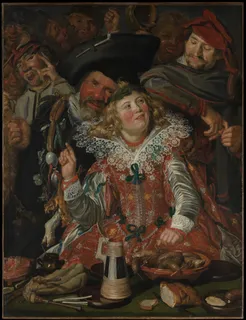 Merrymakers at ShrovetideFrans Halsca. 1616–17
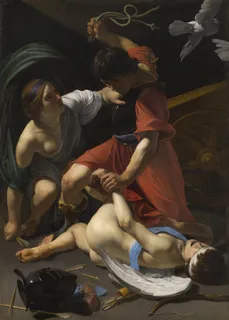 Cupid ChastisedBartolomeo Manfredi1613
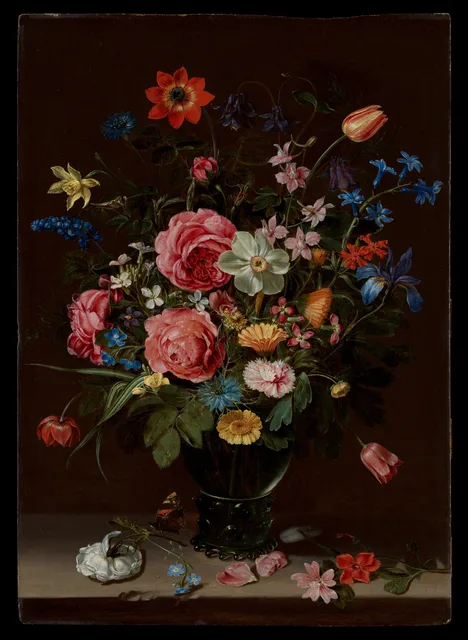 A Bouquet of FlowersClara Peetersca. 1612
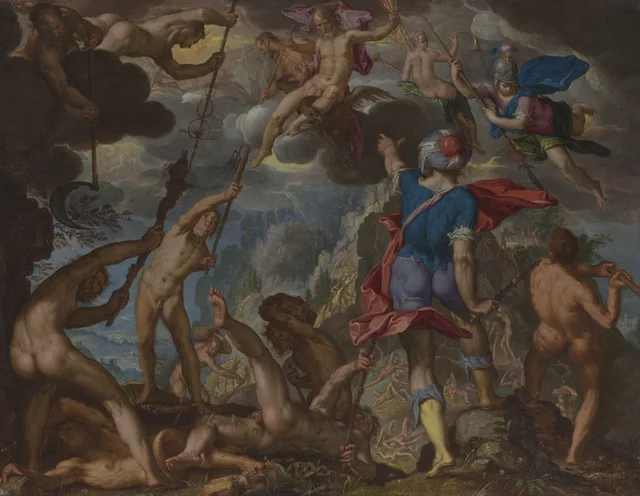 The Battle between the Gods and the GiantsJoachim Antonisz. Wtewaelc. 1608
Too good to keep to yourself
This painting,
for someone who comes to mind
They open it at full size
and see every brushstroke.
About this work
- Artist
- Studio of Kano Takanobu · 1571–1618
- Date
- early 17th century
- Medium
- Pair of six-panel folding screens; ink, color, gold, and silver on paper
- Size
- 165.4 × 360.7 cm
- Culture
- Japan
- Collection
- The Metropolitan Museum of Art
- Image
- Original long edge 4000px · shown at 2560px
- Original
- View on the museum's website ↗