Pyeongye
Painters · 17th century
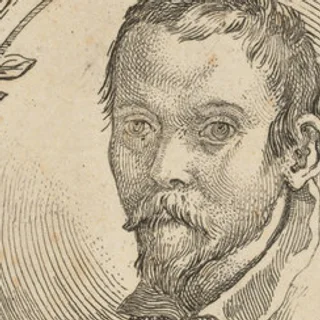
Annibale Carracci
1560–1609
A Bologna tailor's son who opened a drawing-from-life studio with his brother and cousin, then filled a long ceiling in Rome's Palazzo Farnese with the loves of the gods.
Scenes from a life
The life of Annibale Carracci,
scene by scene
- 1582–85Bologna
Three young men open a studio together in Bologna: the cousin Ludovico, the older brother Agostino, and the youngest, Annibale. They first called it the Accademia dei Desiderosi, the academy of those eager to learn. Later it became the Accademia degli Incamminati, the academy of those on their way. Students there did not just copy old pictures. They drew from living people.
The Carracci came from shopkeeping families. Annibale and Agostino's father, Antonio, was a tailor, and Ludovico's father was a butcher. Around this time Annibale painted a big canvas of butchers at work, weighing and cutting meat. That picture, The Butcher's Shop, now hangs at Christ Church in Oxford.
- 1590–92Bologna
Ladders go up in the great hall of Lorenzo Magnani, a senator of Bologna. Around the top of the walls the three Carracci paint the story of Romulus and Remus and the founding of Rome. A few years earlier, in 1584, they had painted the story of Jason and Medea together in a room of the Palazzo Fava.
The Magnani frieze became famous. According to the Bolognese biographer Carlo Cesare Malvasia, when people asked which of the three had painted which scene, the Carracci answered that it was by the Carracci, and that they had all made it together. Scholars today still disagree about who painted what.
- 1595Rome
Annibale moves into the Palazzo Farnese in Rome. Cardinal Odoardo Farnese had called him down from Bologna, where he had made his name. His first job was the ceiling of the cardinal's small study, which he filled with stories of Hercules and Ulysses.
The pay was not generous. According to the Roman painter and biographer Giovanni Baglione, Annibale received ten scudi a month, plus bread and wine from the palace.
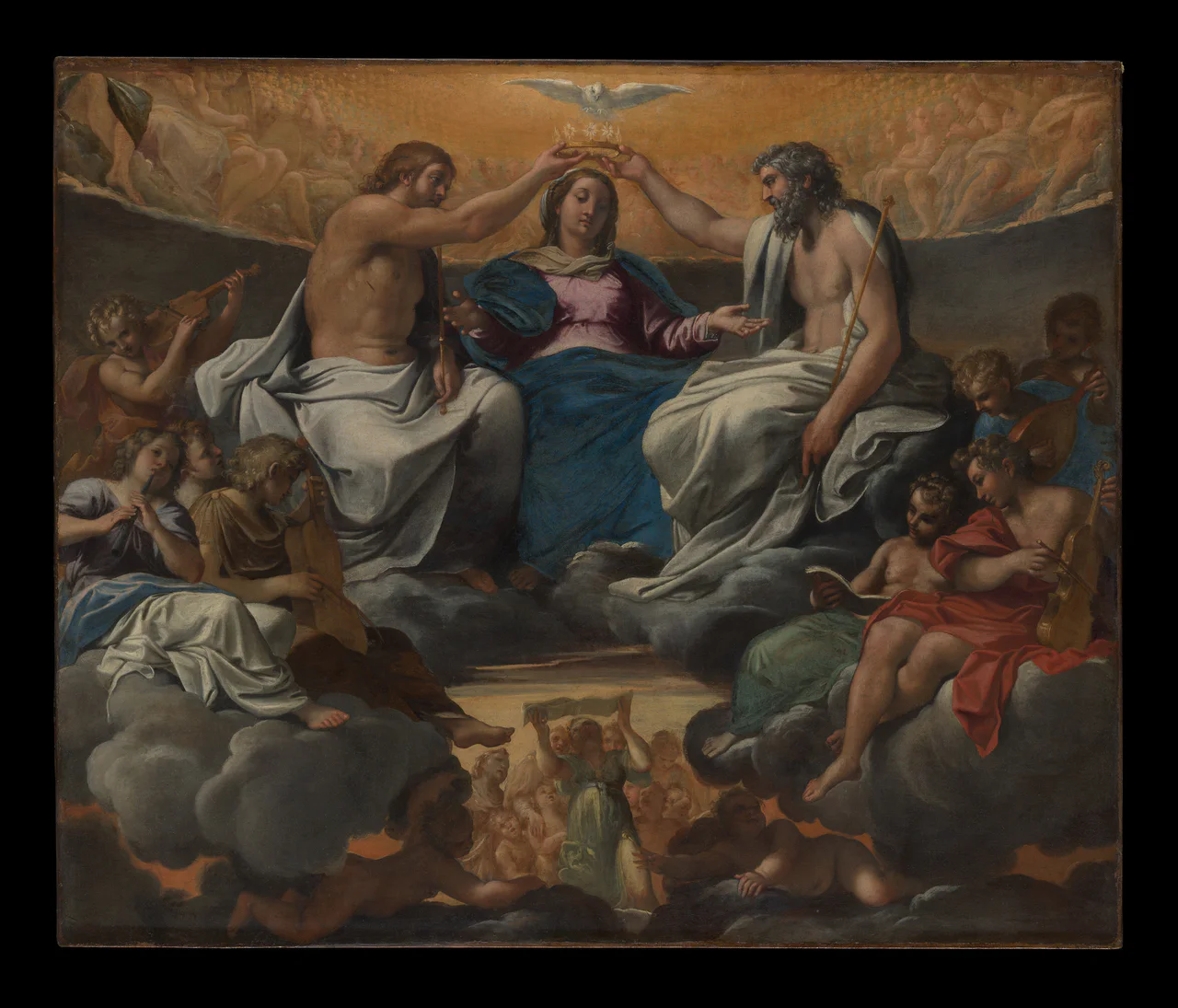
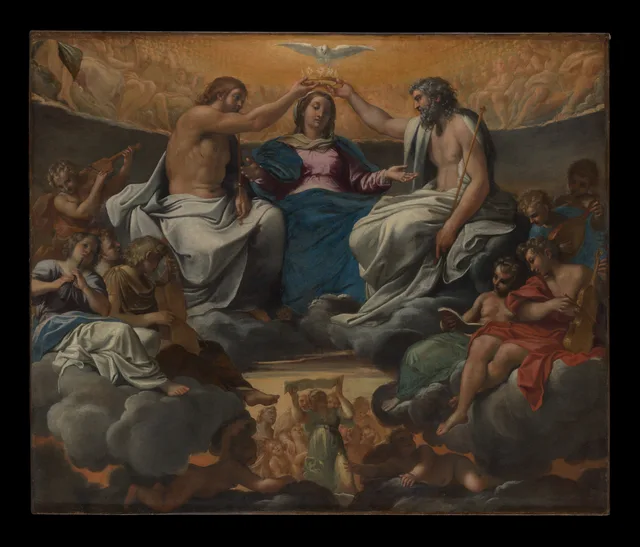
The Coronation of the Virgin comes from these Roman years. On the clouds, the young Christ and a white-bearded God the Father lift a golden crown together. Between them Mary sits in a pink dress and a blue mantle, her hands gently open. Angels with a violin and a pipe sit on the clouds at either side.
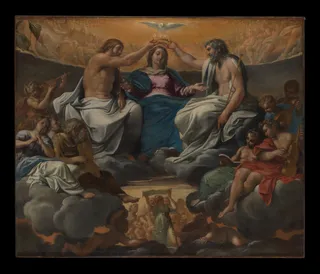 Painted around this timeThe Coronation of the Virgin
- 1597–1600Rome
Scaffolding fills the long gallery of the Palazzo Farnese. Across the whole curved ceiling Annibale paints the loves of the gods, framed by painted statues and painted frames that look like real architecture. His brother Agostino came to Rome to help with the ceiling.
Then the brothers fell out. Around 1600 Agostino left Rome for Parma. There he worked on rooms for Duke Ranuccio I Farnese, and he died in 1602 before the job was done. The two brothers never worked under the same ceiling again.
- 1600Santa Maria del Popolo, Rome
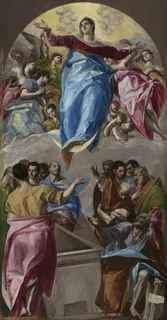
In July, Tiberio Cerasi, treasurer-general to the pope, buys a small chapel in the church of Santa Maria del Popolo. He gave the altarpiece to Annibale. In September he signed a contract with Caravaggio for two paintings for the side walls. Two of the most talked-about painters in Rome would now share one small chapel.
Annibale's part was the Assumption of the Virgin, with Mary rising from her tomb toward heaven. On either side hang Caravaggio's Crucifixion of Saint Peter and Conversion of Saint Paul. Cerasi died on May 3, 1601, and was buried in his chapel. The three pictures still face each other there today.
- 1605Rome
Work stops in the Herrera Chapel of San Giacomo degli Spagnoli. Annibale had taken on frescoes for the Spanish banker Juan Enríquez de Herrera. He designed all the scenes and painted some himself. Then, in 1605, a serious illness struck him, and he put his pupil Francesco Albani in charge of the rest.
After the illness he sank into a deep melancholy and never took on another large project. His years of work on the Farnese ceiling had earned him five hundred gold scudi, plus room and board. One by one, his remaining commissions passed to his pupils.
- 1609Rome
On July 15, 1609, Annibale dies in Rome at forty-eight. As he had wished, he was buried in the Pantheon, beside Raphael, who had been laid there almost ninety years before. The tailor's son from Bologna now rests in Rome's ancient temple next to Raphael.
His Coronation of the Virgin later passed from the Aldobrandini family in Rome to England before reaching the Metropolitan Museum of Art in New York in 1971. Look at the two hands holding up one crown. It is hard not to think of the three Carracci in Bologna, painting together.
People around them
- Agostino Carraccihis older brother by three years, who ran the Bologna studio with him and helped on the Farnese ceiling before they split around 1600.
- Ludovico Carraccihis cousin, who opened the Bologna studio with him and stayed on to run it after Annibale left for Rome.
- Odoardo Farnesethe cardinal who brought him to Rome in 1595 and gave him the study and the long gallery of his palace.
- Caravaggiothe painter who shared the Cerasi Chapel with Annibale from 1600.
- Francesco Albania pupil from Bologna who took charge of the Herrera Chapel when his teacher fell ill in 1605.
Works
Paintings by
Annibale Carracci on Pyeongye
More paintings by this artist will be added.