Pyeongye
Painters · 16th century
El Greco
1540–1614
A painter trained in icon painting on Crete who passed through Venice and Rome, settled in Toledo, Spain, and painted scenes of faith with stretched bodies and restless light.
Scenes from a life
The life of El Greco,
scene by scene
- 1563Candia
Crete was then ruled by Venice. In a document of 1563 from Candia, the island's main city and today's Heraklion, a young man named Domenikos Theotokopoulos is already called a master painter. He grew up making Byzantine-style icons, saints set against gold. Later, in Spain, people would simply call him El Greco, the Greek.
- 1567Venice
He left the island for Venice, the city of Titian and Tintoretto. There he met a different kind of painting: color laid on with visible brushstrokes, and light and shadow sweeping across the whole picture. In 1570 a letter to a cardinal in Rome introduced him as a pupil of Titian.
- 1570Rome
The letter came from the miniature painter Giulio Clovio. Thanks to it, the young Cretan was taken in at the palace of Cardinal Alessandro Farnese, and in 1572 he joined the Academy of Saint Luke, the painters' association of Rome. The Roman physician and art lover Giulio Mancini later wrote down a story: El Greco had said he could repaint Michelangelo's Last Judgment better, and it turned the painters of Rome against him.
- 1577Toledo
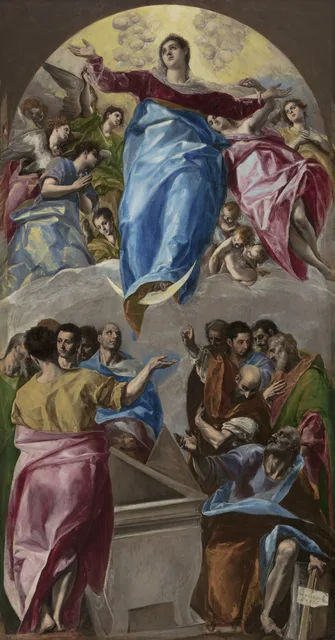
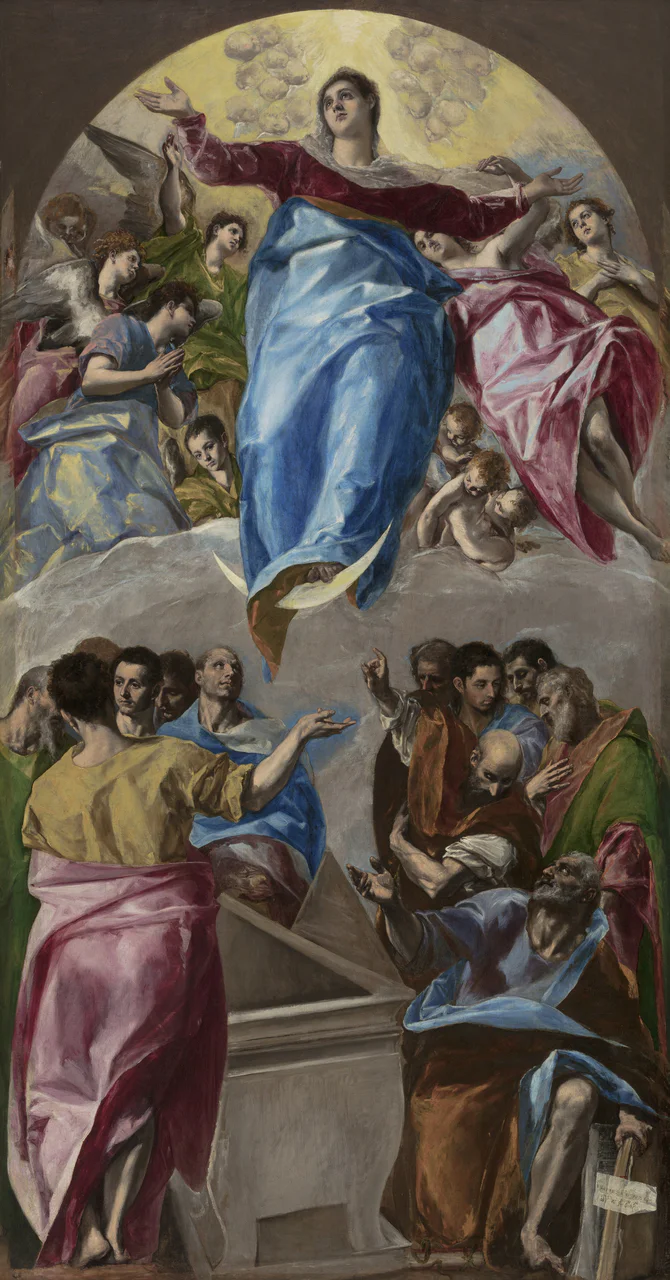
He arrived in Toledo, Spain's old capital. His first big job was a set of altarpieces for the convent church of Santo Domingo el Antiguo. Its centerpiece, The Assumption of the Virgin, is more than four meters tall. Up top, the Virgin rises on a crescent moon among angels. Down below, the apostles crowd around her empty tomb, arms flung wide. In the lower right corner, on a small white slip of paper, he wrote his name in Greek letters and the year 1577.
 Painted around this timeThe Assumption of the Virgin
- 1580El Escorial
In 1578 his son, Jorge Manuel, was born in Toledo. Two years later King Philip II ordered The Martyrdom of Saint Maurice for the vast monastery-palace he was building at El Escorial. It was a chance to become a royal painter. The finished picture of 1582 did not please the king, and another artist's painting went up on the altar instead.
- 1586Toledo
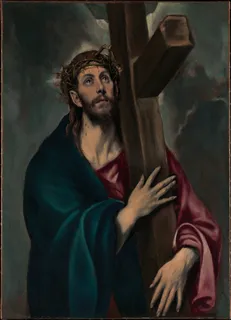
With the court closed to him, he painted for Toledo's churches and citizens. In 1586 the parish of Santo Tomé commissioned The Burial of the Count of Orgaz. In the front, a boy looks straight out at us and points to the dead count. The handkerchief in his pocket carries the painter's signature and the year 1578, the year Jorge Manuel was born. In these years El Greco also painted Christ Carrying the Cross again and again. In this version Christ's upturned face and his long hands on the wooden beam fill almost the whole canvas.
Painted around this timeChrist Carrying the Cross - 1600Toledo
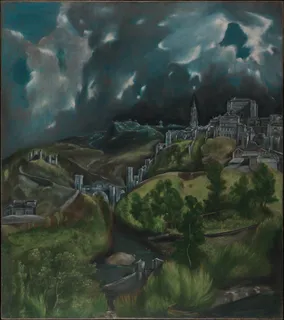
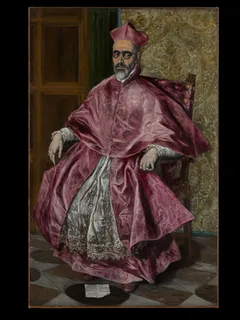
View of Toledo comes from around this time, more than twenty years after he arrived. Blue-black clouds tear open, and the cathedral tower and the fortress on the hill glow white as if struck by lightning. Zoom in on the rock at lower right: there is his signature, in Greek. Around the same time he painted Cardinal Niño de Guevara, head of the Spanish Inquisition. Look for the red silk, the round black-rimmed glasses, and a single white paper dropped on the floor at his feet.
Painted around this timeView of Toledo - 1614Toledo
In 1611 the painter Francisco Pacheco, who would later teach Velázquez, came to Toledo, toured El Greco's studio, and wrote about the visit. El Greco died in Toledo in the spring of 1614. His son Jorge Manuel, who had worked beside him for years, took over the studio.
People around them
- Titianthe Venetian painter whose pupil El Greco was called in the 1570 letter.
- Giulio Cloviothe miniature painter who introduced him to Cardinal Farnese in Rome.
- Alessandro Farnesethe cardinal who gave him a place in his Roman palace.
- Jerónima de las Cuevasthe woman he lived with in Toledo, mother of his son.
- Jorge Manuel Theotokopouloshis son, born in 1578, who worked in his father's studio.
- Fernando Niño de Guevarathe cardinal whose portrait he painted.