 Pyeongye
All tours · Cities and Streets · Room 1
Notes on this room's painting
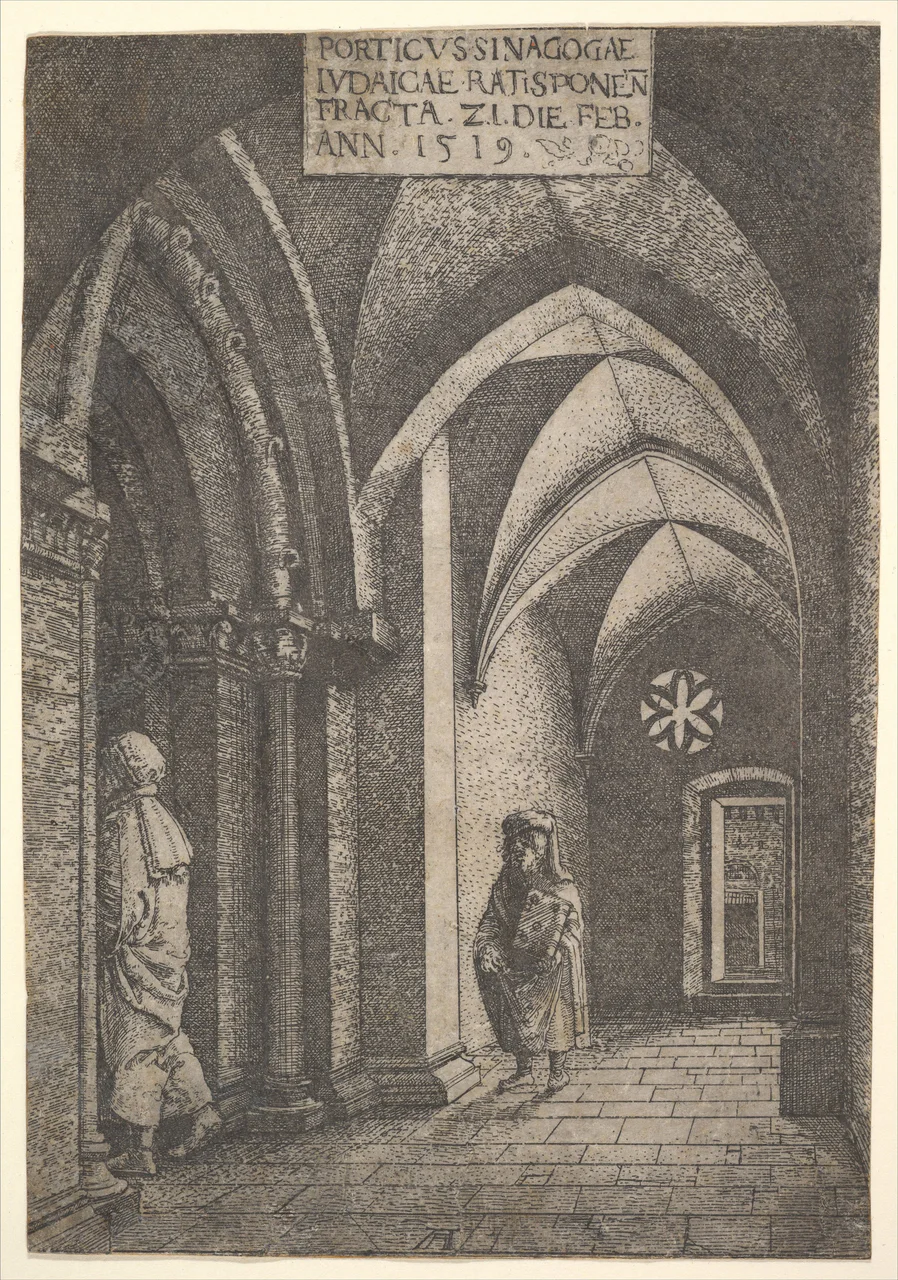
- Two men stand in the vaulted entrance hall of a synagogue, scratched into a small copper plate and printed on paper.
- Albrecht Altdorfer, a painter of the German city of Regensburg, made this etching in 1519.
- The building was torn down the same year. This print records a real place in the last days before it vanished.
Reading the picture
5 places to look closer
Tap a number on the painting to jump to its note, or a close-up to see that spot in the whole picture.
Start with the stone tablet at the top. The Latin says the porch of the Jewish synagogue of Regensburg was destroyed on February 21, 1519. The building still stands in the picture, yet the words already announce its end. A small curl of ornament trails off the right side of the date.
Now look up at the ceiling. Stone ribs meet in sharp points and repeat, one bay after another, deeper into the hall. Altdorfer used loose dots for the lit surfaces and tight crosshatching for the shadows. On a sheet about six inches tall, the vault still feels deep.
Zoom in on the man beside the pillar. He wears a hat and a long beard. One hand holds something against his chest, and the other gathers up the hem of his cloak. His face turns toward us, so it feels as if he is meeting our eyes.
Look at the figure on the far left. He wears a hood-like cap and a long robe, and he shows us his back. We barely see his face. Unlike the man by the pillar, he does not meet our eyes.
Drop down to the middle of the floor. Hidden among the paving stones is a large A with a small A inside it. This is the monogram Altdorfer used to sign his work.
When it was painted
In the winter of 1519, Altdorfer was about thirty-nine. He was a well-known painter in Regensburg, and since 1517 he had also sat on the city's Outer Council. In January of that year, Emperor Maximilian I died. The emperor had protected the city's Jewish community.
The city moved quickly to expel its Jews. According to the Metropolitan Museum, Altdorfer was one of the men chosen to deliver the news. The community was given two hours to empty the synagogue and five days to leave Regensburg.
Just before the building came down, Altdorfer went inside and made two etchings. One shows the columned prayer hall. The other is this entrance hall. The Met describes the print as an early European print that portrays an actual building as it stood.
A chapel to the Beautiful Virgin rose on the site. Pilgrims soon crowded in, and Altdorfer made a woodcut of the Virgin for the pilgrimage. The same man helped remove a community, recorded the building it lost, and served the shrine that replaced it.
The print entered the Met's collection in 1926. Look again at the man by the pillar. Five hundred years later, the people who once crossed this hall survive on this small sheet of paper.
Questions to think about
- Look for itIf you follow the stone ribs of the ceiling, how many bays can you count before the hall disappears into shadow?
- Why?Why do you think Altdorfer chose to record a building that his own council had decided to destroy?
- What about you?Neighborhoods still disappear today, through redevelopment or war. If your street were about to vanish, what would you want to photograph or draw before it was gone?