 Pyeongye
All tours · From Dawn to Night · Room 1
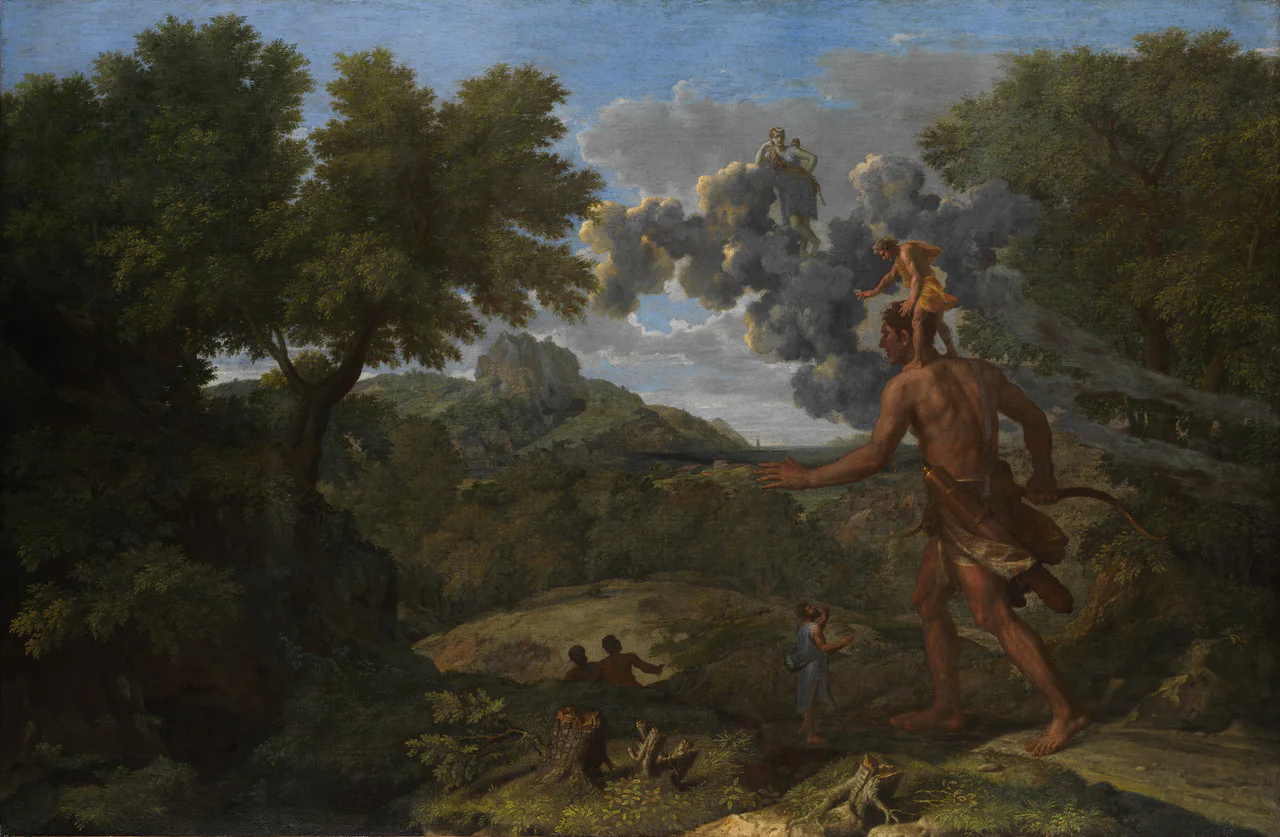
Notes on this room's painting
- Orion, a blind giant hunter, strides toward the sunrise with a small guide on his shoulders and one hand groping the air.
- The French painter Nicolas Poussin made it in Rome in 1658, when he was about sixty-four.
- It tells a myth about a giant, yet most of the canvas is landscape: dense trees, rolling clouds, and distant hills.
Reading the picture
5 places to look closer
Tap a number on the painting to jump to its note, or a close-up to see that spot in the whole picture.
Zoom in on the top of Orion's head. A small man in yellow stands on the giant's shoulders and points the way ahead. This is Cedalion, the guide in the myth. He has become the eyes of a giant who cannot see.
Look at Orion's outstretched hand. His fingers are spread as he feels his way through empty air. Beyond his fingertips you can see the sea and a tower far away, but Orion cannot. We, who can see, and the giant, who cannot, are standing before the same view.
Zoom in on Orion's waist. He grips a bow in one hand, and a quiver hangs at his hip. In myth, Orion was a famous hunter. He has lost his sight, but he still carries a hunter's gear.
Look up at the clouds. A woman rests a hand against her cheek and gazes down at Orion. She is usually identified as Diana, goddess of the hunt. The clouds drift low enough to wrap around the giant's head.
Zoom in near the giant's feet. A man in a blue tunic tips his head back and raises a hand as he looks up. Putting this ordinary-sized man next to Orion makes the giant's size easy to feel.
When it was painted
In 1658 Poussin was living in Rome and struggling with a hand that shook when he held a brush. He had been born in France but moved to Rome in 1624, at about thirty, and spent nearly all the rest of his life there. In letters to friends he admitted that the trembling slowed his work.
Once, he had been called home. In 1640 he went to Paris at the king's summons, but the big court projects and the quarrels with rival painters wore him out, and within two years he was back in Rome. After that he much preferred working for private collectors who understood painting, rather than for the court.
This canvas was made for one of those collectors, the Frenchman Michel Passart, a man who loved landscape painting. For him Poussin set a giant's story inside deep woods and rolling clouds.
The picture holds a puzzle. Why do the clouds drift all the way down around the giant's head? In 1944 the art historian Ernst Gombrich offered an answer. He argued that Poussin built the scene from a handbook of myths by the sixteenth-century Italian scholar Natale Conti, who explained the Orion story as an account of how clouds and rain are formed.
The Metropolitan Museum of Art bought the painting in 1924, and it has been in New York ever since. Look again at the dark clouds billowing down behind Orion's head. They quietly carry the meaning that Gombrich uncovered.
Questions to think about
- Look for itCan you find the woman on the cloud looking down at the giant?
- Why?Why do you think Poussin put the giant off to the right and filled the rest of the canvas with landscape?
- What about you?Orion borrows the eyes of the guide on his shoulders to find his way. Does our society today do enough to help people with disabilities find their way alongside everyone else?