 Pyeongye
All tours · From Dawn to Night · Room 2
Notes on this room's painting
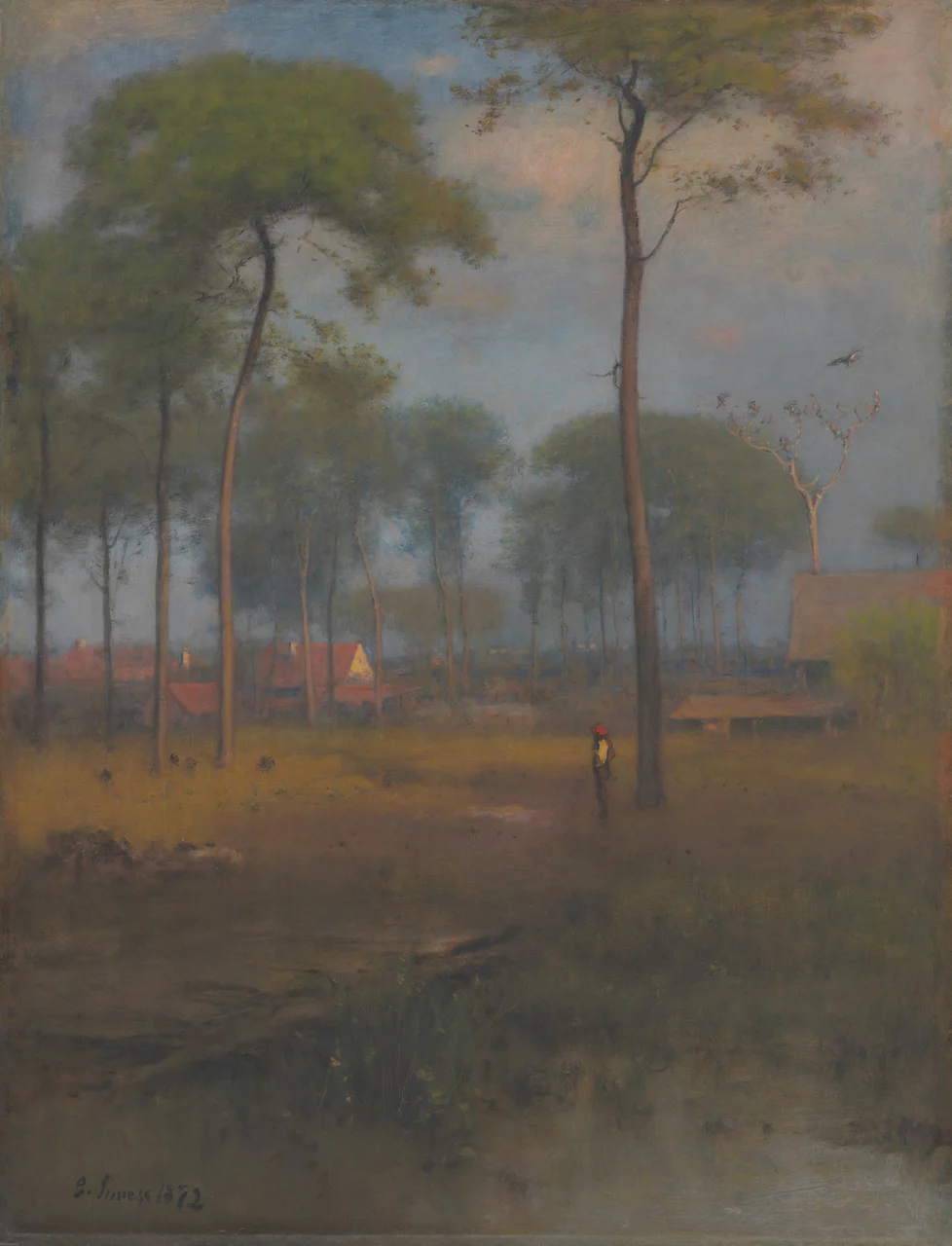
- A grove of tall Florida pines at sunrise, with one small figure standing alone in an open, grassy clearing.
- Painted by the American artist George Inness in 1892, in Tarpon Springs, Florida.
- Soft outlines and layers of pink, blue and ocher turn a real place into the quiet mood of early morning.
Reading the picture
4 places to look closer
Tap a number on the painting to jump to its note, or a close-up to see that spot in the whole picture.
Find the tiny person in the clearing, just right of center. He is no bigger than a fingernail, yet he wears a red hat. It is the sharpest red in the whole picture. The museum suggests the hat stands in for the low morning sun.
On the left, red roofs show between the tree trunks. One gable end glows yellow, as if the first sunlight has touched only that wall. The houses dissolve at the edges like shapes seen through mist.
Follow the tall pine on the right up into the sky. Beside its straight trunk, a single pink cloud floats in pale blue. The soft pinks and blues of sunrise fill the top of the canvas. Even the leaves are not painted one by one, but as hazy clumps of color.
Zoom in on the nearly bare tree at the far right. Its branches spread open like fingers. Above it, a bird glides past with its wings stretched out.
When it was painted
By 1892 Inness was well into his sixties. He had just set up a house and studio in Tarpon Springs, a town on Florida's Gulf Coast. His main home was still in Montclair, New Jersey.
It had been a long road. As a young man he painted American mountains and rivers down to the last leaf. In the 1850s he spent time in Italy and France and saw the work of the Barbizon painters, and his brushwork grew broader and softer. By his last years, tone and mood mattered to him far more than detail.
Faith ran through these pictures too. Inness followed the Christian teachings of the Swedish thinker Emanuel Swedenborg, who held that everything in the visible world carries a spiritual meaning. For Inness, painting a forest at dawn was a way of looking slowly and quietly, a kind of religious experience.
Two years after this picture, in 1894, Inness died while traveling in Europe, at Bridge of Allan in Scotland. The painting went into the collection of the Chicago businessman Edward B. Butler and came to the Art Institute of Chicago with that collection in 1911.
Now look up from the signature in the lower left corner and find the small figure in the clearing again. One fingernail-sized red hat holds the whole wide morning together. It is a morning from the last years of the painter's life, held in one small dot of color.
Questions to think about
- Look for itHow many spots of red can you find in this wide landscape?
- Why?Why do you think Inness made the person so small, with no face we can see?
- What about you?How often do you get to stand in an early morning landscape with no phone buzzing, and what would change if you did it more?