 Pyeongye
Notes on this room's painting
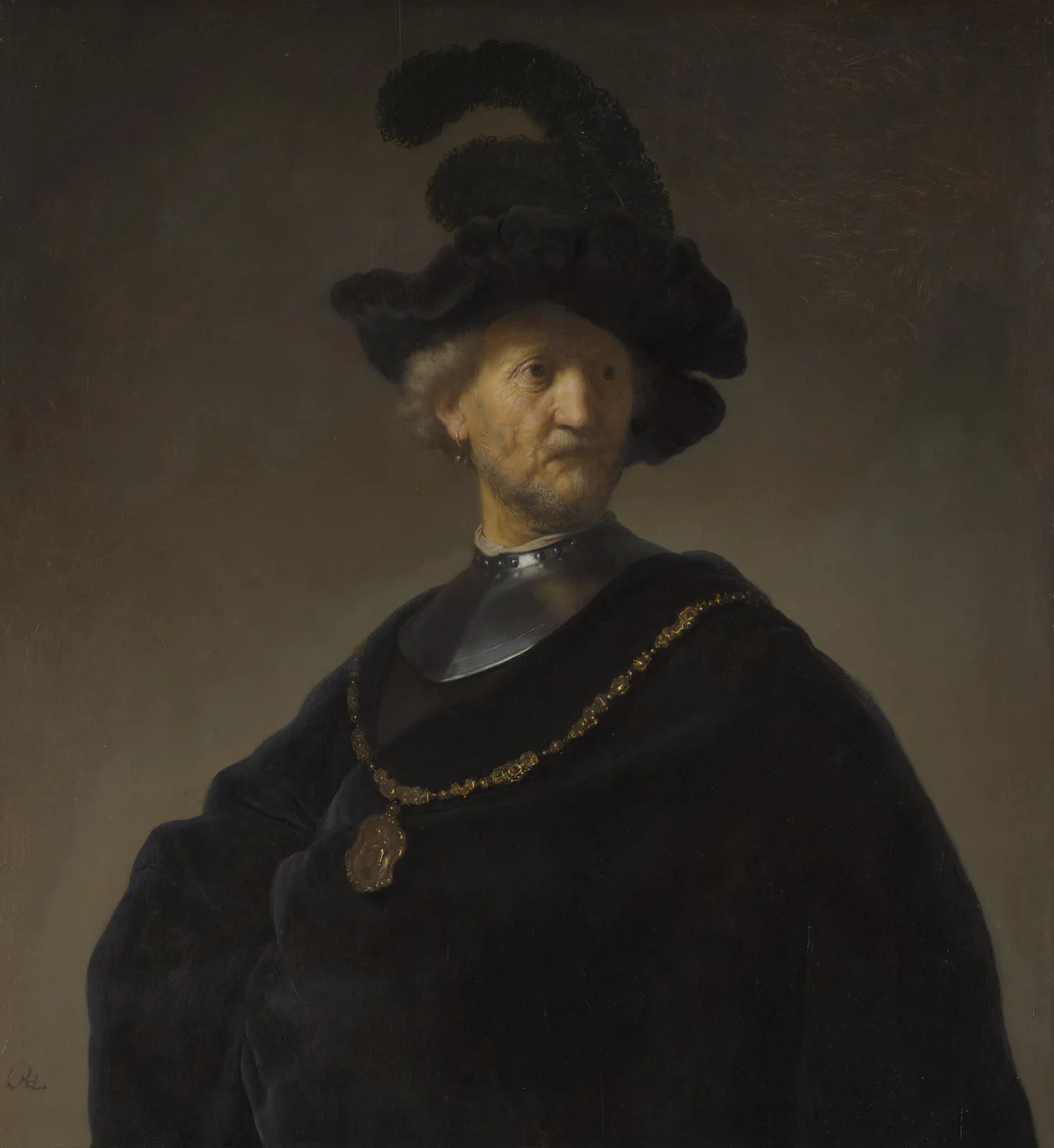
- An old man in a plumed black beret wears a steel gorget at his throat and a heavy gold chain across his chest.
- Rembrandt painted it in oil on a wooden panel in 1631, at about twenty-five, in his hometown of Leiden.
- It is not a commissioned portrait but a tronie, a character study of a face and costume, painted with as much care as any portrait.
Reading the picture
5 places to look closer
Tap a number on the painting to jump to its note, or a close-up to see that spot in the whole picture.
Zoom in on the face. Light falls from the upper left, catching his forehead and the tip of his nose, while the eye on the right sinks into the shadow of his hat. Soft folds of skin sag beneath his eyes, and his close-trimmed beard looks prickly. He watches us from the side.
Look at the gleaming metal below his chin. It is a gorget, a piece of armor that protected the throat and upper chest. A row of round rivets runs along its edge, and a long white highlight slides across the smooth steel. Rough whiskers and cold metal sit side by side, each painted in a completely different way.
Zoom in on the pendant at the end of the chain. Gold links ripple across the dark cloak, and tiny dots of bright paint make the metal glint. The Art Institute of Chicago points out that this chain shows up in several of Rembrandt's pictures, so he probably kept one in his studio.
Now look up at the plume. Dark green feathers curl high above the black beret. The museum says the chain and gorget hint at an honored military life, while the feathered hat calls up an earlier age. Rembrandt collected costumes like these to turn his models into other people.
Zoom in on the lower left corner. Against the dark background you can find a small monogram where the letters R and L seem to tangle. In these Leiden years the young Rembrandt often signed his pictures with a monogram like this instead of his name.
When it was painted
In 1631 Rembrandt was twenty-five and still working in Leiden, side by side with the slightly younger painter Jan Lievens. The two pushed each other hard. According to the Art Institute of Chicago, they turned character studies like this one into an affordable alternative to portraits, using bold lighting, odd costumes and lively poses to catch buyers' eyes.
This old man was a favorite model for Rembrandt and his circle. For a long time he was called Rembrandt's father, but the painter's father had already died in 1630. The museum notes that recent research suggests the model may have been the keeper of an almshouse in Leiden.
Rembrandt's own life was about to change. Around 1631 he left Leiden for the much larger city of Amsterdam and began working with the art dealer Hendrick Uylenburgh. The next year he painted The Anatomy Lesson of Dr. Nicolaes Tulp, and Amsterdam quickly took notice.
The museum adds one more detail. Famous painters like Peter Paul Rubens and Anthony van Dyck received real gold chains as gifts from royal patrons, but Rembrandt never did. This panel was with the Munich dealer Julius Böhler in 1912 and later belonged to the Hungarian collector Marczell von Nemes. It came to the Art Institute in 1922 as part of the Mr. and Mrs. W. W. Kimball Collection.
Look again at the gold chain on the old man's chest. An honor Rembrandt never received, he hung around this stranger's neck with a few drops of paint.
Questions to think about
- Look for itWhere on the old man's face does the light fall most strongly, and where does it fade into shadow?
- Why?Why do you think Rembrandt dressed an ordinary old man in armor, gold and feathers?
- What about you?Today we try on other selves with filters and costumes. When someone dresses up, what do I look at to see who they really are?