 Pyeongye
All tours · The Dutch Golden Age · Room 1
Notes on this room's painting
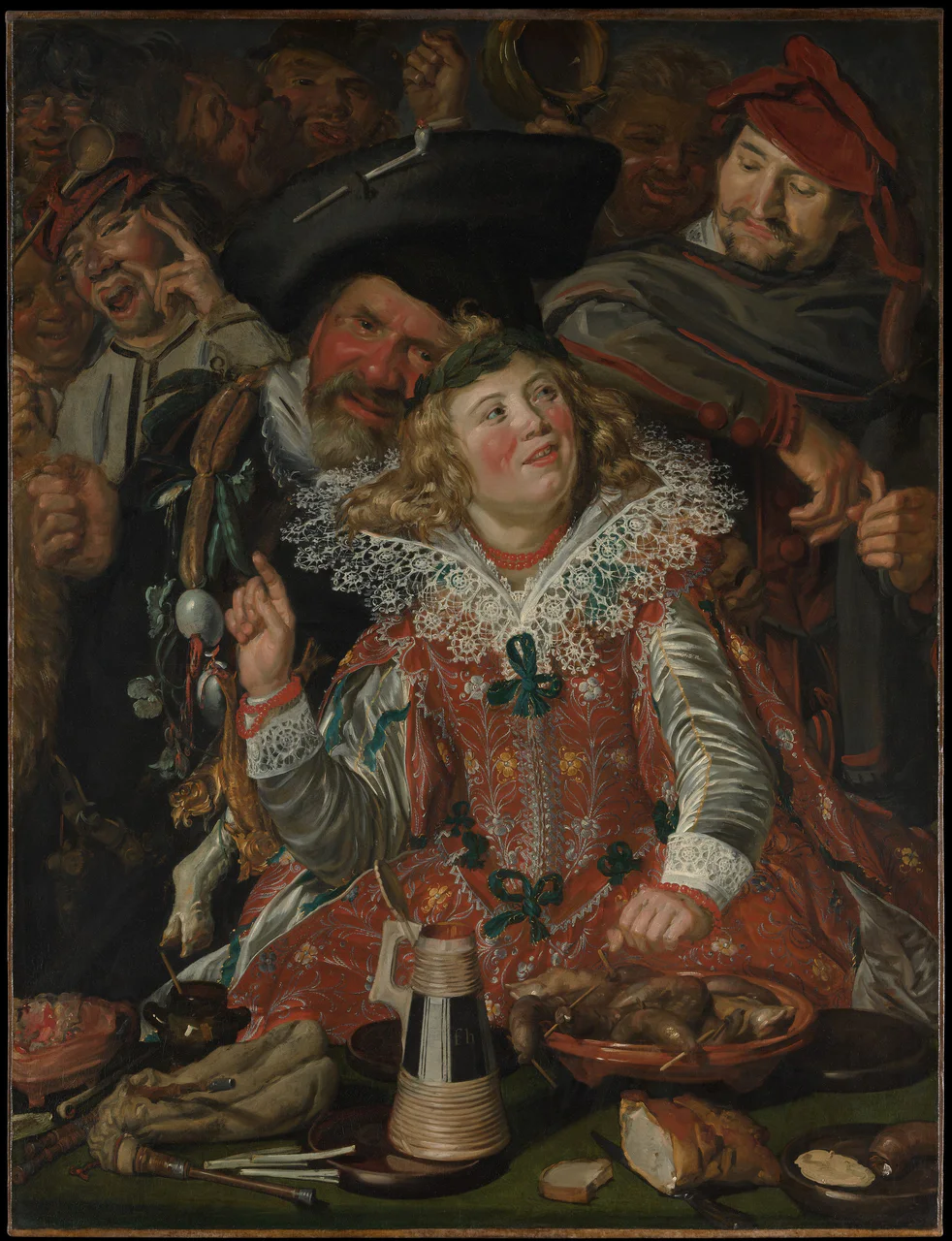
- On a carnival day just before Lent, a crowd of grinning men presses around a richly dressed figure, with food and drink piled on the table.
- Frans Hals, a painter in Haarlem in the Netherlands, painted it in oil on canvas around 1616–17.
- The canvas is more than four feet tall, and faces are packed right up to its edges. You can almost hear the noise.
Reading the picture
5 places to look closer
Tap a number on the painting to jump to its note, or a close-up to see that spot in the whole picture.
Zoom in on the face in the middle. The cheeks are flushed pink, and a wreath of green leaves sits on the curly hair. Several strands of red beads circle the neck. A well-known reading of the picture sees this "lady" as a young man dressed up in women's clothes.
Look at what hangs on the left. Below a fat sausage dangles something round and white, like an egg. Right beside it, the central figure raises a single finger in the air. The wrist wears a bracelet of the same red beads as the necklace.
Zoom in on the upper left corner. One man has stuck a spoon in his cap. The man below him pulls down the skin under his eye with a finger and laughs with his mouth wide open. Hals built these faces out of a few quick strokes of the brush.
Zoom in on the striped jug at the bottom center. On its dark band you can read the letters fh. They are Frans Hals's initials. The painter slipped his signature onto a beer jug.
Drop down to the table at the lower left. A bagpipe lies there, a leather bag with pipes sticking out of it. Next to it are several thin white sticks. On the plate to the right, meat sits pierced with wooden skewers.
When it was painted
Around 1616 Hals was about thirty-four, and he had just been through a hard loss. His first wife had died in 1615, leaving him with young children. Yet this is the moment when his brush started pouring out loud, crowded laughter like this.
He had been born in Antwerp. After Spanish troops retook that city, his family moved north to Haarlem. Hals joined the Haarlem painters' guild in 1610, but almost nothing he painted before about 1616 survives. So this canvas is one of the earliest Hals pictures we can still see.
1616 was a big year. He finished a huge group portrait of the officers of Haarlem's St. George civic guard at their banquet. The same year he spent a few months back in Antwerp, the city of his birth. And in 1617 he married again, to Lysbeth Reyniers.
The setting here is Shrovetide, the last days of feasting before Lent, the forty days before Easter when Christians gave up meat. Hals packed that party right up to the edges of the canvas.
Hals died in Haarlem in 1666. For a long time afterward he was largely forgotten. In the nineteenth century his quick, bold brushwork found new fans, among them painters such as Edouard Manet. This picture came to the Metropolitan Museum through the bequest of Benjamin Altman, a New York department store owner who died in 1913. Look again at the central figure's curls and lace collar. The hair is a few thick strokes; the lace is a web of thin white lines.
Questions to think about
- Look for itNear the top center, can you find the drinking glass someone is holding high in the air?
- Why?Why do you think Hals squeezed the people so close together that they fill the canvas right to its edges?
- What about you?Shrovetide was a day to enjoy everything before going without. Is that like the big meal some of us eat right before an exam week or a diet starts?