 Pyeongye
All tours · The 1700s: From Rococo to Revolution · Room 1
Notes on this room's painting
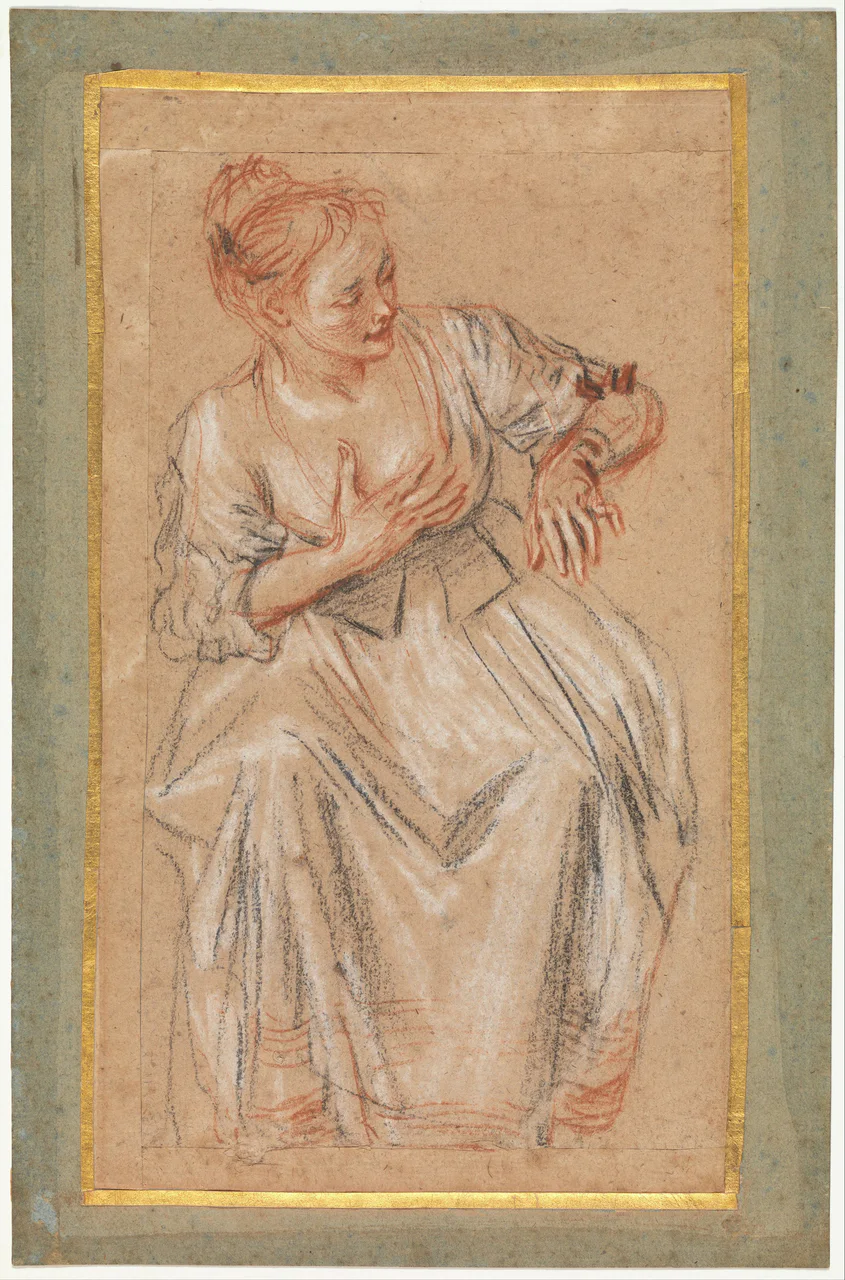
- A young woman in a wide skirt sits with one hand on her chest and snaps her head to the right, as if someone had just called her name.
- The French painter Antoine Watteau drew her around 1716–17 in black, red, and white chalk.
- On a sheet only 24 cm tall, three chalks are enough to tell skin apart from cloth.
Reading the picture
4 places to look closer
Tap a number on the painting to jump to its note, or a close-up to see that spot in the whole picture.
Zoom in on her face. The hair, nose, and mouth are drawn in red chalk. A little white chalk is rubbed onto her cheek and forehead to catch the light. Her lips are slightly parted, as if she is about to say something.
Look at the hand pressed to her chest. The fingers are a few quick strokes of red. Just above it, white chalk brightens her chest. The hand looks as if it took only seconds, yet you can feel the pressure of her fingertips.
Move to the end of her other arm. She bends her wrist and lets her fingers hang down. Over the red lines, Watteau added a few strokes of black to put shadow between the fingers. At the cuff, a dark mark of black chalk suggests a ribbon or trim.
Now look at the skirt across her lap. Here the red almost disappears, leaving only black and white. Black lines break into a V where the fabric folds, and white chalk gives the surface a silky sheen. Red for skin, black and white for cloth: that is the system.
When it was painted
When Watteau made this drawing he was about thirty-two. Born in Valenciennes in northern France, he had come to Paris as a young man. Around this time he was living in the house of Pierre Crozat, a very rich financier and a famous collector. Crozat owned piles of drawings by Rubens and the Venetian masters, and Watteau studied and copied them.
He also had an overdue assignment. In 1712 the Royal Academy of Painting and Sculpture had accepted him as a candidate and, unusually, let him choose the subject of his reception piece himself. Then he took five years to deliver it. Only in 1717 did he hand in his Pilgrimage to Cythera, and the Academy entered him as a painter of fêtes galantes, elegant outdoor gatherings.
Watteau drew real people in front of him, fast, in red, black, and white chalk. Using the three together is known as trois crayons. His friend the Comte de Caylus later wrote that Watteau kept his drawings in bound books and picked figures out of them when he composed a painting. That is why the same figure can turn up in more than one picture.
He did not have long. He went to London in 1719 and came back to Paris the next year, weakened by tuberculosis. In 1720 he painted a shop sign for the art dealer Gersaint, and in the summer of 1721 he died at thirty-six. Afterward the collector Jean de Jullienne had hundreds of his drawings reproduced as prints, and Watteau's figures traveled all over Europe. This sheet came to The Met in 1975 with the Robert Lehman Collection.
Look again at that sudden turn of her head. Someone seems to have called her, and Watteau caught the moment with a few quick lines of red.
Questions to think about
- Look for itWhere in this drawing did Watteau use red chalk, and where did he use only black and white?
- Why?Why do you think he chose the moment she turns her head instead of a quiet, still pose?
- What about you?Today we can photograph strangers in a second. When we record people we see in public and use those images later, what should we be careful about?