 Pyeongye
All tours · The Italian Renaissance · Room 1
Room 1
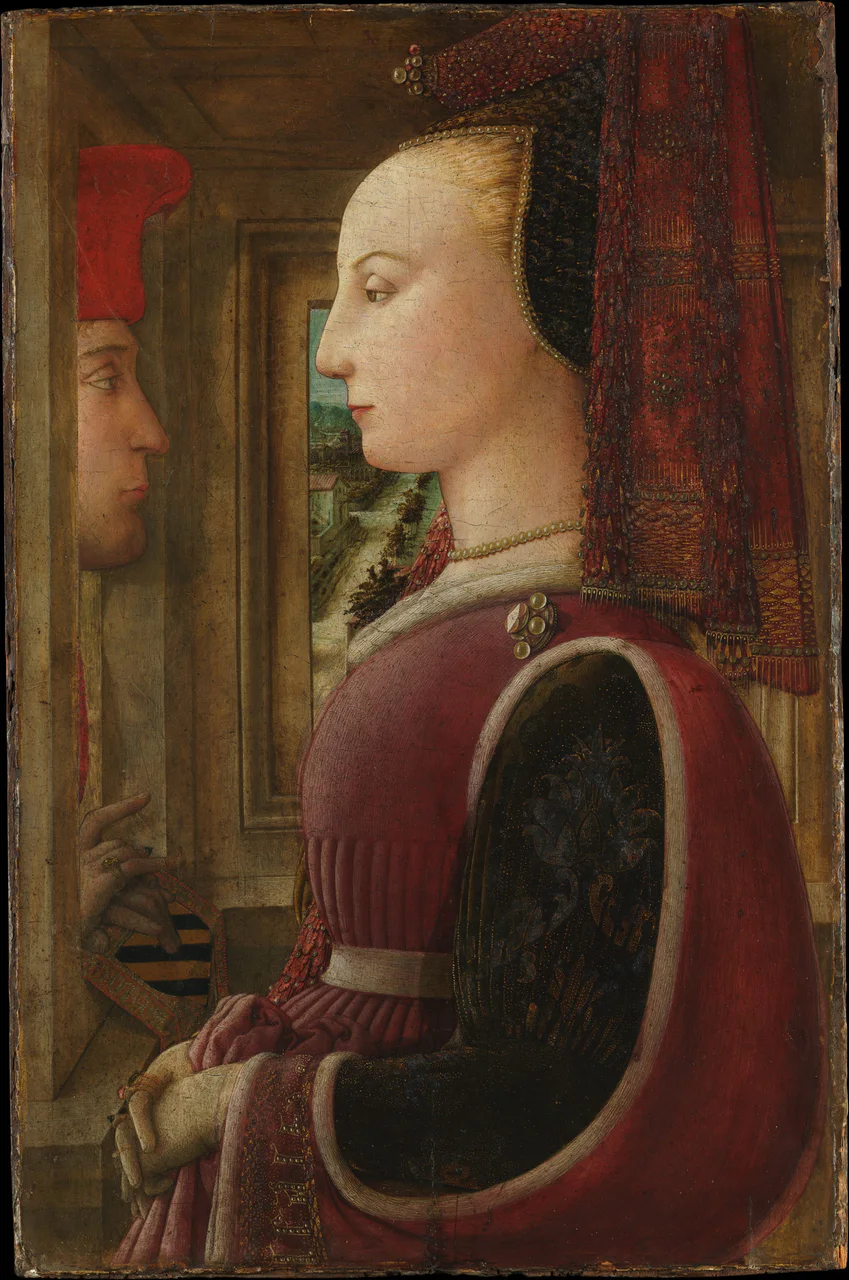
Portrait of a Woman with a Man at a Casement
Fra Filippo Lippica. 1440Tempera on wood64.1 × 41.9 cm
Notes on this room's painting
- A woman in a red dress stands in profile, while a man leans in at a window on the left and looks at her.
- Fra Filippo Lippi, a friar and painter in Florence, made it in tempera on a wooden panel around 1440.
- One small panel holds a room, a view out the window, and a man at the casement. It makes you wonder what is going on between these two people.
Reading the picture
5 places to look closer
Tap a number on the painting to jump to its note, or a close-up to see that spot in the whole picture.
Zoom in on the woman's face. Her forehead is high and smooth, and her blond hair is tucked into a dark net edged with pearls. Her eyes look straight ahead, and her lips are pressed shut. Fine cracks in the old paint spread across her face like a spider's web.
Zoom in on the man at the window on the left. He wears a red cap, and the edge of the window frame cuts off the back of his head as he gazes at her. His face is painted in darker tones than hers.
Look at the man's hand. A hand with a ring sets a shield striped in black and gold on the windowsill. A shield like this is a coat of arms, the sign of a family. It tells us which family this man belongs to.
Zoom in on the view out the window, just below her chin. Tiny red-roofed houses, a tower, a stretch of water, and green hills are packed into that narrow opening. Behind the two people, the outside world opens up.
Zoom in on the end of her sleeve near the bottom. Letters stitched in pearls and gold thread run down the red cuff. The museum reads them as lealtà, the Italian word for loyalty.
When it was painted
Filippo lost his parents when he was small and was placed as a child in the Carmine, the Carmelite friary in Florence. He took his vows there around 1421. In those years Masaccio was painting frescoes in the Brancacci Chapel of the same church, and many scholars believe the young friar learned by studying them.
His talent got him noticed, but money was tight. A letter he wrote to Piero de' Medici in 1439 still survives. In it he calls himself the poorest friar in Florence and asks for help, saying he has six nieces of marrying age to look after. This portrait comes from about that time, when Lippi was in his mid-thirties.
So who ordered it? The Met reads the shield on the windowsill as the coat of arms of the Scolari family of Florence. On that basis the couple is identified as Lorenzo di Ranieri Scolari and Angiola di Bernardo Sapiti, who married around 1436. Another scholar has argued that the arms belong to the woman's family instead, so the names are not settled.
The New York collector Henry G. Marquand gave it to the museum in 1889.
Lippi's own life stayed eventful. In the 1450s, while working in Prato, he began living with a nun, Lucrezia Buti. Their son, Filippino Lippi, grew up to be a painter too.
Look again at the window. The man does not step into the room. He leans on the frame and holds out his shield. Put that shield next to the word loyalty stitched on her sleeve, and you can see why this picture is so often read as a story about marriage.
Questions to think about
- Look for itJust below her shoulder, can you find the brooch with little round ornaments?
- Why?Why do you think Lippi put the man outside the window, with the back of his head cut off by the frame?
- What about you?The word loyalty is stitched on the woman's sleeve. In marriage or love today, what goes wrong when only one person is expected to be faithful?