 Pyeongye
All tours · Portraits: Reading Faces · Room 1
Room 1
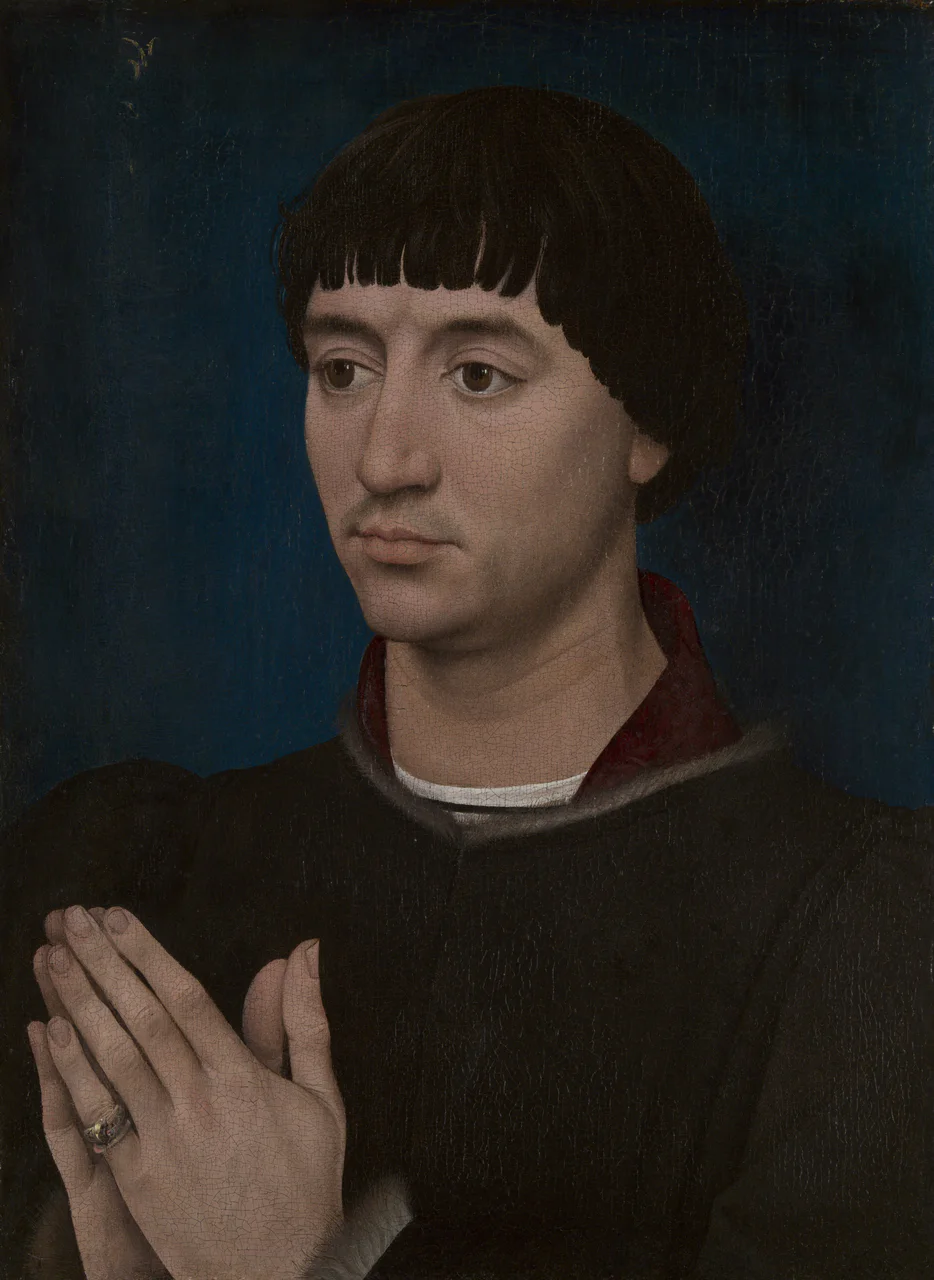
Portrait of Jean Gros (recto); Coat of Arms of Jean Gros (verso)
Rogier van der Weyden1460–64Oil on panel38.5 × 28.8 cm
Notes on this room's painting
- A young man in black presses his hands together and gazes quietly off to the left, not at us.
- Rogier van der Weyden painted this portrait of Jean Gros in oil on a wooden panel in 1460–64.
- It was once one half of a small folding diptych, and the panel he was looking at now hangs separately in a museum in Tournai, Belgium.
Reading the picture
5 places to look closer
Tap a number on the painting to jump to its note, or a close-up to see that spot in the whole picture.
Zoom into the eyes. Each brown iris holds a tiny white spot of reflected light. His gaze does not meet ours. It slides off past the left edge of the panel, toward where a painting of Mary and the infant Jesus was once hinged.
Look at his haircut. The dark brown hair is cut straight across the forehead and rounded above the ears like a bowl. The ends of the fringe are drawn strand by strand. Against the deep blue background, the outline of his head stands out sharply.
Zoom in below his chin. A thin band of white shirt shows at the neck, and above it come a dark red lining and a trim of gray fur. His coat is almost entirely black, so white, red and fur gather in this narrow spot. Look closely at the skin, too, and you will see a fine web of cracks, the kind that forms in old paint over centuries.
Move down to the hands at the lower left. Palms pressed together and fingertips tilted upward, they are hands in prayer. The nails, the creases at the knuckles and the tendons on the back of the hand are all carefully painted. Set against the dark background, the hands catch the eye almost as much as the face.
Zoom in on the ring. A gold band holds a dark setting, with a small touch of red at its edge. It is no bigger than a fingernail, yet the glint of metal is still there.
When it was painted
Picture Brussels around 1460. Rogier van der Weyden is about sixty, and he has been the city's official painter since 1436. Trained in his hometown of Tournai, he is now the artist that the top people of the Burgundian court turn to for portraits and prayer pictures.
The young man here, Jean Gros, worked for Charles, the heir who would become Duke of Burgundy. Van der Weyden painted Charles himself in these same years, and that portrait now hangs in Berlin. Gros ordered for himself the kind of folding prayer diptych that the duke's inner circle owned. The Art Institute reads the commission as a sign of his ambition and of how close he stood to the court.
This was one of the painter's last works. Van der Weyden died in Brussels in June 1464. His great Justice panels for the Brussels town hall burned in the bombardment of 1695 and are lost. This portrait, by contrast, is a small panel under forty centimeters tall, made to be folded shut and carried.
After that, the two halves went separate ways. The portrait turned up in the nineteenth century in the collection of Dr. De Meyer in Bruges. It then passed through the Paris collection of Rodolphe Kann and crossed to America. The Chicago collector Martin A. Ryerson lent it to the Art Institute, and it entered the museum's collection in 1933.
The Virgin and Child panel ended up in the Renders collection in Bruges, where it was heavily restored. Today it hangs in Tournai, the town where the painter was born. Both panels carry Jean Gros's coat of arms on the back. Look again at his brown eyes. He is still gazing past the left edge, toward a Madonna an ocean away.
Questions to think about
- Look for itIf you had to pick the three brightest spots in this painting, where would they be?
- Why?Why do you think Jean Gros paid for the same kind of prayer picture that royals and the duke's inner circle owned?
- What about you?People today often use photos and profiles to show who they are close to. In what ways is Jean Gros's portrait doing something similar?