 Pyeongye
All tours · Faces of Water · Room 2
Notes on this room's painting
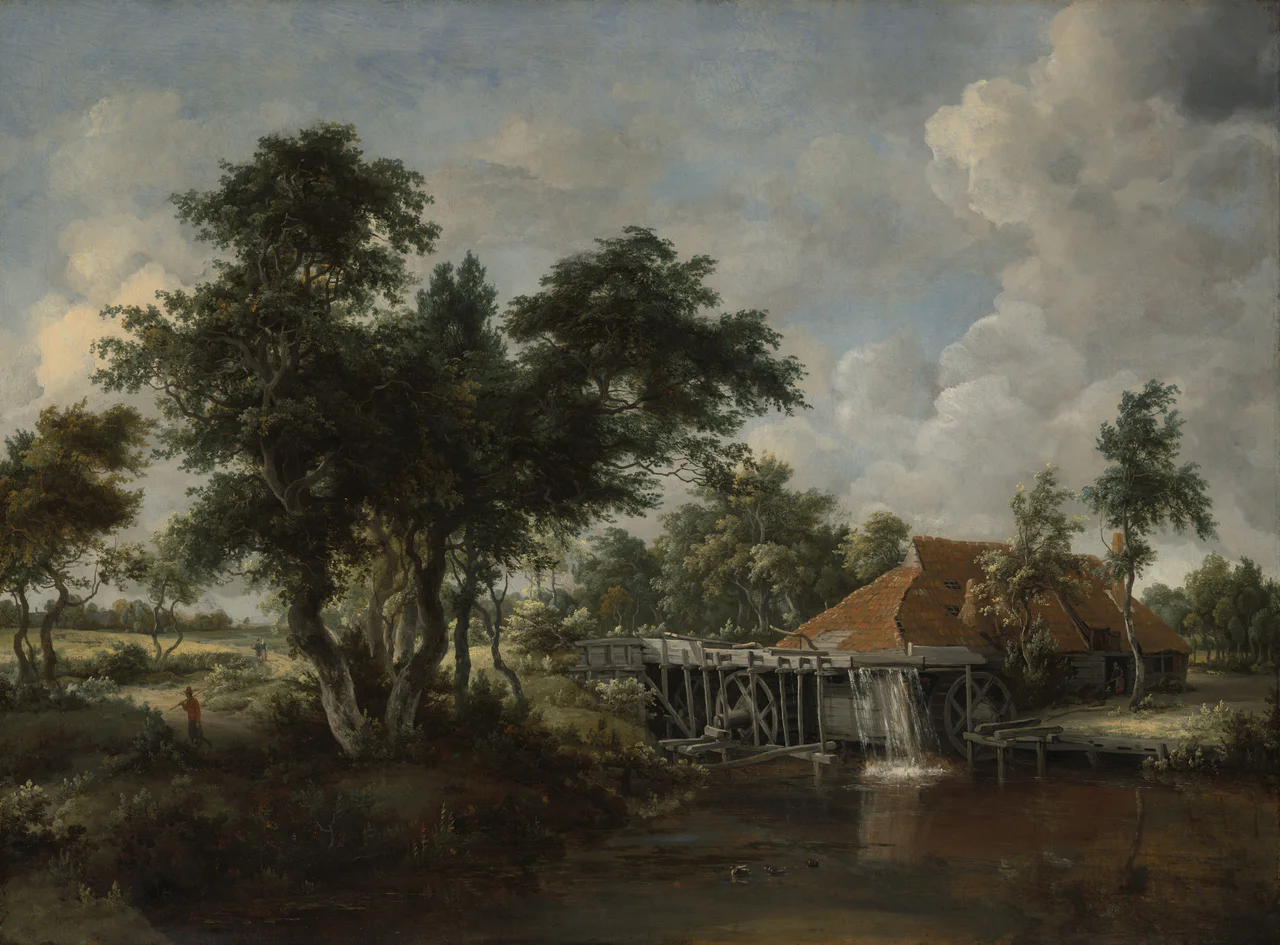
- A watermill with a big red tile roof sits at the edge of a wood, and water pours from a wooden chute into the pond below.
- The Dutch painter Meindert Hobbema painted it around 1665, when he was about twenty-seven.
- It is one of more than thirty watermill pictures Hobbema made, packed with carefully painted water, trees, and clouds.
Reading the picture
5 places to look closer
Tap a number on the painting to jump to its note, or a close-up to see that spot in the whole picture.
Zoom in on the end of the wooden channel in front of the mill. Water splits into white threads as it falls from the chute, and spray kicks up from the pond. To the right, a big waterwheel with visible spokes stands in shadow. This rush of water turned the wheel that drove the mill.
Look at the red roof. Each tile is painted a slightly different orange or brown, and two small windows open in the slope. A slender tree with pale leaves stands in front of it. The old tiles have faded in patches, so you can see how long the building has stood there.
Zoom in on the path at the left. A man in a red jacket and a hat walks toward us with a long pole over his shoulder. Farther back, two well-dressed figures stroll side by side. The Art Institute of Chicago explains that these finely dressed people are meant to suggest the rewards of hard work.
Look down at the dark pond. Three ducks paddle in a line, and a few white strokes of feather reflect on the water. Tiny living things on that broad, still surface give the scene a little motion.
Zoom in on the clouds in the upper right. Cream and gray billow upward in heaps, with patches of blue sky between them. Hobbema gave nearly half the canvas to the sky, which makes the trees and mill on the ground feel snug and sheltered.
When it was painted
Around 1665, Hobbema was about twenty-seven. He was born in Amsterdam in 1638, and by this time he had spent several years learning from the landscape painter Jacob van Ruisdael in the same city. In 1660 Ruisdael put it in writing that Hobbema had studied with him for some years.
The Art Institute notes that Hobbema often borrowed subjects from his teacher, including the watermill. Mills like this one lined country waterways in the Netherlands, and people would have seen them as symbols of life passing by and of Dutch hard work. Hobbema painted them more than thirty times.
Then, in 1668, his life changed. He married a woman who worked in the household of an Amsterdam burgomaster, and his teacher Ruisdael stood as a witness at the wedding. After the marriage Hobbema got a job with the city as a gauger, measuring wine casks for tax, and from then on he painted far less. Still, in 1689 he produced his famous view of a tree-lined road, The Avenue at Middelharnis.
Hobbema died poor in 1709. Later, British collectors of the eighteenth and nineteenth centuries eagerly bought his landscapes. This painting was already listed in a catalogue of Dutch painters published in London in 1835.
Look again at the water falling in front of the wheel. The young painter laid it down thread by thread with the tip of his brush, and it is still pouring into the pond.
Questions to think about
- Look for itBesides the people on the path at the left, can you find anyone else hidden in the picture?
- Why?Why do you think Hobbema filled the middle of the canvas with big trees instead of the mill?
- What about you?After he married, Hobbema took a steady job and painted much less. If you had to choose between the work you love and a secure life, how would you decide?