 Pyeongye
Artwork · 13th century
LeoTurn on Magnifier at the lower right and move slowly across the painting.
Full screen opens it edge to edge.Tap the painting to fill the screen.
Spread two fingers to look closer.
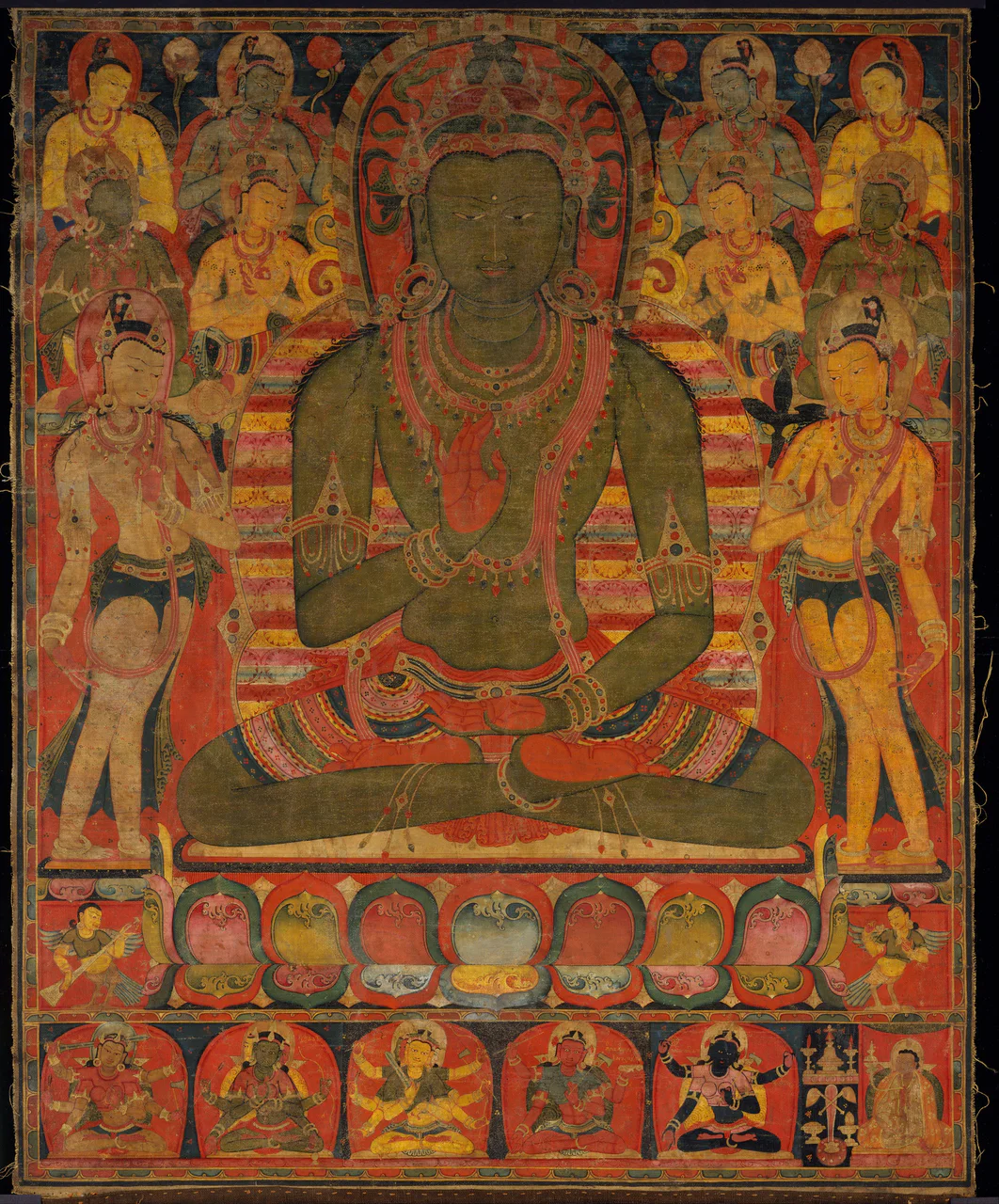
Buddha Amoghasiddhi with Eight Bodhisattvas
Unknown artist · Central Tibetca. 1200–50Distemper on cloth68.9 × 54 cm
At a glance
- A green-skinned Buddha, Amoghasiddhi, sits on a lotus throne with his right hand raised, surrounded by bodhisattvas.
- An unnamed painter made it in Central Tibet around 1200 to 1250, using distemper on cloth.
- One cloth about 27 inches tall holds a whole layered world: Buddha, bodhisattvas, winged musicians, many-armed deities and a monk.
Reading the picture
5 places to look closer
Tap a number on the painting to jump to its note, or a close-up to see that spot in the whole picture.
Start with the face. The skin is a deep olive green. The eyes are half closed, and a small dot sits in the middle of the forehead. A pointed crown set with red jewels rises above.
Now zoom in on the right hand, lifted in front of the chest. The red palm faces you and the fingers point straight up. This is the gesture Amoghasiddhi always makes, usually read as do not be afraid. Look at the beads, red and dark, hanging from every necklace and bracelet.
Look at the golden bodhisattva standing on the right. His head tilts, and his hip swings out to one side, so his whole body curves. The Buddha in the middle sits perfectly still. The figures beside him seem ready to move.
In the red panel at lower left is a figure with a human face and the wings and legs of a bird. He holds a long-necked string instrument at an angle and plays it. He is a heavenly musician.
Go to the far bottom right. A monk in an orange robe sits there. In the dark panel beside him are a tiny stupa, burning lamps and offering bowls. Tibetan paintings often placed a monk performing a ritual, or the person who paid for the painting, in this bottom row.
When it was painted
When this was painted, in the first half of the thirteenth century, monks from India were living and teaching in Tibet. The great Buddhist monasteries of northeastern India were being destroyed in invasions, and many monks moved on to Nepal and Tibet. The Kashmiri master Shakyashribhadra arrived in Tibet in 1204 and taught there for years.
Early painting in Central Tibet closely followed the Buddhist art of northeastern India under the Pala kings. The Met points out that the bodhisattvas' pointed crowns link this work to the wall-painting tradition of Drathang monastery in Central Tibet. Amoghasiddhi himself is the Buddha of the north among the Five Buddhas, and his name means unfailing success.
Meanwhile, to the north, the Mongols were growing in power. Mongol troops entered Tibet in 1240. A few years later, the Sakya master Sakya Pandita set out on a long journey to meet the Mongol prince Köden. That meeting began a relationship between Tibet and the Mongols that would last a long time.
The painter's name was not recorded. Made with mineral pigments mixed with glue on cloth, the painting came to the Metropolitan Museum in 1991.
Look again at the Buddha's raised right hand. In unsettled years, with monks arriving from India and leaving for the Mongol court, the painter set that one gesture at the very center of the cloth.
Questions to think about
- Look for itAround the Buddha, how many bodhisattvas are standing, and how many are seated?
- Why?Why do you think the painter made the Buddha large and upright but let the bodhisattvas sway?
- What about you?If you could make the do not be afraid gesture to someone today, who would it be, and what would you say?
Too good to keep to yourself
This painting,
for someone who comes to mind
They open it at full size
and see every brushstroke.
About this work
- Artist
- Unknown artist · Central Tibet
- Date
- ca. 1200–50
- Medium
- Distemper on cloth
- Size
- 68.9 × 54 cm
- Culture
- Central Tibet
- Collection
- The Metropolitan Museum of Art
- Image
- Original long edge 3704px · shown at 2560px
- Original
- View on the museum's website ↗