 Pyeongye
Artwork · 13th century · Duccio di Buoninsegna
LeoTurn on Magnifier at the lower right and move slowly across the painting.
Full screen opens it edge to edge.Tap the painting to fill the screen.
Spread two fingers to look closer.
At a glance
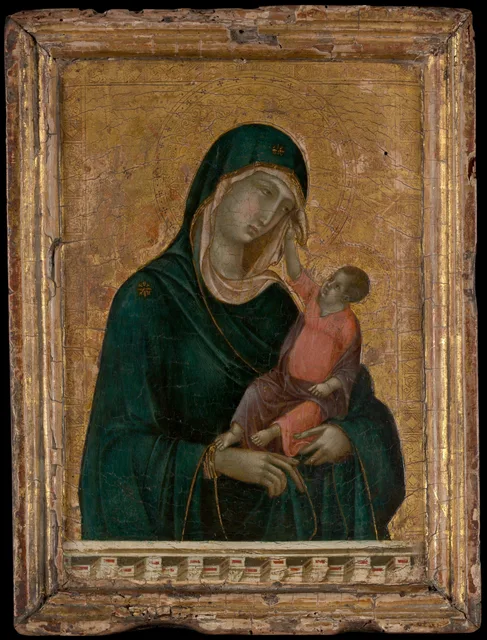
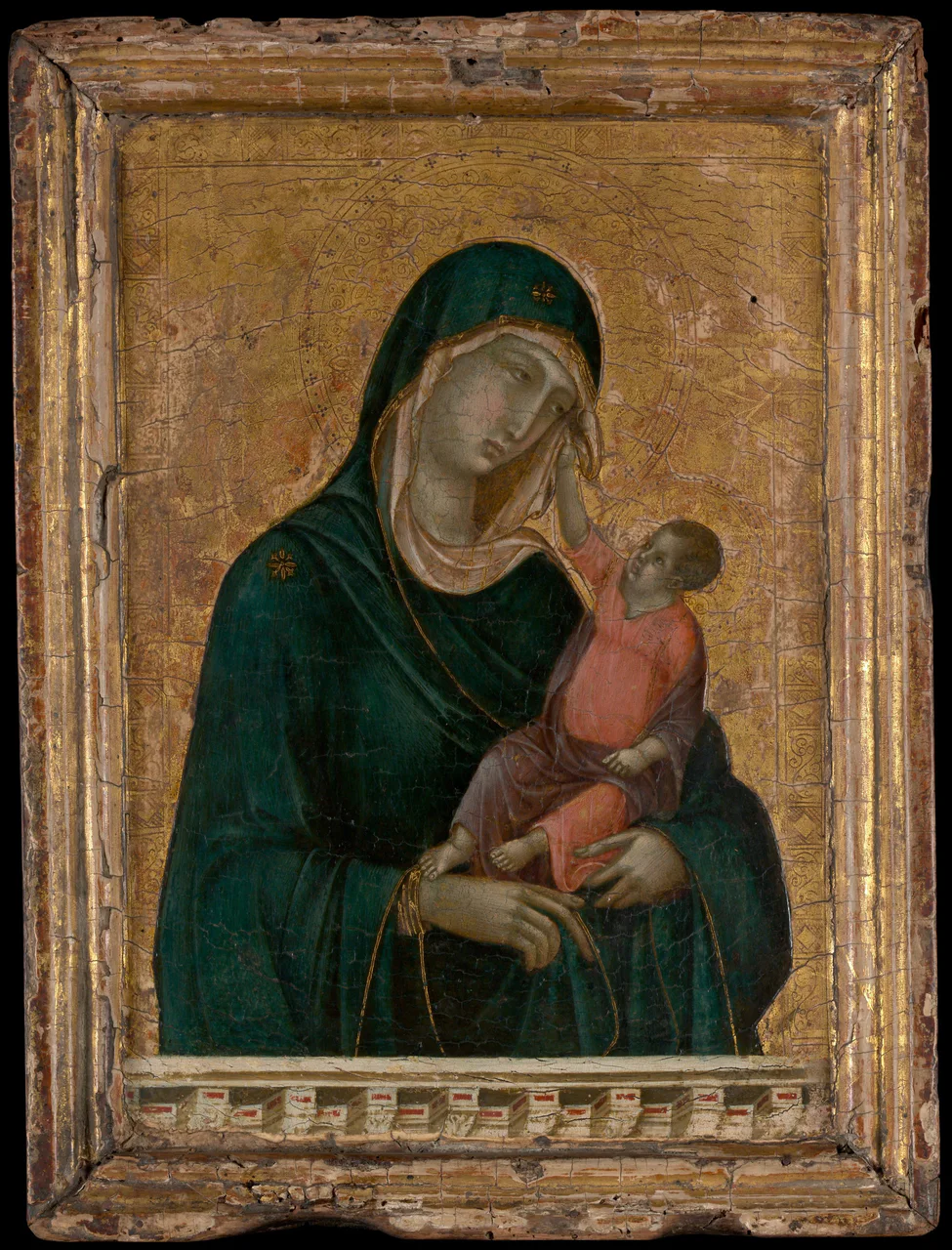
- Mary, in a deep green cloak, holds the infant Jesus, who reaches up and tugs at the edge of her veil.
- Duccio di Buoninsegna, a painter from Siena in Italy, made it around 1290–1300 in tempera and gold on wood.
- Even with its frame it is only about 28 centimeters tall, a little bigger than a notebook, and its original frame is still attached after some seven hundred years.
Reading the picture
5 places to look closer
Tap a number on the painting to jump to its note, or a close-up to see that spot in the whole picture.
Zoom in on Mary's face. A long nose, almond eyes, and a small mouth stand out crisply against the gold. She holds her child, yet she is not looking at him. Her expression carries less joy than a quiet worry.
Look at the baby's hand. He stretches out a chubby arm and grabs the end of his mother's white veil. His head tips back as he gazes up at her face. It is the kind of thing any baby might do.
Zoom in on Mary's shoulder at the left. A single gold star shines on the green cloak. There is another one on the cloak above her forehead. Marking Mary with stars is a very old tradition.
Look at Mary's hand and the baby's feet. His small bare feet rest just above her long, thin hand. A fine gold line runs down the edge of her cloak.
Look at the very bottom of the picture. A band painted like a stone ledge runs in front of Mary. A row of blocks marked with red sits along it, so it feels as if we are looking at her over a parapet. Below it, the wooden frame is marked here and there with dark patches.
When it was painted
In 1285, a religious confraternity in Florence hired a painter from neighboring Siena. They wanted a huge Madonna, far taller than a person, for the church of Santa Maria Novella. The contract still survives. Duccio was already famous enough to be called in from another city.
He was not always a model citizen, though. Siena's city records show him paying fines again and again. He also ran up debts, and after his death his children refused to accept his estate. This small Madonna and Child dates from around 1290–1300.
There was also a day all of Siena remembered. In 1311, when his great altarpiece for the cathedral, the Maestà, was finished, the townspeople carried it in procession from his workshop to the cathedral. This little panel is a very different kind of object. It is thought to have been made for prayer at home.
Its first recorded owner was the Russian count Grigorii Stroganoff, who lent it to a large exhibition of early Sienese art in Siena in 1904. That is why it is often called the Stroganoff Madonna. Later it passed to the Belgian collector Adolphe Stoclet, and his family kept it for generations.
In 2004 the Metropolitan Museum bought it. It was the last known painting by Duccio still in private hands. Look again at the dark patches along the bottom of the frame. The museum reads them as burns from candles lit below the picture, the marks of people who prayed in front of it long ago.
Questions to think about
- Look for itCan you find the circular patterns of the halo cut into the gold background?
- Why?Why do you think Duccio gave Mary a worried look instead of a happy one while she holds her baby?
- What about you?Seven hundred years ago, people kept this little picture close and prayed in front of it. What do we keep near us today to steady ourselves, and what does it actually give us?
Same period
Painted around the same time,
somewhere else
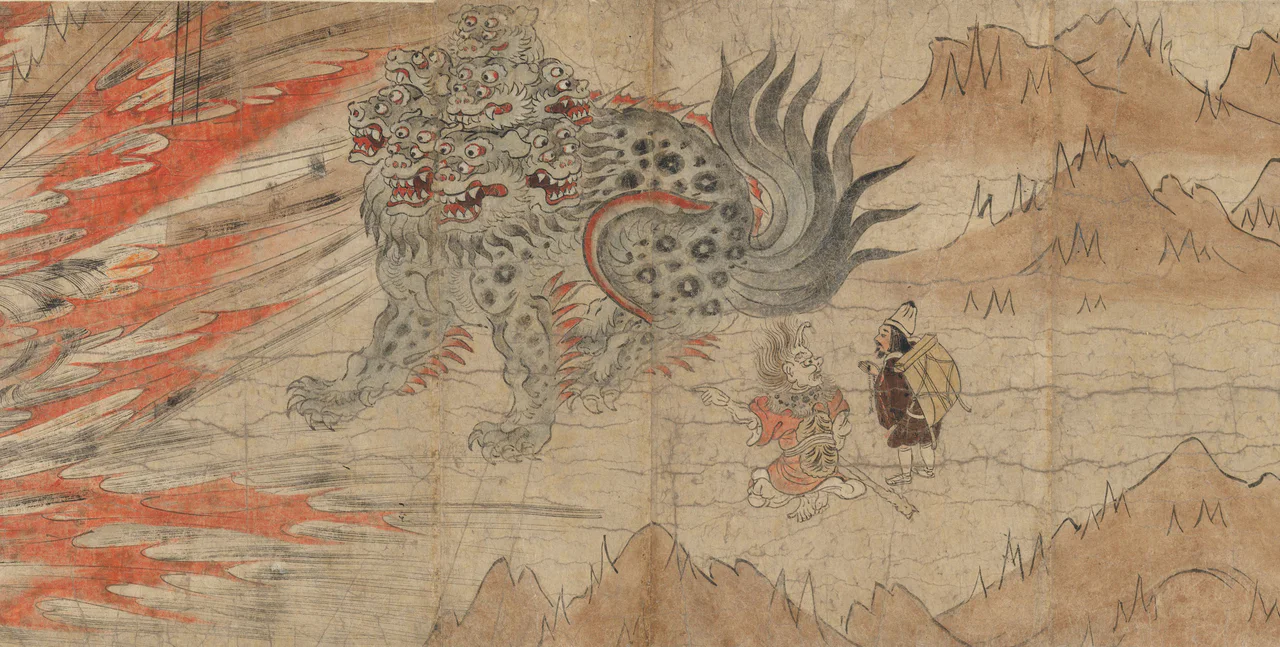 Illustrated Legends of the Kitano Tenjin Shrine (Kitano Tenjin engi emaki)Unknown artist · Japanlate 13th century
 Acala, The Buddhist ProtectorUnknown artist · Nepal, Kathmandu Valleyequivalent to February / March 1322
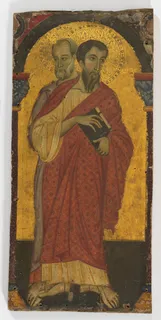 Saints Bartholomew and SimonMaster of Saint Francisca. 1272
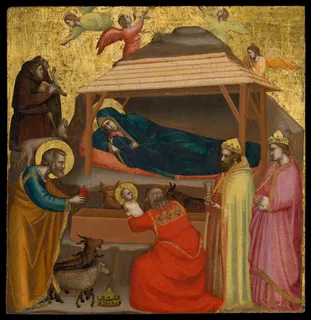 The Adoration of the MagiGiotto di Bondonepossibly ca. 1320
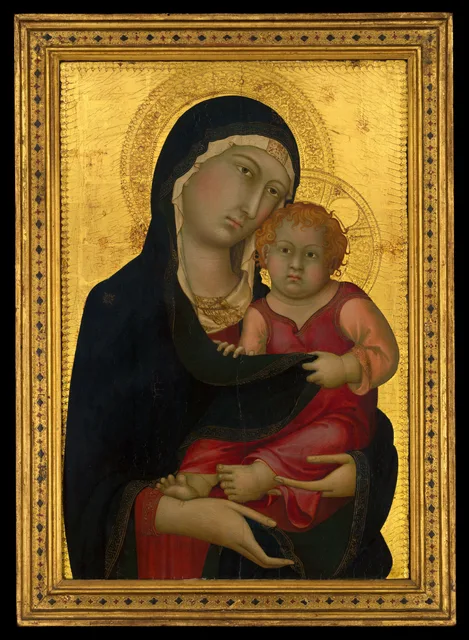 Madonna and ChildSimone Martinica. 1326
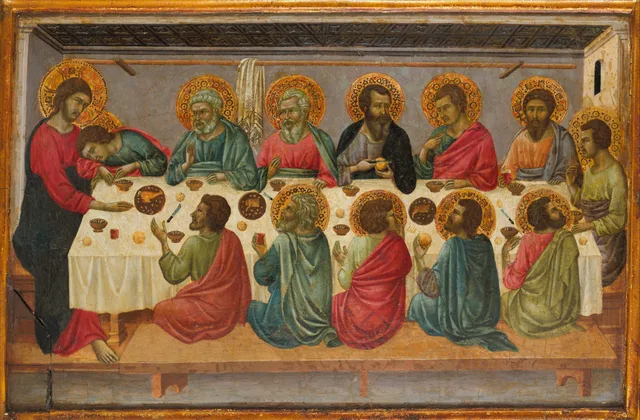 The Last SupperUgolino da Sienaca. 1325
Too good to keep to yourself
This painting,
for someone who comes to mind
They open it at full size
and see every brushstroke.
About this work
- Artist
- Duccio di Buoninsegna · 1278–1318
- Date
- ca. 1290–1300
- Medium
- Tempera and gold on wood
- Size
- 27.9 × 21 cm
- Collection
- The Metropolitan Museum of Art
- Image
- Original long edge 3542px · shown at 2560px
- Original
- View on the museum's website ↗