 Pyeongye
Artwork · 13th century
LeoTurn on Magnifier at the lower right and move slowly across the painting.
Full screen opens it edge to edge.Tap the painting to fill the screen.
Spread two fingers to look closer.
Illustrated Legends of the Kitano Tenjin Shrine (Kitano Tenjin engi emaki)
Unknown artist · Japanlate 13th centurySet of five handscrolls; ink, color, and cut gold leaf (kirikane) on paper28.8 × 689.4 cm
At a glance
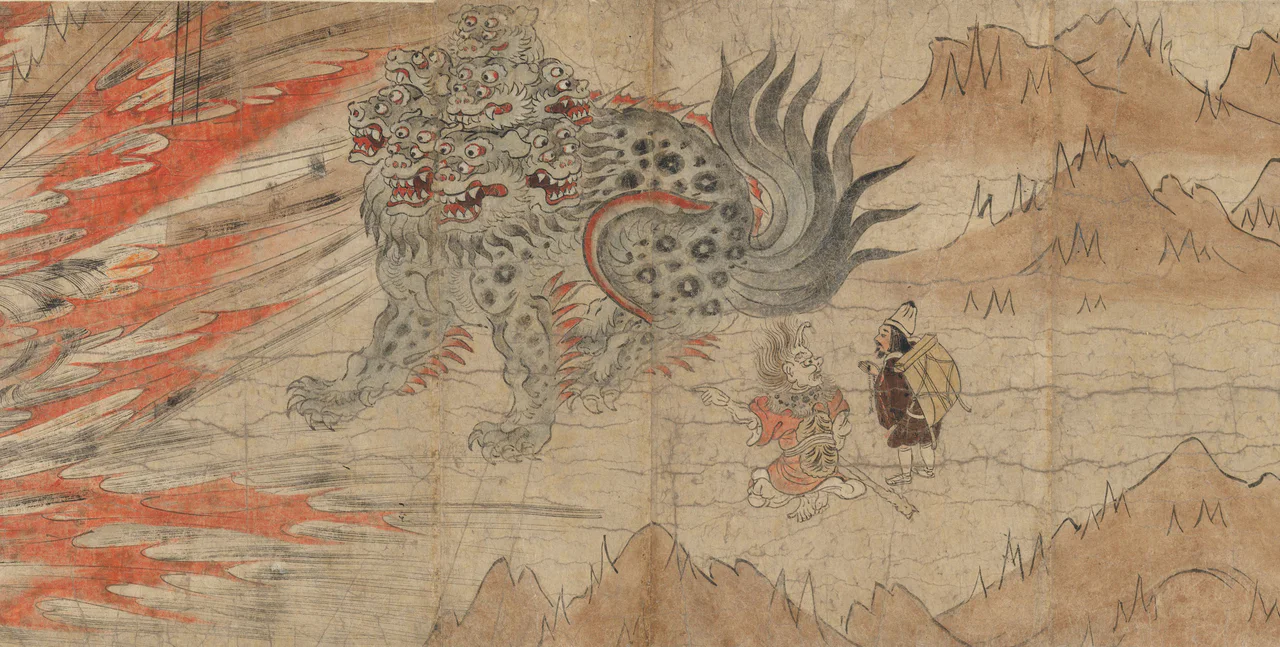
- A spotted, many-headed beast, rushing flames, a pointing demon and a traveler holding prayer beads all meet in one scene.
- An unnamed artist in Japan made this set of five handscrolls in the late thirteenth century, with ink, color and cut gold leaf on paper.
- The scrolls are only about 11 inches tall, but each runs from roughly 19 to 29 feet long. Together they tell, in pictures and words, how the god of the Kitano Shrine came to be.
Reading the picture
5 places to look closer
Tap a number on the painting to jump to its note, or a close-up to see that spot in the whole picture.
Zoom in on the beast's heads. Close to ten lion-like faces are piled on top of one another. Every eye has a red rim, and the open mouths bare white fangs and red tongues. Each head glares in a different direction, as if there is nowhere to hide.
Move to the beast's back end. Its gray tail splits into many strands and shoots upward like flames. The body is crowded with dark ring-shaped spots, and red fur juts out behind the legs like little blades.
Look at the far left edge. Red paint and fine ink lines sweep across at a slant. It feels as if fire and a fierce wind are pouring out from the beast. The artist drew line after line in the same direction to create that speed.
Now find the demon sitting in front of the beast. His hair stands up like fire, and his eyes bulge. A spotted hide hangs around his neck, and a striped hide wraps his waist. He stretches one arm out to point at something.
Next to him stands a traveler. He has a beard and a white cap, and a big box-like pack sits on his back. Prayer beads hang from his pressed-together hands. He looks like someone praying as he is shown the way past the beast and the demon.
When it was painted
In 903, a scholar died far from home in Dazaifu, on the island of Kyushu. He was Sugawara no Michizane, a poet and scholar who had risen to Minister of the Right at court. In 901 he was slandered and sent away from the capital, and two years later he died in exile.
Then trouble came to Kyoto. In 930, lightning struck a hall of the imperial palace and killed court officials. People thought of Michizane's angry spirit, and in 947 a shrine to him was founded at Kitano in Kyoto. That is how Michizane became the god Kitano Tenjin.
These scrolls were made in the late thirteenth century, some 350 years later. More than thirty sets of scrolls telling Michizane's life and the rise of his worship survive. The Met ranks this set of five second in age and quality only to the early thirteenth-century scrolls kept at the Kitano shrine itself. The painter's name was not recorded.
According to the Met, the scrolls include a scene in which two blue dragons come out of a minister's ears and announce Michizane's plan to avenge his unjust exile and death. Follow the frightening scenes, and you watch one man's grievance turn into a religion.
The scrolls themselves have traveled far. They were handed down at Taisanji, a temple in Igawadani near Kobe. In the Meiji era they belonged to the statesman Marquis Inoue Kaoru. Then, in 1925, they came to the Met, bought with the Fletcher Fund.
Look again at the traveler holding prayer beads. He stands before the flames and the many-headed beast. After more than 700 years of temples, private homes and an ocean crossing, he is still standing at the edge of that frightening road.
Questions to think about
- Look for itHow many heads does the beast have, and is any of them keeping its mouth closed?
- Why?Why would a story about a man wrongly sent into exile be told alongside such frightening beasts and flames?
- What about you?People who were treated unfairly still sometimes get their good name back only after they die. What would it take to set things right while they are still alive?
Same period
Painted around the same time,
somewhere else
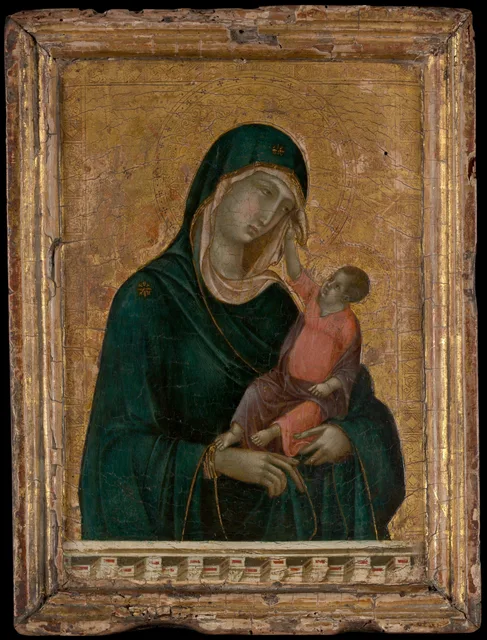 Madonna and ChildDuccio di Buoninsegnaca. 1290–1300
 Saints Bartholomew and SimonMaster of Saint Francisca. 1272
 Acala, The Buddhist ProtectorUnknown artist · Nepal, Kathmandu Valleyequivalent to February / March 1322
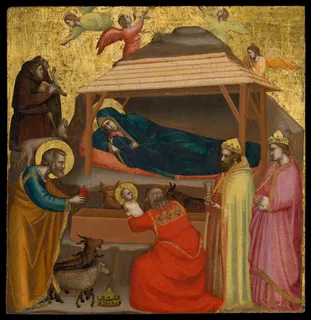 The Adoration of the MagiGiotto di Bondonepossibly ca. 1320
 Madonna and ChildSimone Martinica. 1326
 The Last SupperUgolino da Sienaca. 1325
Too good to keep to yourself
This painting,
for someone who comes to mind
They open it at full size
and see every brushstroke.
About this work
- Artist
- Unknown artist · Japan
- Date
- late 13th century
- Medium
- Set of five handscrolls; ink, color, and cut gold leaf (kirikane) on paper
- Size
- 28.8 × 689.4 cm
- Culture
- Japan
- Collection
- The Metropolitan Museum of Art
- Image
- Original long edge 3509px · shown at 2560px
- Original
- View on the museum's website ↗