Pyeongye
Painters · 14th century
Simone Martini
1315–1344
A painter from Siena who carried his gold-ground pictures from the walls of his city hall to the court of the king of Naples and on to the papal city of Avignon.
Scenes from a life
The life of Simone Martini,
scene by scene
- 1315Siena
In the great council hall of Siena's town hall, a huge Virgin appears across an entire wall. Angels and saints crowd around her throne under a canopy. This is the Maestà, painted in the very room where the city's rulers met. Simone Martini signed the fresco and put the year 1315 on it.
Six years later, in 1321, Simone stood in front of the same wall again. He repainted parts of the fresco. He was back repairing his own work.
- 1317Naples
In July 1317 King Robert of Naples knights the painter from Siena. The king also grants Simone a yearly income of fifty ounces of gold. A painter had become a royal knight.
That same year Simone painted Saint Louis of Toulouse for the king. Louis was Robert's older brother, who gave up his right to the throne to become a friar. In the picture the saint sits enthroned and places a crown on the head of the kneeling Robert.
- 1324Siena
Simone marries Giovanna. Her father, Memmo di Filippuccio, was a painter, and so was her brother, Lippo Memmi. With this marriage Simone joined a Sienese family of painters, and his brother-in-law Lippo went on to work beside him for years.
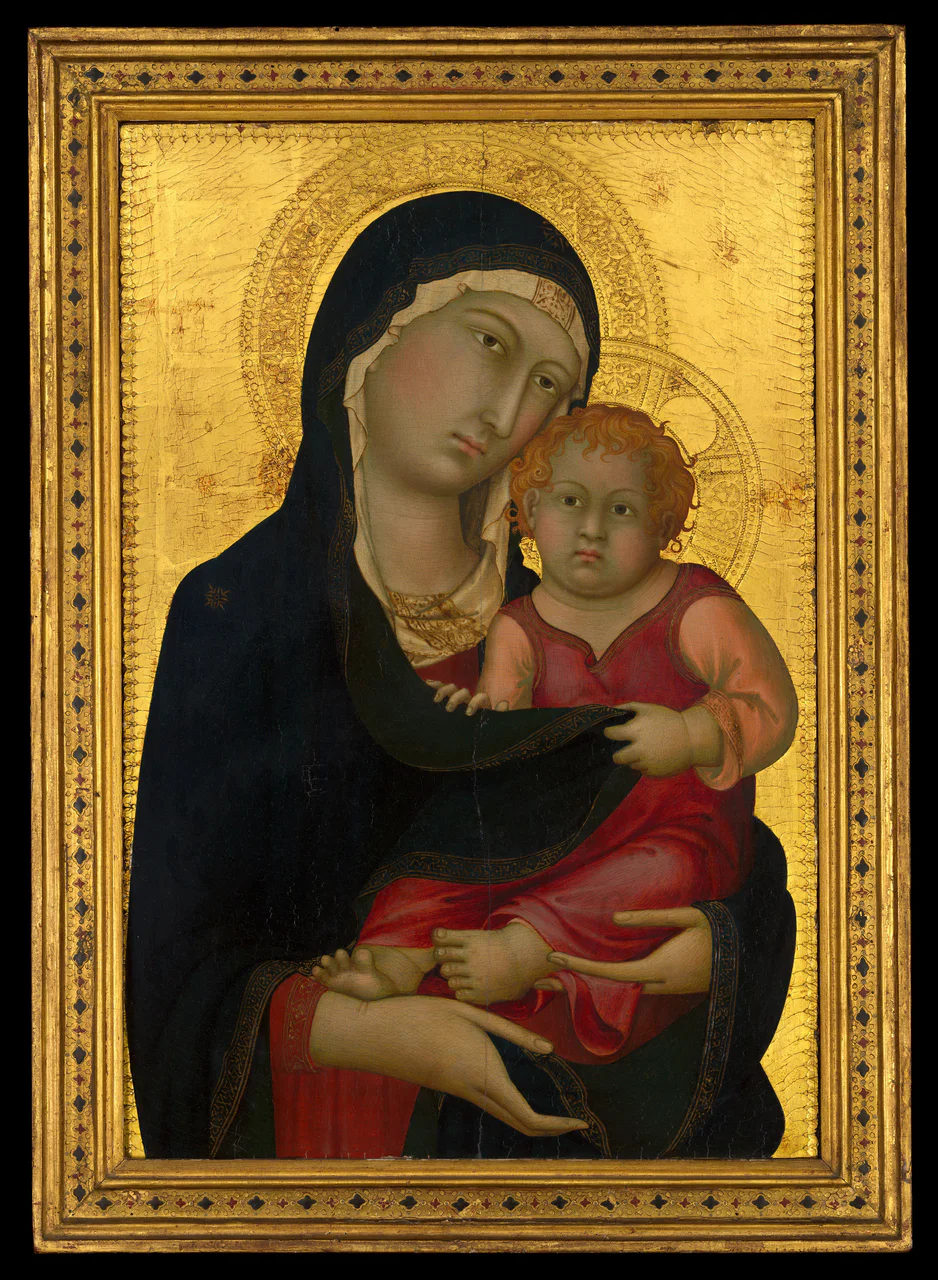
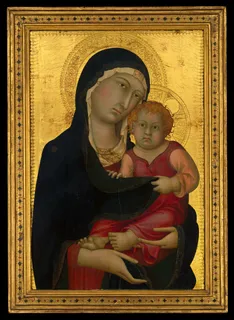
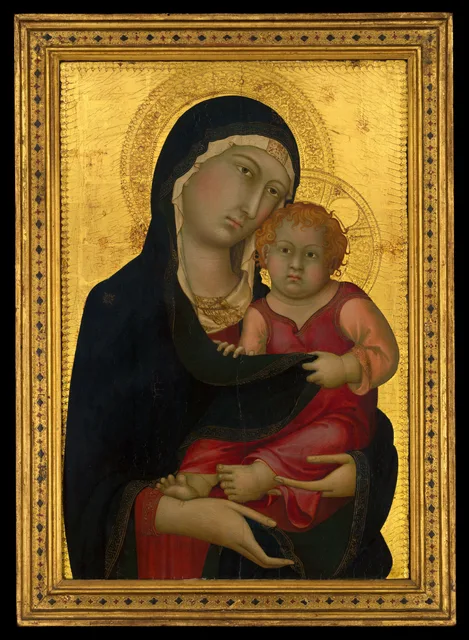
The Madonna and Child dates from a few years later. The Virgin, in a dark mantle, tilts her head so her cheek rests against the child's curls. The baby, red-haired and dressed in red, grips the edge of her mantle in his small hand.
 Painted around this timeMadonna and Child
- 1330Siena
In 1330 the city of Siena enters a payment to Simone in its accounts. It is for painting two castles, Montemassi and Sassoforte, on the walls of the town hall. Both had recently been taken by Siena's troops.
The same room holds a famous fresco of a general riding past a castle, Guidoriccio da Fogliano. It was long taken for Simone's work, but since the late 1970s scholars have argued over whether he really painted it.
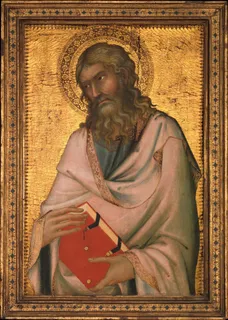
A few years earlier he had painted a five-part altarpiece. One of its panels is Saint Andrew. The bearded saint stands against gold, holding a red book with both hands and glancing to the side.
Painted around this timeSaint Andrew - 1333Siena
A new altarpiece is set up in Siena Cathedral. It is an Annunciation for the altar of Saint Ansanus, one of the city's patron saints. Two names are written beneath it, Simone Martini and his brother-in-law Lippo Memmi, with the year 1333.
On a field of gold the angel Gabriel kneels and greets the Virgin, who shrinks back from him. The altarpiece is now in the Uffizi in Florence.
- 1330sAvignon
Simone settles in Avignon, the city in southern France where the popes then lived. There he became close to the poet Petrarch. Simone painted a portrait of Laura, the woman Petrarch loved, and the poet wrote two sonnets about it. One line runs, Ma certo il mio Simon fu in paradiso: surely my Simone had been to paradise.
The portrait of Laura is lost. But the picture Simone painted on the opening page of Petrarch's own copy of Virgil survives in the Biblioteca Ambrosiana in Milan. Simone died in Avignon in the summer of 1344.
People around them
- King Robert of Napleshe knighted Simone and granted him a yearly income in gold.
- Giovannahis wife from 1324, daughter of the painter Memmo di Filippuccio.
- Lippo Memmihis brother-in-law, who signed the 1333 Annunciation with him.
- Petrarchthe poet he knew in Avignon, who praised Simone's portrait of Laura in two sonnets.
Contemporaries