 Pyeongye
Artwork · 14th century · Simone Martini
LeoTurn on Magnifier at the lower right and move slowly across the painting.
Full screen opens it edge to edge.Tap the painting to fill the screen.
Spread two fingers to look closer.
At a glance
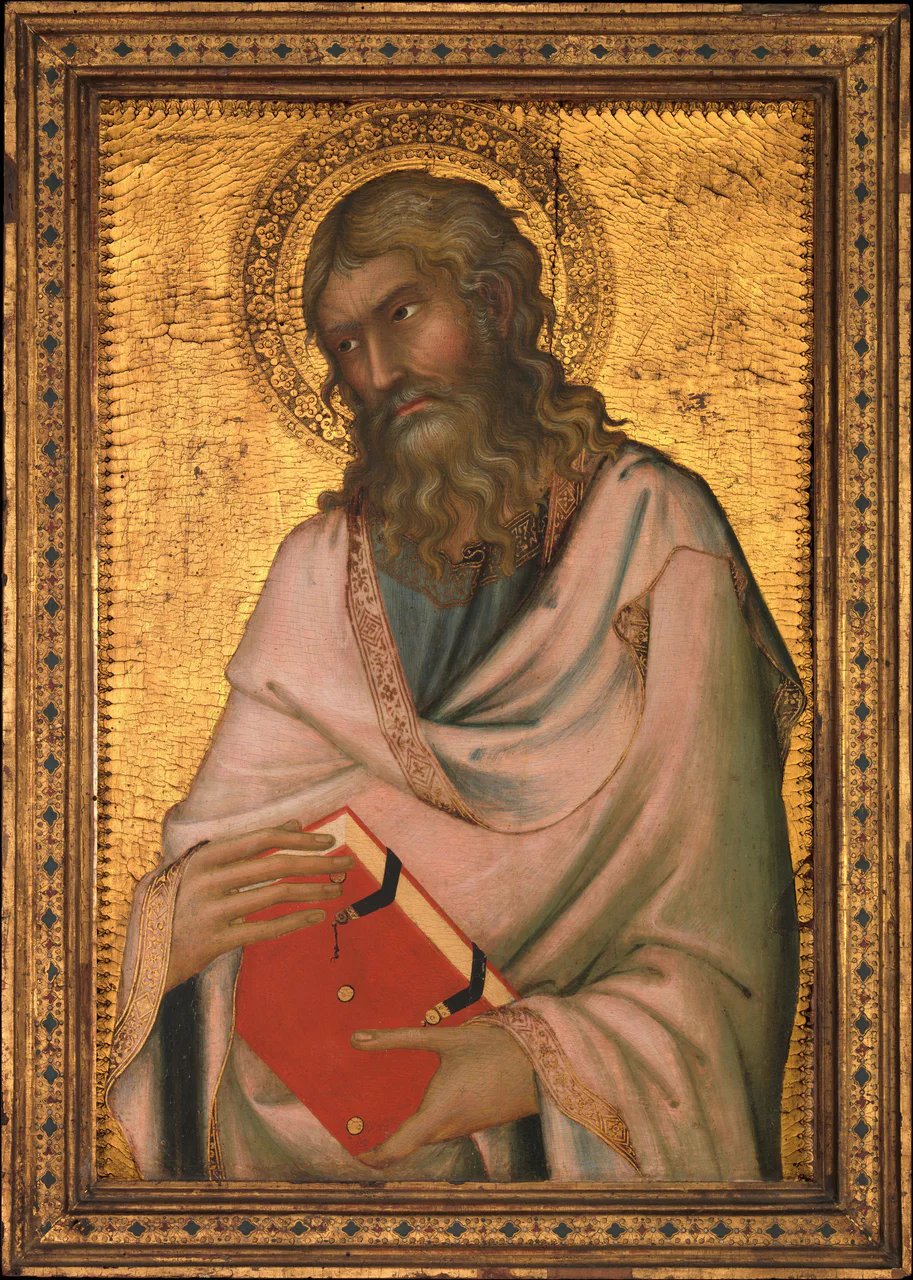
- The apostle Andrew, with a long beard, holds a red book in both hands against a background of gold.
- The Sienese painter Simone Martini made it around 1326 in tempera and gold leaf on a wooden panel.
- The panel is only 57 centimeters tall, yet every strand of hair and every tiny mark in the gold was worked by hand.
Reading the picture
5 places to look closer
Tap a number on the painting to jump to its note, or a close-up to see that spot in the whole picture.
Zoom in on the halo behind his head. Little flower shapes rise from the gold like bumps. They were not painted. They were pressed in one by one with small metal punches. In flickering candlelight, each dent would have caught the light on its own.
Look at his face. His brow is creased, and his eyes slide off to the left, watching something we cannot see. His wavy beard and hair are made of countless fine lines laid side by side. Across the surface, a web of tiny cracks shows the painting's age.
Now zoom in on the red book. Two black leather straps wrap around the cover, each ending in a gold clasp. Round metal studs are set into the cover. One strap end has come loose, and a few threads dangle from it.
Follow the edge of his pink cloak. Along its border band, small brown flowers and vines have been painted in. Inside it, you can see a deep blue-green robe. The pink and the blue-green make each other look brighter.
Zoom in on the frame at the left. Dark blue-green and red four-lobed shapes alternate along the gilded molding. Just inside, along the edge of the gold background, a row of rounded, wave-like marks has been stamped.
When it was painted
Around 1326, Simone Martini was one of the leading painters in Siena. Eleven years earlier he had covered a wall of the town hall's council chamber with a huge Maestà. For King Robert of Naples he had painted Saint Louis of Toulouse. In 1324 he married Giovanna, the sister of his fellow painter Lippo Memmi.
This panel is one of five that made up a portable altarpiece. The Met suggests it may have been ordered by the government of Siena itself. In the fifteenth century, the five panels served as the center of a larger altarpiece in the main chapel of the town hall.
Today the five are scattered. Saint Ansanus and the Madonna and Child are in the Met's Robert Lehman Collection. Saint Peter is at the Museo Thyssen-Bornemisza in Madrid, and Saint Luke is at the Getty Museum in Los Angeles. This Saint Andrew came to the Met in 1941 as a gift from George Blumenthal.
The panel also had a case of mistaken identity. For years it was credited to Lippo Vanni, a Sienese painter working decades later. In 1974 the art historian Miklós Boskovits argued that all five panels were by Simone, and that view is now widely accepted.
In the later 1330s Simone moved to Avignon, where the popes were living. There he became friends with the poet Petrarch. Petrarch praised Simone's portrait of Laura, the woman he loved, in two sonnets, though the portrait itself is lost. Simone died in Avignon in 1344.
Now look back at Andrew's eyes. They slide off to the left. When the altarpiece was whole, that is where the Madonna and Child sat, in the center panel.
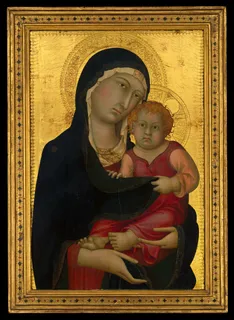
More by the same painter
Questions to think about
- Look for itOn the hand covering the top of the book, can you find the fingertip pressing lightly on one of the round metal studs?
- Why?Why do you think the painter filled the background with solid gold instead of sky or a room?
- What about you?Seven hundred years ago, people lit candles and prayed in front of pictures like this, so what screen do we gaze at quietly for a long time today, and what does it leave us with?
Same period
Painted around the same time,
somewhere else
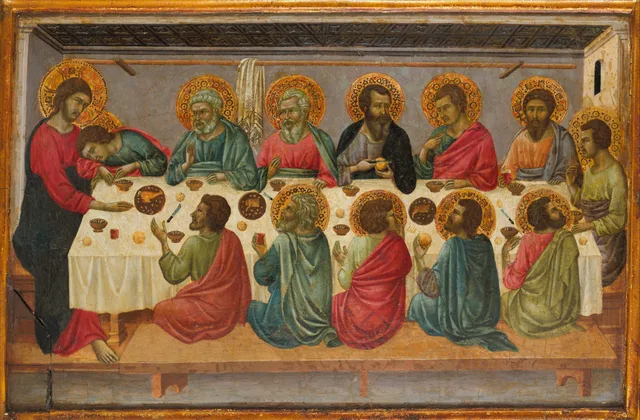 The Last SupperUgolino da Sienaca. 1325
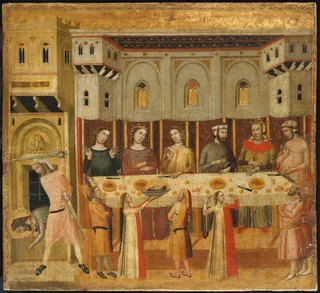 The Feast of Herod and the Beheading of the BaptistGiovanni Baronzioca. 1330–35
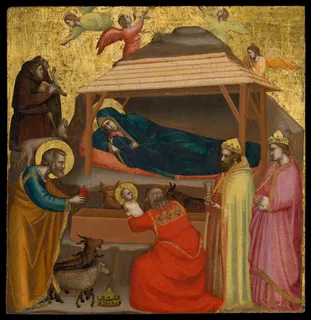 The Adoration of the MagiGiotto di Bondonepossibly ca. 1320
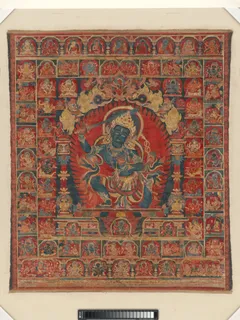 Acala, The Buddhist ProtectorUnknown artist · Nepal, Kathmandu Valleyequivalent to February / March 1322
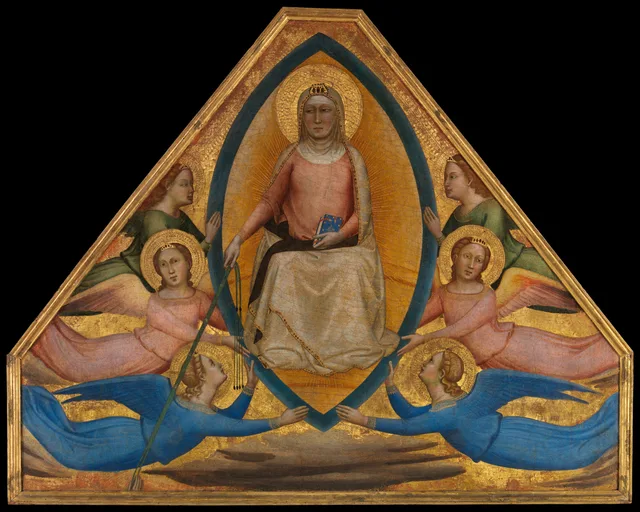 The Assumption of the VirginBernardo Daddi1337–38
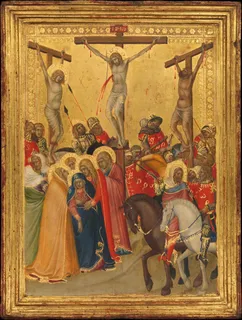 The CrucifixionPietro Lorenzetti1340s
Too good to keep to yourself
This painting,
for someone who comes to mind
They open it at full size
and see every brushstroke.
About this work
- Artist
- Simone Martini · 1315–1344
- Date
- ca. 1326
- Medium
- Tempera on wood, gold ground
- Size
- 57.2 × 37.8 cm
- Collection
- The Metropolitan Museum of Art
- Image
- Original long edge 3883px · shown at 2560px
- Original
- View on the museum's website ↗