Pyeongye
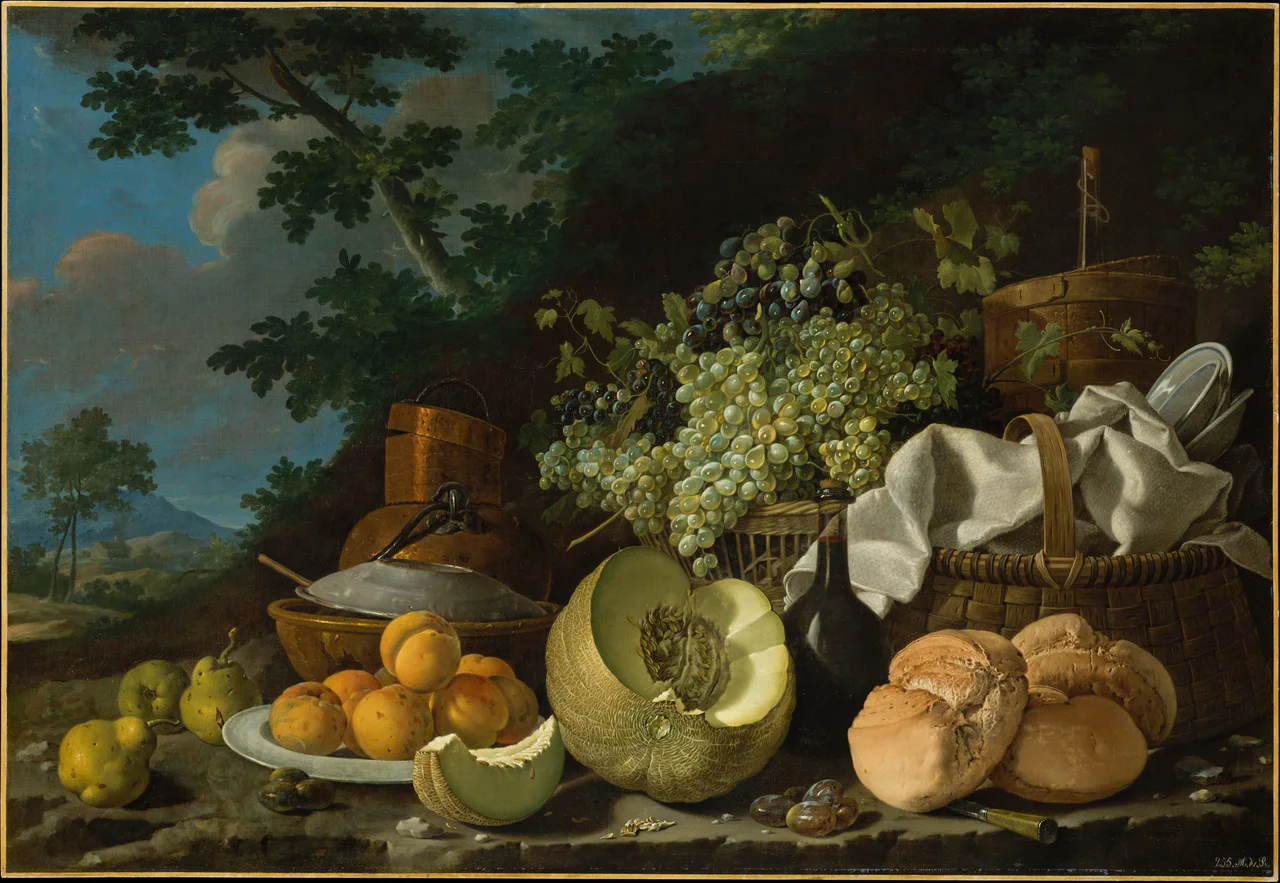
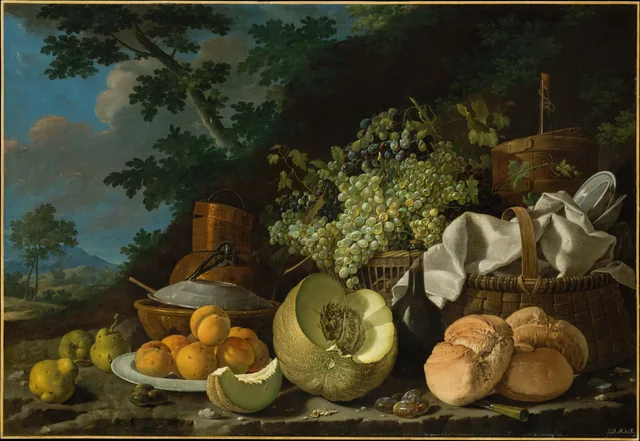
This picture makes you hungry. In the middle, a basket overflows with green and dark grapes. In front of it, a melon has been cut open to show its insides. On the left, a plate is heaped with orange fruit. But the thing that holds your eye longest is not the fancy fruit. It is three plain loaves of bread in the lower right.
The painting is called The Afternoon Meal (La Merienda). A merienda is the light snack Spaniards eat in the afternoon. The painter, Luis Meléndez, was an eighteenth-century Spanish artist. He was born in Naples in 1716 and died in Madrid in 1780. He made this picture around 1772.
Get close to the loaf at the front.
The top of the round loaf has split wide open. The outer crust is smooth and golden brown. Through the crack you see the paler, rougher bread inside. Its fibers stand up as if they had been pulled apart, and it is full of tiny holes.
Crust and crumb are nearly the same brown, yet they look completely different. The crust is painted with soft, even strokes that leave it shiny. The crumb is built from short, light dabs laid over each other, so it looks dry and crumbly. You can almost feel it shedding crumbs on your fingers. Meléndez even painted the small dark specks dotted across the crust.
Did the loaf burst open in the oven, or did someone tear it? The painting does not say. But there is a clue just underneath.
A knife lies tucked under the bread. The blade disappears below the loaf, and only the yellow handle points out toward us. A thin band of metal between handle and blade catches a small, bright spark of light. It feels as if someone is about to pick it up.
Meléndez gave every surface this kind of attention. On the melon rind he drew a net pattern, line by line. On the fruits lying on the ledge in front, which look like plums, a whitish bloom sits on the dark skin. Smooth, rough, and dusty things all share one table.
The containers behind them each shine in their own way. On the left, a copper vessel with an iron handle glows red. In front of it, a gray lid rests at a tilt on a yellowish basin. At the upper right, the neck of a bottle, tied with cord, pokes out of a wooden tub. All of it is laid out on a large canvas, more than a meter and a half wide.
Meléndez painted a large group of still lifes for the Spanish royal family. Most of them are now in the Prado Museum in Madrid. Yet he never won the post of court painter. His still lifes usually sit on a table against a dark background. This one is different. Behind the food, trees, sky, and distant hills open up outdoors.