 Pyeongye
Artwork · 18th century · Luis Meléndez
LeoTurn on Magnifier at the lower right and move slowly across the painting.
Full screen opens it edge to edge.Tap the painting to fill the screen.
Spread two fingers to look closer.
At a glance
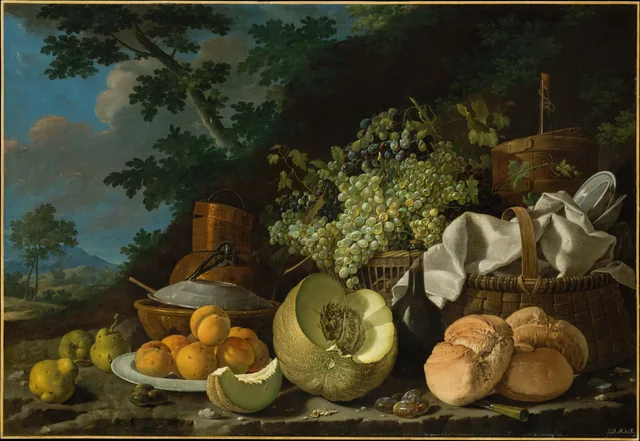
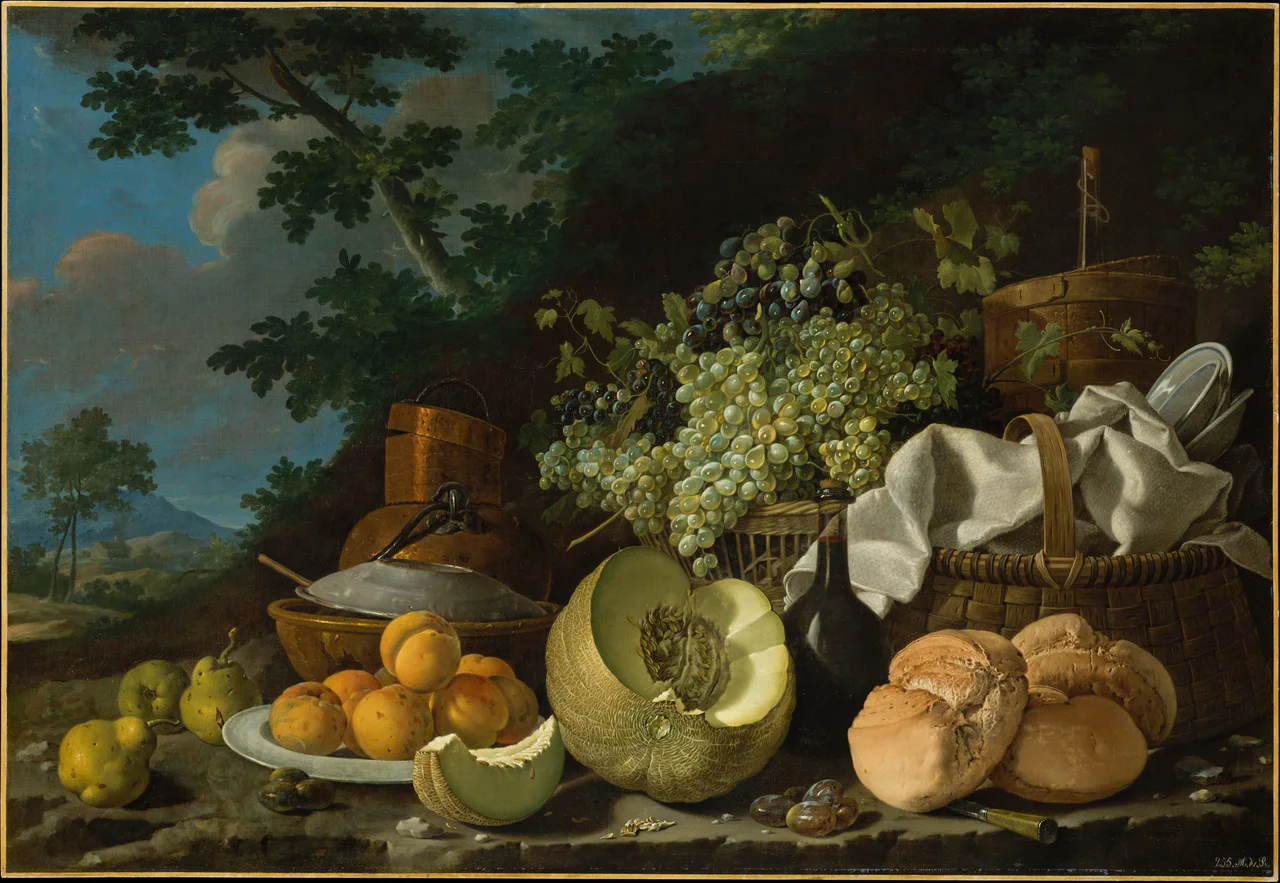
- Grapes, a melon, bread, copper pots, and a basket are spread out on a rock beneath shady trees.
- The Spanish still-life painter Luis Meléndez made it around 1772.
- There is not a single person in sight, yet it looks as if someone just cut the melon and set the basket down for a picnic.
Reading the picture
4 places to look closer
Tap a number on the painting to jump to its note, or a close-up to see that spot in the whole picture.
Start with the heap of grapes at the top center. Pale green grapes and dark purple ones spill over the edge of a basket. Each grape carries a small white spot of light, so they look firm enough to pop. Look closely and you will see a few that are starting to shrivel.
Drop down to the melon. Its rind is covered with a tight white net pattern, and the cut flesh inside is a soft green. In the middle, long seeds are tangled in stringy fibers. A separate slice lies in front of it, ready to eat.
Now the loaves at the lower right. Their crusts split open in the oven and curl up in crisp flakes. Underneath, a knife with a yellow handle pokes out toward us. That one knife makes it feel as though someone will be back any second to cut the bread.
Move left to the copper container. It has a lid and an iron loop handle, and in front of it sits a wide bowl covered with a pewter-gray plate. Meléndez laid strokes of orange and brown side by side on the copper, so the metal seems to shine.
When it was painted
Around 1772, Luis Meléndez was in his mid-fifties and living in Madrid. He made his living painting fruit, bread, and pots. What he wanted most was a post as painter to the king, and it never came.
His troubles started young. He was born in Naples in 1716, the son of a painter of miniatures, and trained at the art academy in Madrid. In 1748 his father fell out badly with the academy, and the son was thrown out too. He spent several years in Italy before coming back to Spain.
From about 1771 he worked on a series for the Prince of Asturias, the future Charles IV: still lifes meant to show, one by one, the foods grown on Spanish soil. Many of those canvases now hang in the Prado. Even so, his requests to be named a court painter were turned down. He died poor in Madrid in 1780.
Curators at The Met link this picture to the outings well-off Madrid families took into the countryside to escape the summer heat. They also think it probably once had a companion canvas of the same size, a landscape.
The painting passed through private collections in Madrid and elsewhere. It came to The Met in 1982 with the collection of Jack and Belle Linsky, and the terms of that gift mean it may not be lent. To stand in front of this picnic, you have to go to New York.
Meléndez usually set his food on a wooden table against a dark wall. Now look at the upper left. There is blue sky, a bank of clouds, and a hazy mountain in the distance. In this picture, at least, he carried the meal outdoors.
Hidden stories in this painting
Questions to think about
- Look for itCan you find the grapes in the pile that are starting to wrinkle and dry out?
- Why?Why do you think Meléndez left out the people and showed only a meal that seems half begun?
- What about you?A painter this careful never found steady work at court. Do we make it possible today for people with real skill to earn a living from it?
Same period
Painted around the same time,
somewhere else
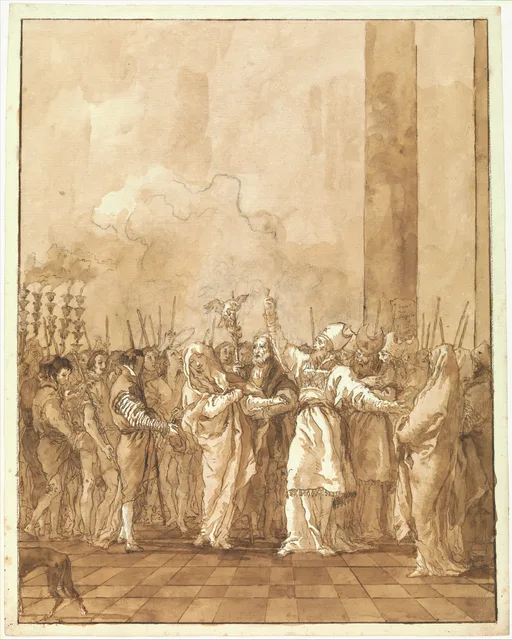 The Betrothal of the VirginGiovanni Domenico Tiepoloca. 1770
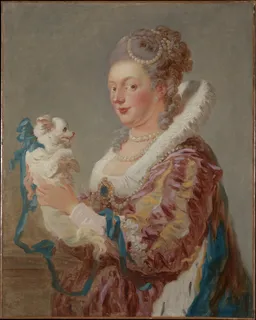 Marie Emilie Coignet de Courson (1716–1806) with a DogJean Honoré Fragonardca. 1769
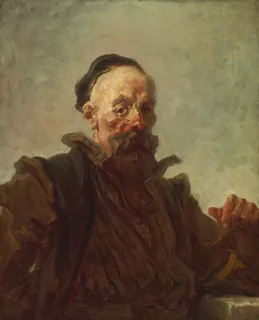 Portrait of a Man in CostumeJean Honoré Fragonardc. 1767–68
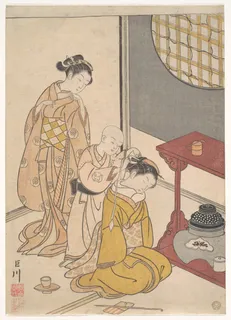 Night Rain at the Double-Shelf Stand, from the series Eight Parlor Views (Zashiki hakkei)Suzuki Harunobuca. 1766
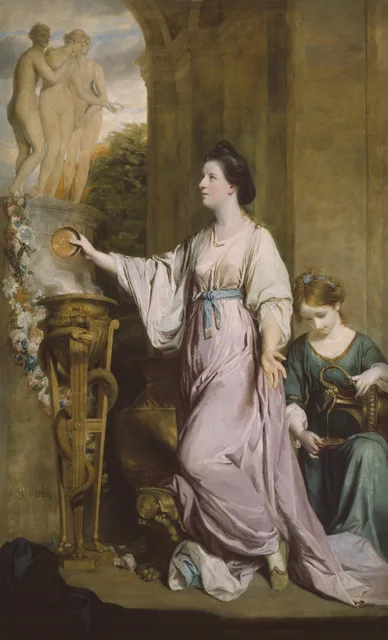 Lady Sarah Bunbury Sacrificing to the GracesSir Joshua Reynolds1763–65
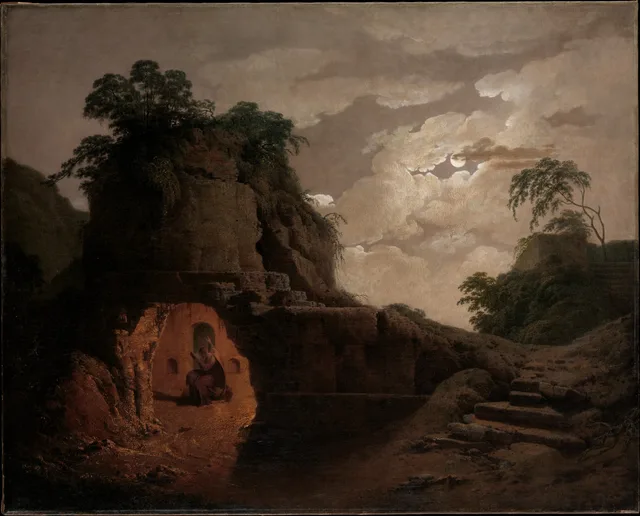 Virgil's Tomb by Moonlight, with Silius Italicus DeclaimingJoseph Wright1779
Too good to keep to yourself
This painting,
for someone who comes to mind
They open it at full size
and see every brushstroke.
About this work
- Artist
- Luis Meléndez · 1716–1780
- Date
- ca. 1772
- Medium
- Oil on canvas
- Size
- 105.4 × 153.7 cm
- Collection
- The Metropolitan Museum of Art
- Image
- Original long edge 3807px · shown at 2560px
- Original
- View on the museum's website ↗