 Pyeongye
Notes on this room's painting
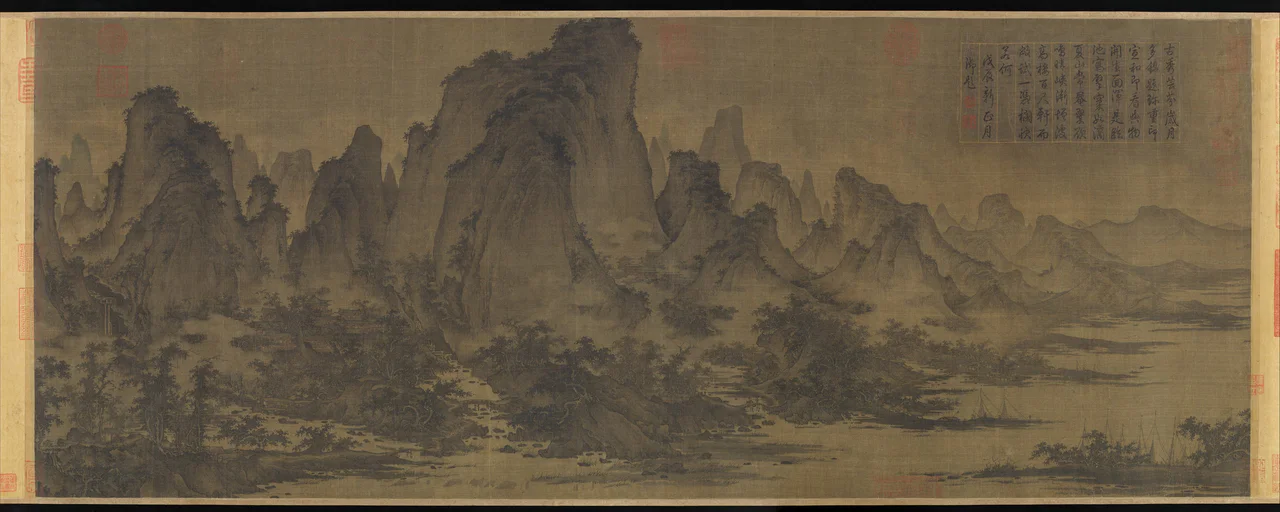
- Summer mountains: towering peaks above valleys, a bridge, buildings tucked into the hills, a waterside village and sailboats.
- Qu Ding, a Northern Song painter, made this handscroll in ink and light color on silk around 1050.
- The painting itself is about 45 inches long. Within it, mountains shoot upward while the water stretches far and flat.
Reading the picture
4 places to look closer
Tap a number on the painting to jump to its note, or a close-up to see that spot in the whole picture.
Zoom in on the tallest peak in the middle. Its rock walls rise straight up, and the summit and ridges are covered with trees dabbed on in dark ink dots. Lower down, the ink turns pale, so the mountain's waist seems wrapped in damp mist.
Look at the valley at lower left. Steps zigzag up the slope to buildings tucked among the trees. Below, a stream runs past, crossed by a small bridge. Even inside these huge mountains, there are paths where people come and go.
Now go to the shore at lower right. Two boats with tall masts float side by side, their ropes slanting down from the masts to the bows. You can just make out tiny people on deck. On the bank behind them, village houses cluster among the trees.
In the sky at upper right is a block of writing set in ruled columns. At the end are the characters 御題, meaning written by the emperor, and red seals. Inside the text you can spot 夏山, summer mountains, and 宣和, the reign name of Emperor Huizong of the Northern Song.
When it was painted
In the mid-eleventh century, in Kaifeng, the Northern Song capital, a painter named Qu Ding worked in Emperor Renzong's painting academy. The museum gives his active years as about 1023 to 1056. Song-dynasty records say he followed the style of the landscape painter Yan Wengui.
The museum is careful here, describing this scroll as attributed to Qu Ding. And there is a twist. The title written at the front of the scroll calls it Summer Mountains by Yan Wengui. The master's name and the follower's name end up sharing a single scroll.
The clue to its early date is in the seals. The museum notes that collector's seals of the Northern Song emperor Huizong support a date in that era. Huizong loved painting and greatly enlarged the imperial collection.
About seven hundred years later, the Qing emperor Qianlong unrolled it too. The writing in the sky at upper right is a poem he composed and added, dated to the first month of the wuchen year, 1748. Later the scroll belonged to the Wang family, and in 1973 it entered The Metropolitan Museum of Art as a gift of the Dillon Fund.
Look once more at the great peak in the middle. A Song emperor, a Qing emperor and many collectors unrolled this same mountain one after another. It is through this one summer landscape that Qu Ding's name still reaches us.
Questions to think about
- Look for itHow many places with houses or other buildings can you find in the painting?
- Why?Why do you think the painter made the people and boats so small beneath such huge mountains?
- What about you?Have you ever been somewhere that made you feel this small next to nature? What should we do less of to protect places like that?