 Pyeongye
Notes on this room's painting
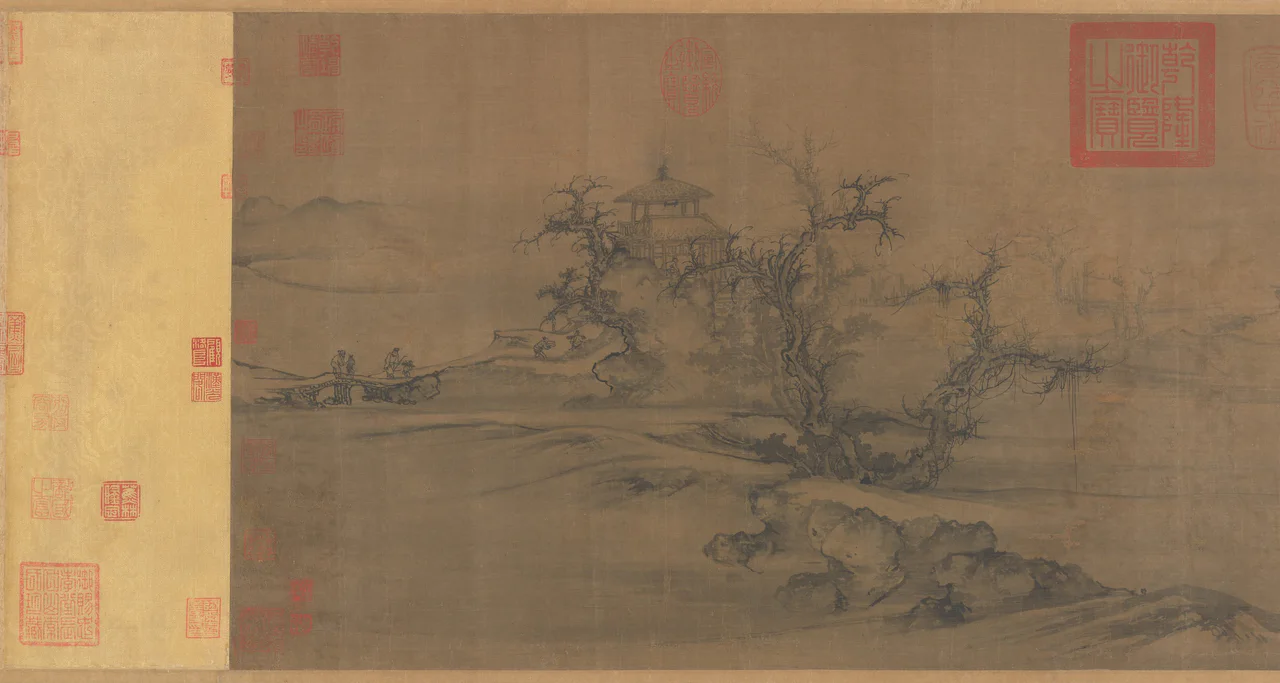
- In ink, a riverbank of twisted old trees, a pavilion behind them, travelers crossing a bridge and low mountains fading into the distance.
- Guo Xi, a court painter of the Northern Song dynasty, painted this handscroll on silk in ink and light color around 1080.
- Guo Xi described three ways of seeing distance in a landscape. Here he shows one of them, the view that stretches out flat and far.
Reading the picture
5 places to look closer
Tap a number on the painting to jump to its note, or a close-up to see that spot in the whole picture.
Zoom into the little bridge on the left. Two grown men are crossing, each with a small boy beside him. The man on the right leans on a long staff. The figures are no bigger than a fingernail, yet you can see them stepping forward.
A pavilion rises among the old trees. A second roofed story sits on top of the lower building, and its railings and posts are drawn in thin ink lines. It looks like the place the travelers are heading to rest.
Look at the tips of the branches. The small twigs bend downward and hook at the ends. Because they look like a crab's claws, this way of drawing branches is called crab-claw branches. Guo Xi and the painters who followed him used it often.
Zoom in on the rocks below. The ink was thinned with water and laid on so it spreads, which makes the rocks round and soft, like lumps of cloud. Only the edges are pressed in darker ink, so the forms seem to swell toward you.
Find the big red seal at the upper right. It reads 乾隆御覽之寶, a seal saying the Qianlong Emperor viewed this work. Seals scattered across the scroll are traces of the many collectors it passed through over hundreds of years.
When it was painted
Around 1080, in Kaifeng, the capital of the Northern Song, Guo Xi was already a celebrated court painter. Emperor Shenzong loved his work, and palace screens and walls were filled with his landscapes. His Early Spring, now in the National Palace Museum in Taipei, is dated 1072.
The Met sees this handscroll as a late work. The museum suggests he painted it for a fellow official who was about to retire. His ideas about the three kinds of distance survive in Lofty Message of Forests and Streams, compiled by his son Guo Si.
Yet Guo Xi's paintings were not always treasured. After Shenzong died in 1085, taste at court changed. The Song writer Deng Chun recorded that Guo Xi's paintings were taken down, stored away and even used as rags to wipe tables.
This scroll survived anyway. In the Yuan dynasty, the painter and calligrapher Zhao Mengfu added a poem after it, lamenting how hard it is to capture mountains and streams in ink, and how official duties kept him from the hermit's life he longed for. The painting itself is only about a meter long, but with its mounting and the writings joined to it, the whole scroll runs past eight meters. In 1981 John M. Crawford Jr. gave it to The Metropolitan Museum of Art.
Look again at the travelers on the bridge. If this was a gift for a friend leaving office, the pavilion among the old trees might be the place where he could finally rest.
Questions to think about
- Look for itOf the four people on the bridge, who seems to be carrying something, who is leading, and where do you think they are going?
- Why?Why might Guo Xi have painted this scene with only light and dark ink instead of bright colors?
- What about you?Is there a place on your daily route you would like to walk into and stay a while? What would it take to keep it from disappearing?