 Pyeongye
The story of this room
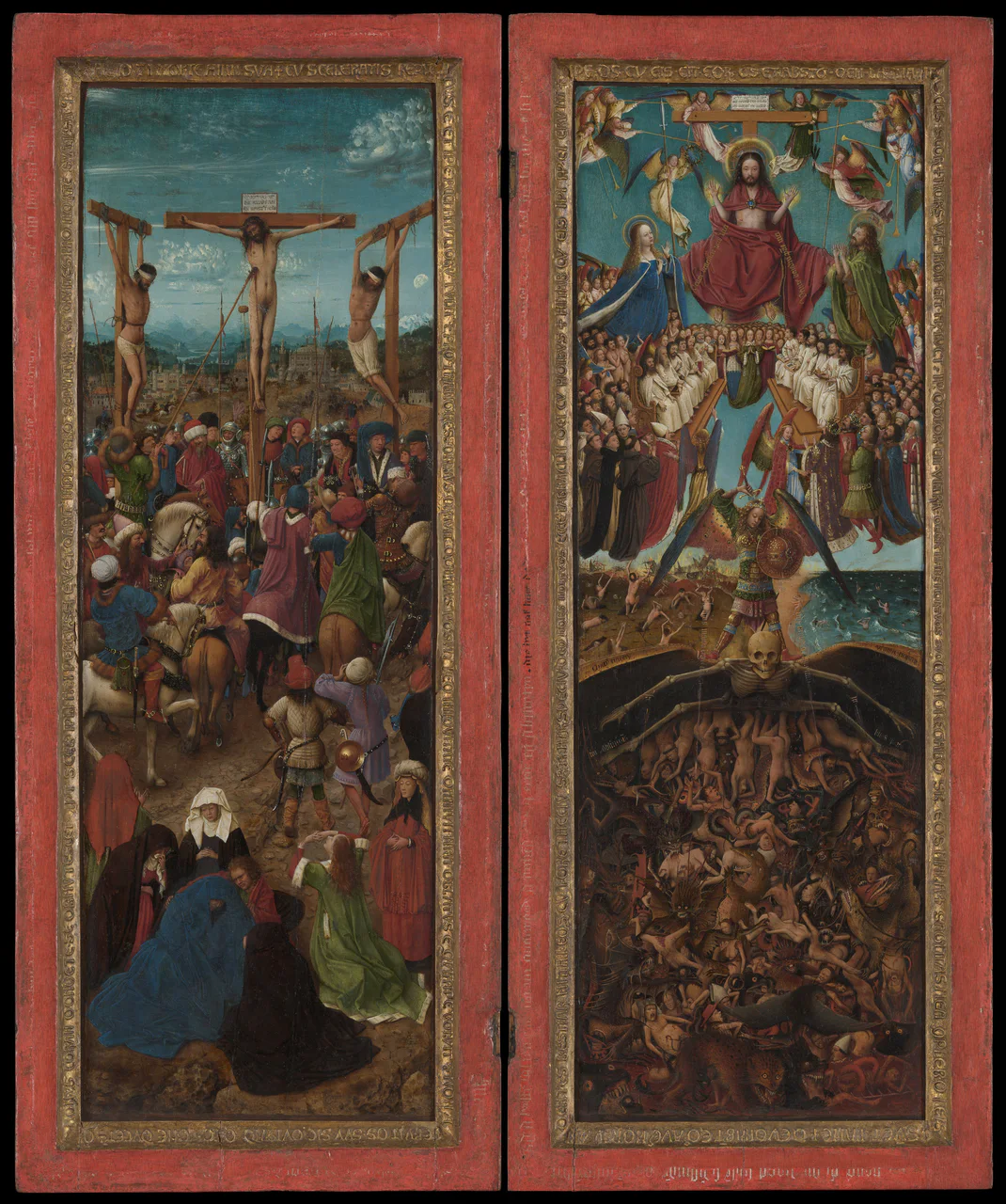
The first room surprises people. They expect something huge. Instead, two narrow panels hang side by side, each about 22 inches tall and less than 8 inches wide. Leo straightens his red beret and points with his silverpoint. Come closer. This picture hides almost everything from anyone standing at the door.
Start with the left panel. Three crosses rise over a crowd of soldiers on horseback and onlookers packed shoulder to shoulder. But look past them, up into the right side of the sky. A pale moon hangs there in broad daylight. Below it, far away, the mountain peaks are white with snow.
Now drop to the bottom of the same panel. A woman in a deep blue mantle has collapsed, her face hidden. A young man in red holds her up from behind. Beside them, a woman in green, her back to us, clasps her hands above her head and faces the crosses. The farther you get from the crosses, the heavier the grief becomes.
The right panel shows the Last Judgment. At the top, Christ sits in a red robe with both hands raised. In the middle stands an armored angel, sword lifted, a round shield on his arm. Zoom in on his wings. They are covered with eye spots, like peacock feathers.
Under the angel's feet, a skeleton spreads a pair of bat-like wings from edge to edge. Below it, people tumble headfirst into darkness. On the right, tiny figures climb out of the waves of the sea. Leo starts a note in his mirror-writing notebook, then stops and shakes his head. So many people, in so small a space.
The Met dates these panels to about 1436 to 1438 and credits them to Jan van Eyck and his workshop. Van Eyck worked in Bruges and served as court painter to Philip the Good, Duke of Burgundy. He built his colors from thin layers of oil paint, which let him reach a jewel-like clarity and astonishingly small details. The panels were first painted on wood and were later transferred to canvas.
Next, we leave heaven and hell behind and come down to earth. More than a century later, in a field of ripe wheat, a group of farmers is stopping for lunch.