 Pyeongye
The story of this room
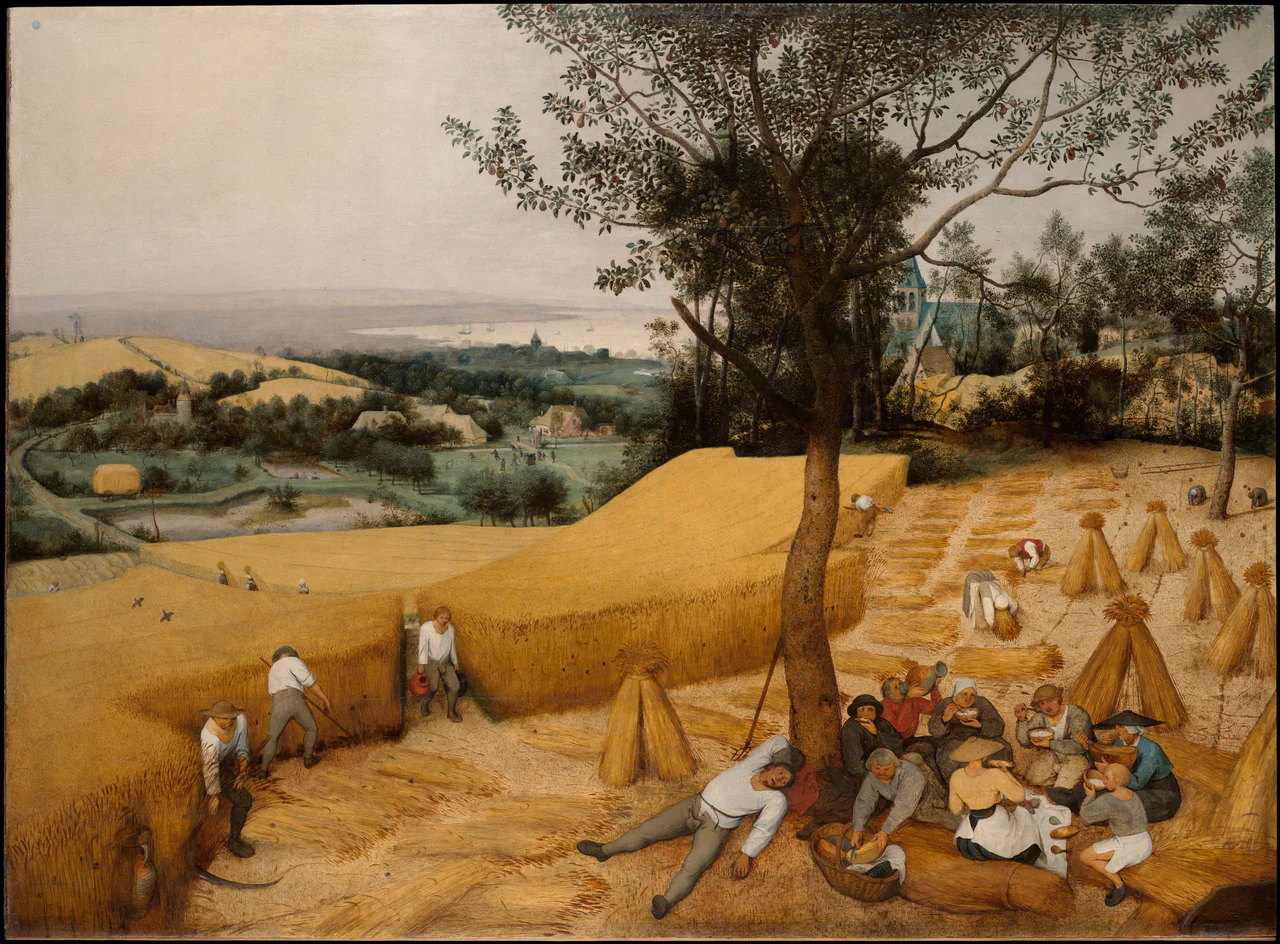
Step through the door and the whole wall turns gold. It is wheat, ripe and high, under a hazy summer sky. Leo pretends to wipe sweat from his forehead. After the heaven and hell of the first room, this one holds only land and people.
Find the big tree in the middle. Under it, a man in a white shirt lies stretched out on the stubble, legs apart, mouth open, fast asleep. His belt has come loose. One arm is flung behind his head. Every time I stand here, I swear I can hear him snore.
Right next to him, the rest of the crew is having lunch. Some hold bowls and spoon something up. Someone slices bread. A man tips a big jug back and drinks. There is a basket of bread at their feet. You can almost hear the clatter of a short break.
Now look left. A narrow path has been cut through the standing wheat, and a man walks out of it carrying a red water jug. In front of him, others are still swinging their scythes.
Far off on the right, under another tree, two people bend over to pick up fallen red fruit. Beyond the field you can see a church roof, and on the left, far away, a bay with ships on the water. Leo traces a line in his notebook, from the sleeping man all the way to the sea. Your eye walks the whole distance.
Pieter Bruegel the Elder painted this in 1565, in oil on an oak panel. It belongs to a series about the times of the year, ordered by Niclaes Jongelinck, a merchant in Antwerp. The series is usually thought to have had six pictures. Five survive today, in Vienna, Prague, and here at The Met in New York.
In Bruegel's day, big paintings usually starred saints, kings, or gods. Bruegel gave more than five feet of oak to farmhands on their lunch break.
Next, we cross to Spain. Instead of a clear summer field, a city on a hill waits under a storm.