 Pyeongye
Artwork · 16th century · Hans Baldung
LeoTurn on Magnifier at the lower right and move slowly across the painting.
Full screen opens it edge to edge.Tap the painting to fill the screen.
Spread two fingers to look closer.
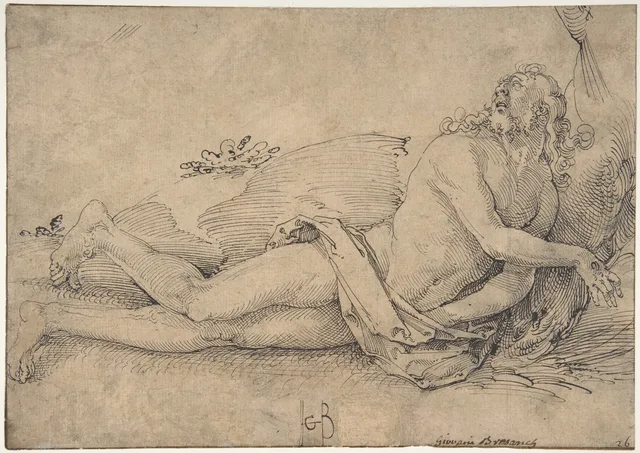
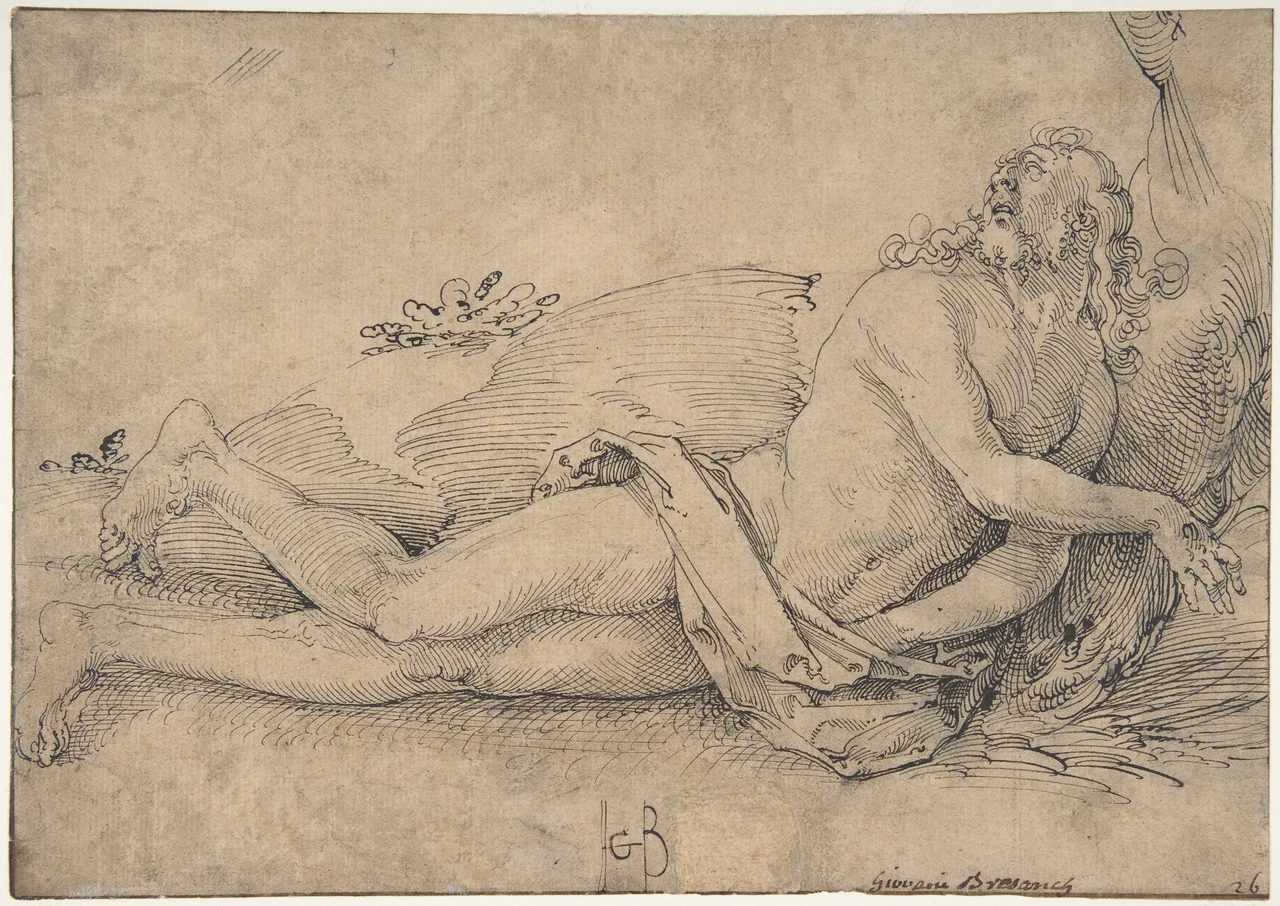
Ecstatic Christ
Hans Baldungca. 1510–11Pen and two shades of carbon black ink, traces of black chalk underdrawing16.9 × 24.0 cm
At a glance
- Christ, with long curling hair, lies stretched out on a slope, mouth open, gazing up toward the sky.
- The German artist Hans Baldung Grien made this pen drawing around 1510–11, using two shades of black ink.
- With no color at all, only pen lines that curve around every rounded form, he tells skin, cloth, and ground apart.
Reading the picture
5 places to look closer
Tap a number on the painting to jump to its note, or a close-up to see that spot in the whole picture.
Zoom in on the face at the upper right. The head is thrown far back and the mouth is open, showing the teeth. The eyes look upward. Hair and beard are made of little looping curls, one after another.
Find the hand reaching forward near the middle. Its fingers grip a fold of the cloth draped over the body. The back of the hand is left almost blank, while the cloth is filled with dense hatching. That contrast between empty and filled makes the hand seem to come toward us.
Now look at the other hand, hanging at the far right. The wrist is bent and the fingers droop limply. All around it, crisscrossing lines build up a dark net of shadow. The face is full of feeling, but this hand looks completely drained.
Zoom in on the foot of the bent leg at the far left. The toes press against the ground. The lines on the leg are not straight. They curve with the roundness of the calf. Baldung builds a solid body simply by changing the direction of his pen strokes.
Look at the letters at the bottom center. H, G, and B are joined into one mark. This is Baldung's monogram, the way he signed his work. In the lower right corner, someone has also written what looks like another name and the number 26.
When it was painted
Around 1510, Hans Baldung was in his mid-twenties and had just put down roots in Strasbourg. He became a citizen there in 1509 and married the following year. For several years before that, he had worked in Albrecht Dürer's workshop in Nuremberg. Now he was starting out under his own name.
Baldung did not come from a family of artists. Many of his relatives were lawyers and scholars. Nobody knows for sure where his nickname Grien, meaning green, came from. Some think it was his love of the color, and others think it set him apart from the other Hanses in Dürer's shop.
These were years of bold experiments in print as well. In 1510 he issued a woodcut of witches gathered around a steaming jar, printed from two blocks so that light lines glow against a dark tone. The same hand that drew this ecstatic Christ was also conjuring eerie witches.
In 1512 he moved to Freiburg to paint the great high altarpiece of its cathedral. When that long job was done, he returned to Strasbourg, where he lived until his death in 1545.
His bond with Dürer lasted. After Dürer died in 1528, a lock of the older artist's hair came into Baldung's hands. It is still kept today at the Academy of Fine Arts in Vienna.
This sheet came to the Metropolitan Museum in 1975 with the Robert Lehman Collection. Follow the looping curls of Christ's hair one by one. Each one was drawn by a young artist who had just stepped out of Dürer's workshop on his own.
Questions to think about
- Look for itWhere in this drawing do the lines cross most densely, so that the paper looks almost black?
- Why?Why do you think Baldung showed Christ with his head thrown back and mouth open, instead of quietly praying?
- What about you?Great joy and great pain both show plainly on a face. How do we react today when someone lets such strong feelings show in front of others?
Same period
Painted around the same time,
somewhere else
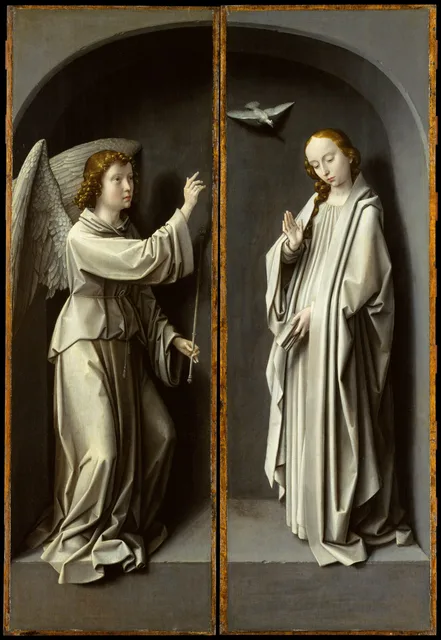 Archangel Gabriel; The Virgin AnnunciateGerard Davidca. 1510
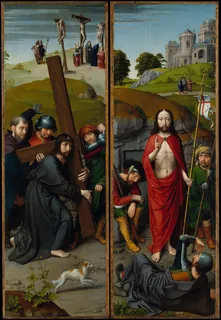 Christ Carrying the Cross, with the Crucifixion; The Resurrection, with the Pilgrims of EmmausGerard Davidca. 1510
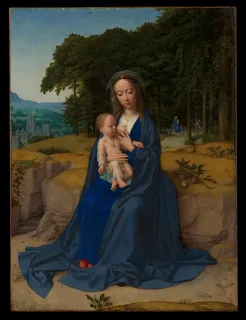 The Rest on the Flight into EgyptGerard Davidca. 1512–15
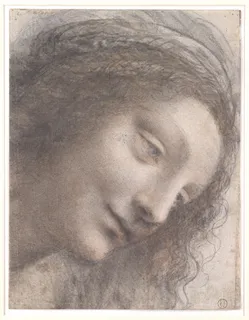 The Head of the Virgin in Three-Quarter View Facing RightLeonardo da Vinci1510–13
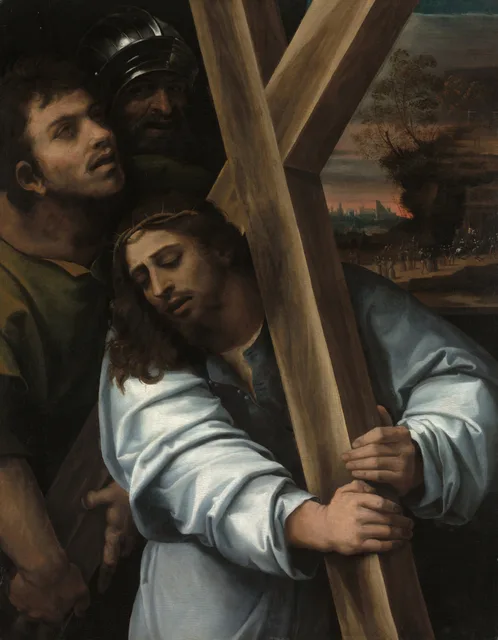 Christ Carrying the CrossSebastiano del Piomboc. 1515–17
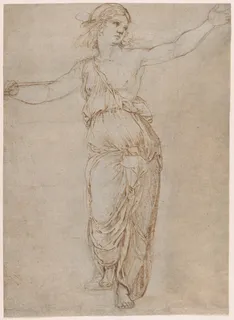 LucretiaRaphael1508–10
Too good to keep to yourself
This painting,
for someone who comes to mind
They open it at full size
and see every brushstroke.
About this work
- Artist
- Hans Baldung · 1484–1545
- Date
- ca. 1510–11
- Medium
- Pen and two shades of carbon black ink, traces of black chalk underdrawing
- Size
- 16.9 × 24.0 cm
- Collection
- The Metropolitan Museum of Art
- Image
- Original long edge 3843px · shown at 2560px
- Original
- View on the museum's website ↗