 Pyeongye
Artwork · 16th century · Leonardo da Vinci
LeoTurn on Magnifier at the lower right and move slowly across the painting.
Full screen opens it edge to edge.Tap the painting to fill the screen.
Spread two fingers to look closer.
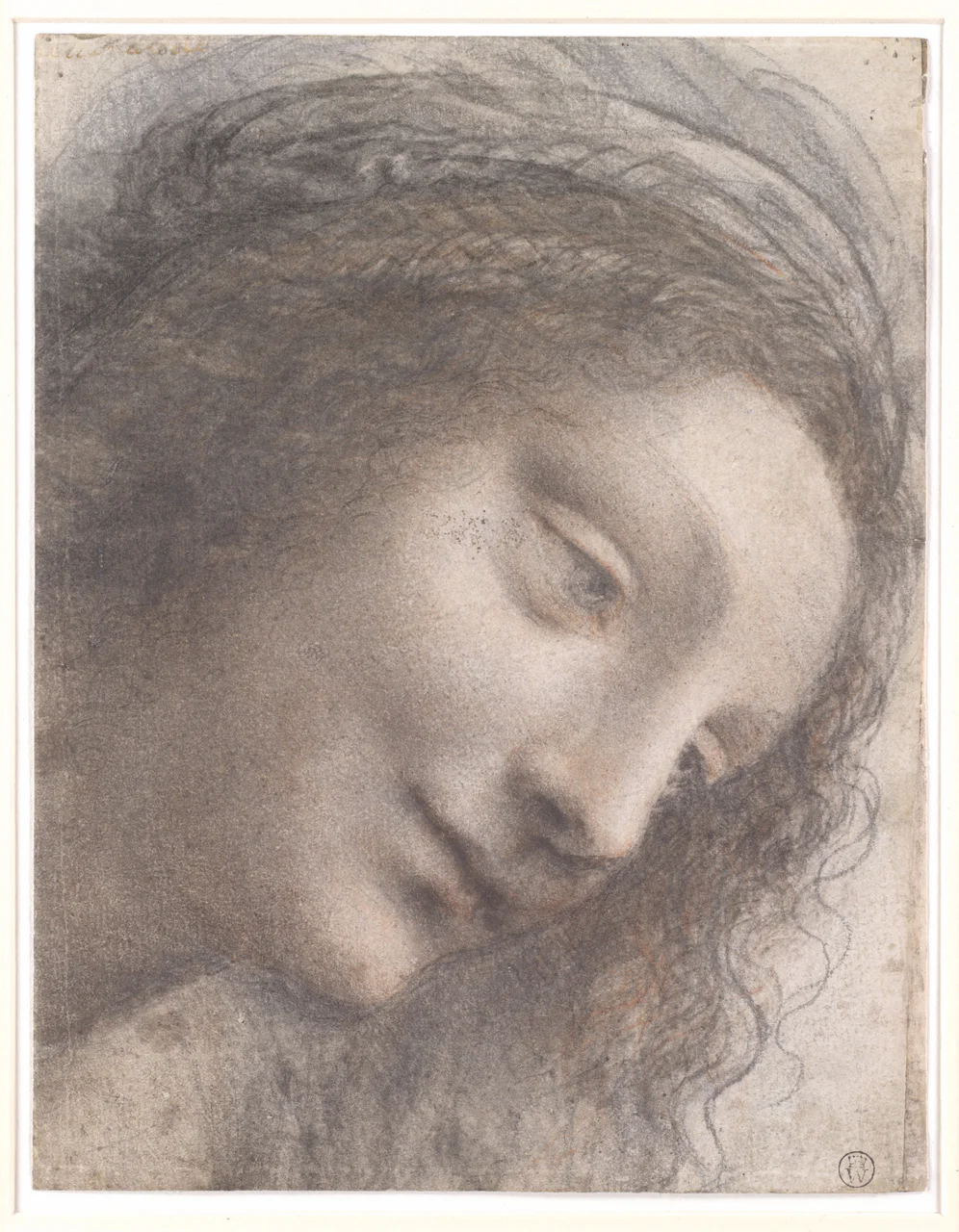
The Head of the Virgin in Three-Quarter View Facing Right
Leonardo da Vinci1510–13Black chalk, charcoal, and red chalk, with some traces of white chalk (?); some remains of framing lines in pen and brown ink at upper right (not by Leonardo)20.3 × 15.6 cm
At a glance
- The bowed head of the Virgin Mary, eyes lowered, drawn in chalk and charcoal on a sheet about the size of a hand.
- Leonardo da Vinci made it around 1510–13 while preparing The Virgin and Child with Saint Anne, now in the Louvre.
- Up close you can watch him build a rounded face almost entirely from rubbed, smoky shadow instead of outlines.
Reading the picture
4 places to look closer
Tap a number on the painting to jump to its note, or a close-up to see that spot in the whole picture.
Zoom into the lowered eye. The pupil is barely visible under a heavy lid. A thin line of red chalk runs along the edge of the eyelid. That faint warmth inside the gray shadow makes the skin feel alive.
Look between the nose and the mouth. There is almost no hard outline. Leonardo simply rubbed dark shadow, like smoke, under the tip of the nose and at the corners of the lips.
Zoom into the hair falling at the lower right. Here, unlike the face, the black chalk lines stay crisp. The locks curl downward in loose waves. He rubbed the face soft but drew the hair fast, treating the two in completely different ways.
Zoom into the top of the head. Short strokes flow in layers through the dark mass of hair, with touches of red chalk mixed in. The direction of the strokes shows how the hair wraps around the bowed forehead.
When it was painted
When he made this drawing, Leonardo was close to sixty. He was living in Milan, then ruled by France, and working for the French king. In the winter of 1510 he was in Pavia, dissecting human bodies with the physician Marcantonio della Torre and drawing muscles and bones.
There was one painting he could not let go of. It shows the Virgin Mary seated on the lap of her mother, Saint Anne, reaching toward the Christ Child. From about 1500 Leonardo worked again and again on ways to bind these three figures into a single group. This head is considered a study for the Virgin's face in that picture.
In 1513 he left Milan for Rome. In 1516 he accepted an invitation from King Francis I of France and crossed the Alps. He spent his last years at the manor of Cloux, near Amboise in the Loire valley.
In 1517 an Italian cardinal and his party came to visit him there. The cardinal's secretary, Antonio de Beatis, wrote in his diary about three paintings Leonardo showed them. One was the Virgin and Child seated on the lap of Saint Anne. Leonardo still kept it with him, never quite finished. He died at Cloux in 1519.
This small sheet traveled down the centuries and entered The Metropolitan Museum of Art in 1951. Look once more at the lowered eye. A face Leonardo refined for years is being born right here, on a piece of paper you could hold in one hand.
More by the same painter
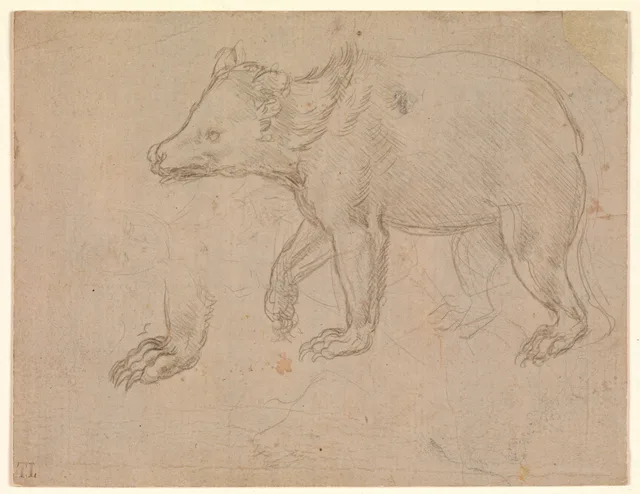
Questions to think about
- Look for itHow many places can you find where Leonardo used red chalk on this face?
- Why?Why do you think he blurred the face so softly but drew the hair with clear lines?
- What about you?He reworked one painting for well over a decade and never fully finished it. In a world that praises speed, what is the value of working on something slowly for a long time?
Same period
Painted around the same time,
somewhere else
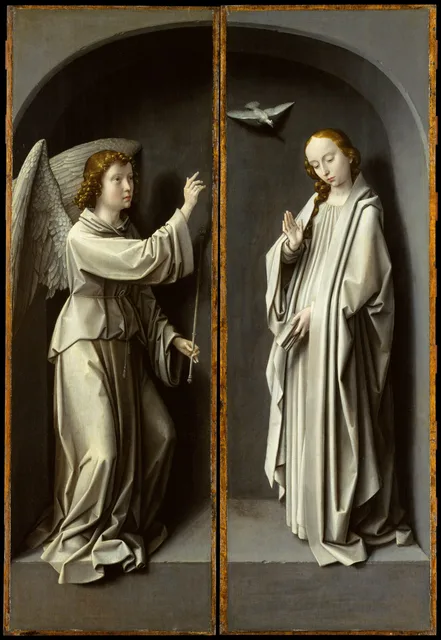 Archangel Gabriel; The Virgin AnnunciateGerard Davidca. 1510
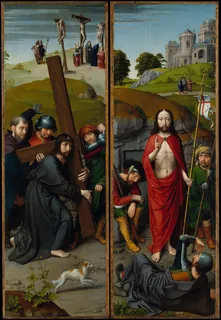 Christ Carrying the Cross, with the Crucifixion; The Resurrection, with the Pilgrims of EmmausGerard Davidca. 1510
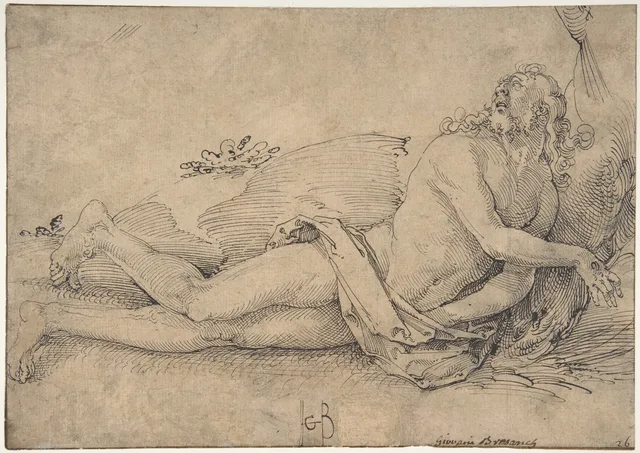 Ecstatic ChristHans Baldungca. 1510–11
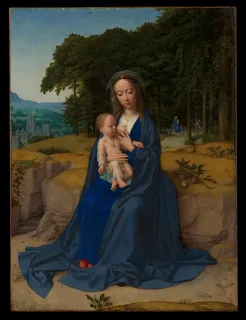 The Rest on the Flight into EgyptGerard Davidca. 1512–15
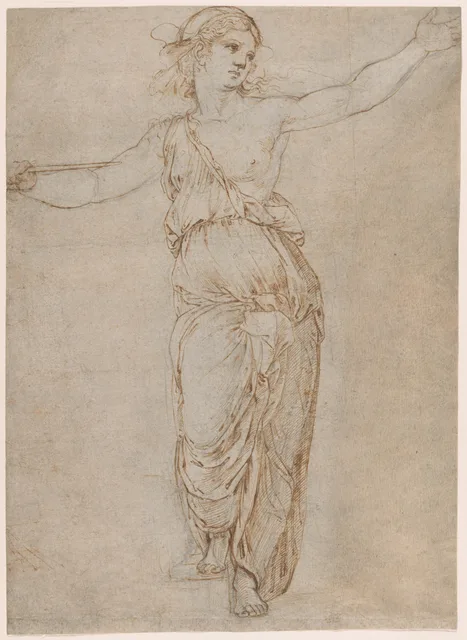 LucretiaRaphael1508–10
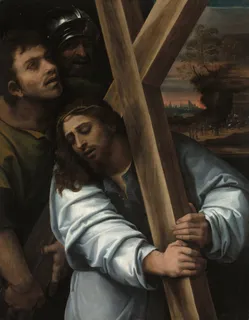 Christ Carrying the CrossSebastiano del Piomboc. 1515–17
Too good to keep to yourself
This painting,
for someone who comes to mind
They open it at full size
and see every brushstroke.
About this work
- Artist
- Leonardo da Vinci · 1452–1519
- Date
- 1510–13
- Medium
- Black chalk, charcoal, and red chalk, with some traces of white chalk (?); some remains of framing lines in pen and brown ink at upper right (not by Leonardo)
- Size
- 20.3 × 15.6 cm
- Collection
- The Metropolitan Museum of Art
- Image
- Original long edge 3822px · shown at 2560px
- Original
- View on the museum's website ↗