 Pyeongye
Artwork · 16th century · Gerard David
LeoTurn on Magnifier at the lower right and move slowly across the painting.
Full screen opens it edge to edge.Tap the painting to fill the screen.
Spread two fingers to look closer.
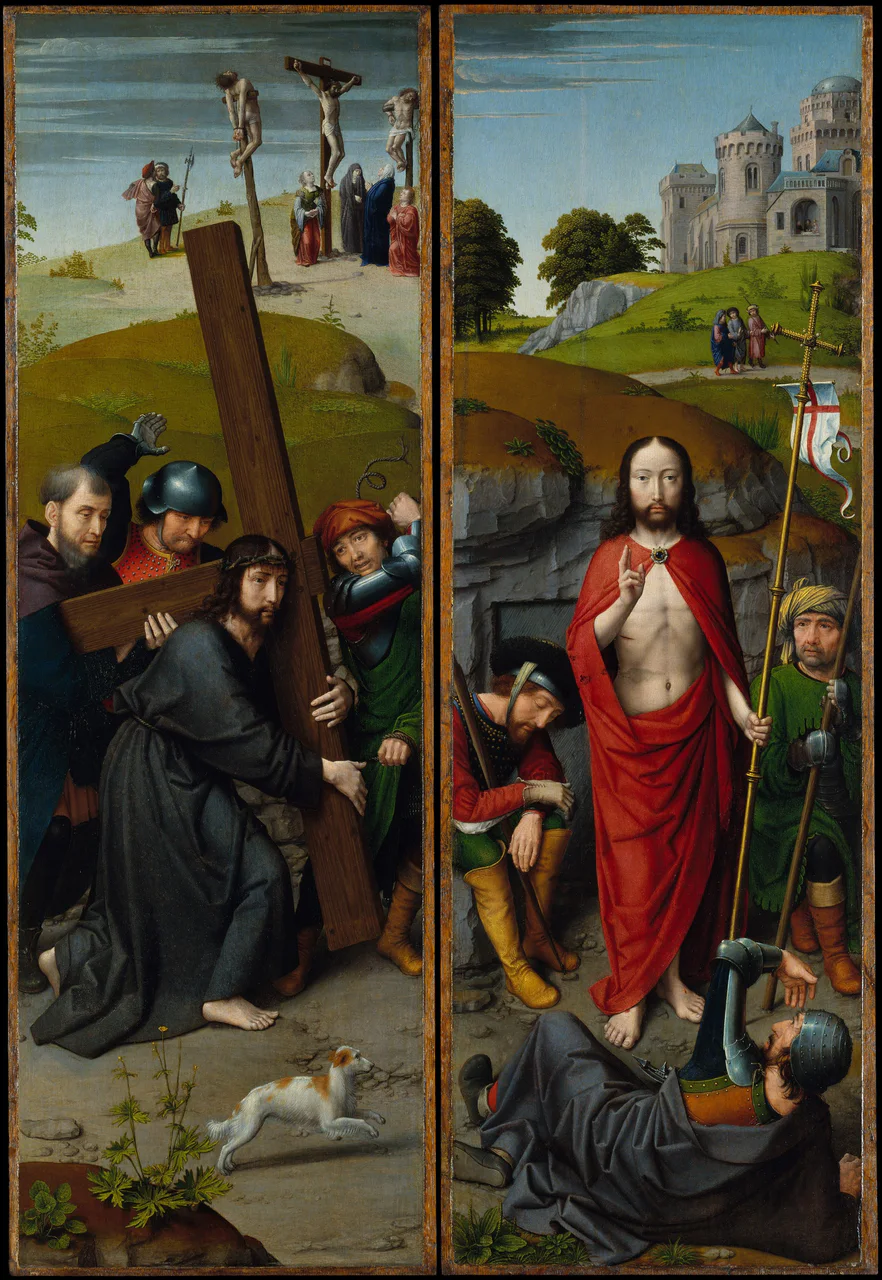
Christ Carrying the Cross, with the Crucifixion; The Resurrection, with the Pilgrims of Emmaus
Gerard Davidca. 1510Oil on oak panel87.7 × 29.5 cm
At a glance
- Two tall, narrow panels follow Christ from the road to the cross, to his death, and on to the morning he rose again.
- Gerard David painted them in oil on oak around 1510, in Bruges.
- Each panel pairs a large scene up front with a small one on the hill behind, so your eye reads the story in order, from bottom to top.
Reading the picture
5 places to look closer
Tap a number on the painting to jump to its note, or a close-up to see that spot in the whole picture.
Start with the face in the middle of the left panel. Christ wears the crown of thorns and bends under the weight of the cross. Tiny red drops sit where the thorns press into his forehead. Behind him, someone else's hand helps hold up the crossbar.
Now climb to the top of the same panel. Three crosses stand on the hill, and women gaze up at them. The cross carried in the foreground has reached its end. In one panel, the bottom shows the road and the top shows where it leads.
Look at the ground in the lower part of the left panel. A small white dog with orange patches stretches out as it runs. Beside it, a wild plant spreads its leaves one by one beside a rock. David tucked these small living things into the corner of a heavy scene.
Cross over to the right panel. Christ, wrapped in a red cloak, raises two fingers, and a wound still shows on his side. To his left, a soldier in a helmet sits with his eyes shut, dozing. At Christ's feet another soldier has toppled over backward.
Zoom in on the path along the hill at the top right. Three men walk and talk with their hands, and one of them is barefoot. The Gospel of Luke tells of two disciples walking to a village called Emmaus who were joined by the risen Christ but did not recognize him at first. Behind them rises a town with towers like a castle.
When it was painted
Around 1510, Gerard David was a settled and respected man in Bruges. He had come from Oudewater, a small town in Holland, and joined the Bruges painters' guild in 1484. After Hans Memling died in 1494, David became the city's leading painter.
His roots in Bruges ran deep. In 1496 he married Cornelia Cnoop, whose father headed the goldsmiths' guild. In 1509 he gave an altarpiece to a convent in the city, and many scholars read the two faces at its edges as David himself and his wife.
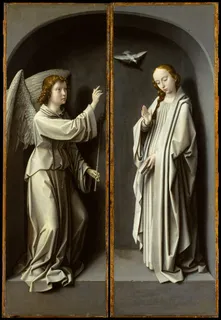
These two panels began life as a pair of folding wings. According to the museum, these scenes were the inner faces, seen when the wings were open. When they were closed, viewers saw the outer faces instead: Archangel Gabriel; The Virgin Annunciate. The fronts and backs have since been separated, but both now belong to the same museum.
What hung between the wings is not certain. The museum suggests that, possibly very early on, they were joined to a Lamentation from David's workshop that is now in the Philadelphia Museum of Art.
The panels traveled a long way after that. They passed through the house of the Earl of Ashburnham in England and the collection of Rodolphe Kann in Paris. In 1912 Philip Lehman of New York bought them, and in 1975 they came to the Metropolitan Museum of Art with the Robert Lehman Collection.
Now look again at the three travelers on the road to Emmaus, at the top of the right panel. When the wings were closed, that road and the cross below it were hidden behind the Annunciation. You only saw this story when the doors were opened.
More by the same painter
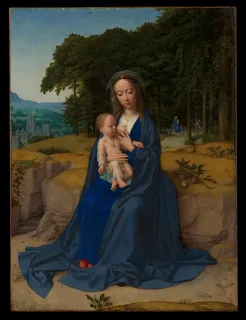
Questions to think about
- Look for itAt the top of the left panel, can you find the woman who clasps her hands and lifts her face toward the cross?
- Why?Why might David have painted a running dog and a wild plant right below such a painful scene?
- What about you?The travelers to Emmaus walked a long way beside someone without knowing who he was. Have you ever been slow to notice what a person close to you was going through?
Same period
Painted around the same time,
somewhere else
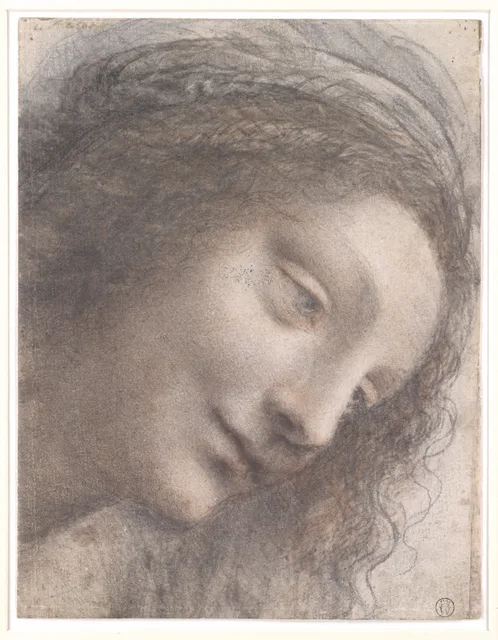 The Head of the Virgin in Three-Quarter View Facing RightLeonardo da Vinci1510–13
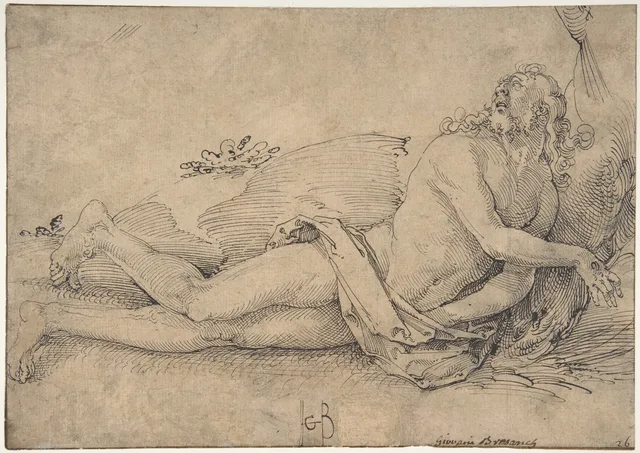 Ecstatic ChristHans Baldungca. 1510–11
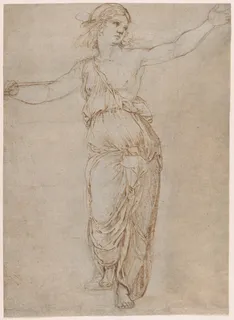 LucretiaRaphael1508–10
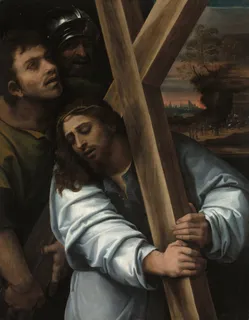 Christ Carrying the CrossSebastiano del Piomboc. 1515–17
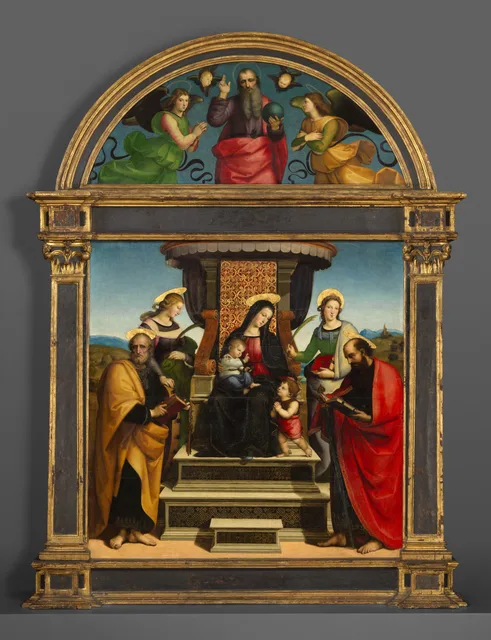 Madonna and Child Enthroned with SaintsRaphaelca. 1504
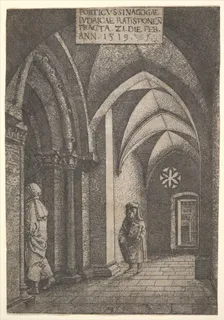 The Entrance Hall of the Regensburg SynagogueAlbrecht Altdorfer1519
Too good to keep to yourself
This painting,
for someone who comes to mind
They open it at full size
and see every brushstroke.
About this work
- Artist
- Gerard David · 1455–1523
- Date
- ca. 1510
- Medium
- Oil on oak panel
- Size
- 87.7 × 29.5 cm
- Collection
- The Metropolitan Museum of Art
- Image
- Original long edge 3722px · shown at 2560px
- Original
- View on the museum's website ↗