 Pyeongye
Artwork · 15th century · Lorenzo Monaco
LeoTurn on Magnifier at the lower right and move slowly across the painting.
Full screen opens it edge to edge.Tap the painting to fill the screen.
Spread two fingers to look closer.
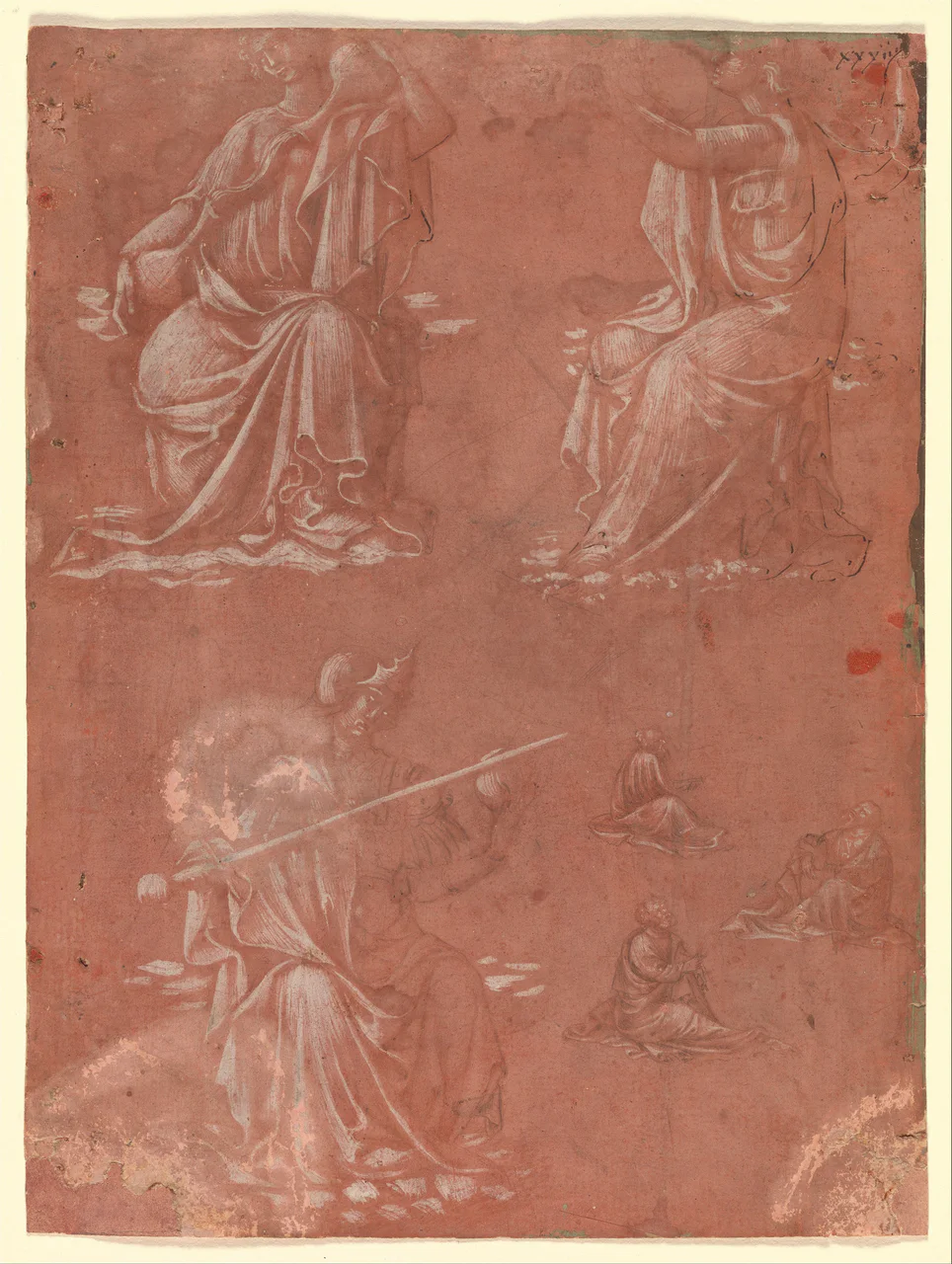
Three Virtues (Temperance, Hope, and Fortitude or Justice) and Studies of a Seated Man
Lorenzo Monacoca. 1420Metalpoint, touches of brush and brown wash, heightened with white (partially oxidized in the figure at the lower left), on reddish violet prepared paper. Some lines retraced in pen and brown ink at a later date.24.9 × 18.5 cm
At a glance
- Three seated women in long robes and a few small seated men share one sheet of reddish-violet paper.
- Lorenzo Monaco, a monk and painter in Florence, drew them around 1420 in metalpoint and white.
- Six hundred years old, it reads like a page from a working sketchbook: fine metal lines that cannot be erased, with white brushed on to make the folds catch the light.
Reading the picture
4 places to look closer
Tap a number on the painting to jump to its note, or a close-up to see that spot in the whole picture.
Zoom in on the figure at the upper right. Her arms reach forward, and strokes of white curve around her sleeve and the folds over her knees. Along her right edge run some dark brown pen lines, much heavier than the rest. According to the museum, some lines on this sheet were gone over in pen at a later date.
Look below the knees of the figure at the upper left. Her robe falls from knee to ground in long channels, then twists into ribbon-like curls at the hem. Where the white is thick, a fold sticks out into the light. Where the paper color shows, the cloth sinks into a hollow.
Go down to the figure at the lower left. She holds a long sword with a round pommel diagonally across her body. This figure is fainter than the two above and looks blotchy in places. The museum notes that some of the white on this figure has oxidized.
Look at the small men at the lower right. One, with curly hair, sits with his knee drawn up. Another leans far back with his head tipped up. They differ from the big figures in size and direction. Just as the title says, these are studies of a seated man tried out in several poses.
When it was painted
Picture Florence around 1420. Lorenzo Monaco was about fifty and a well-known painter in the city. He had been born Piero di Giovanni, but thirty years earlier he had entered the monastery of Santa Maria degli Angeli as a monk. Monaco is simply Italian for monk.
His monastery was known for its huge handwritten choir books, decorated with painted initials. The young monk painted pages for those books. In 1414 he finished a large gold-ground Coronation of the Virgin for the monastery's high altar, which now hangs in the Uffizi in Florence.
Around the time of this drawing, he was covering the walls of the Bartolini Salimbeni family chapel in the church of Santa Trinita with scenes from the life of the Virgin. Meanwhile, in the same city, the young Masaccio was starting to paint in a very different way. Lorenzo did not live to see much of that change. He died in the mid-1420s.
Here is the twist. For a long time this sheet was thought to be by Lorenzo Monaco himself. Today the Metropolitan Museum lists it as the work of an artist in his circle, someone working close to him. The evidence is not strong enough to say it came from his own hand.
The drawing later belonged to the New York banker Robert Lehman and came to the Met in 1975 with the rest of his collection. In the top right corner you can still see Roman numerals that someone wrote on the sheet.
Look again at the women's robes. The long folds that ripple down and curl at the hem are a shape you see again and again in Lorenzo Monaco's paintings. Whoever held the stylus laid white over lines that could never be erased, one stroke of light at a time.
More by the same painter
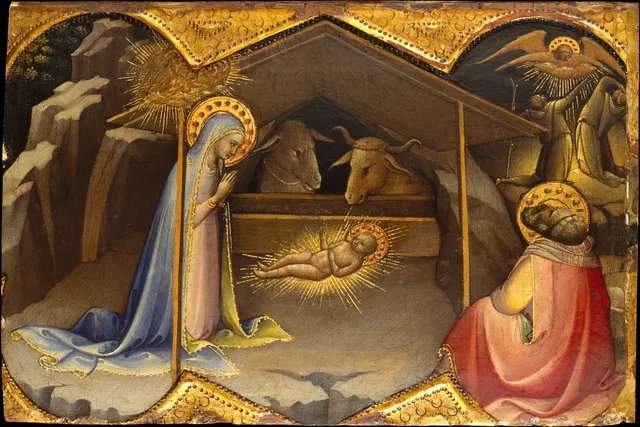
Questions to think about
- Look for itOn which robe are the white lines packed most tightly into folds?
- Why?Why do you think the artist squeezed small seated men into the empty space beside the three large women?
- What about you?Of temperance, hope, courage, and justice, which do you think our society is shortest on today?
Same period
Painted around the same time,
somewhere else
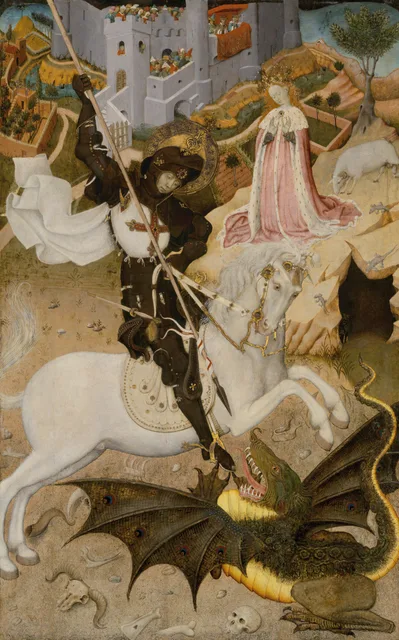 Saint George and the DragonBernat Martorell1434–35
 The Crucifixion; The Last JudgmentJan van Eyckca. 1436–38
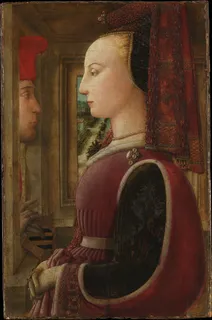 Portrait of a Woman with a Man at a CasementFra Filippo Lippica. 1440
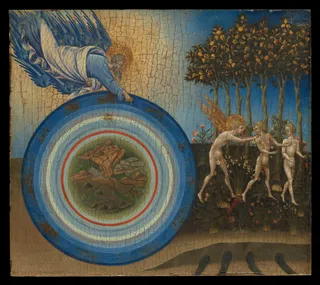 The Creation of the World and the Expulsion from ParadiseGiovanni di Paolo1445
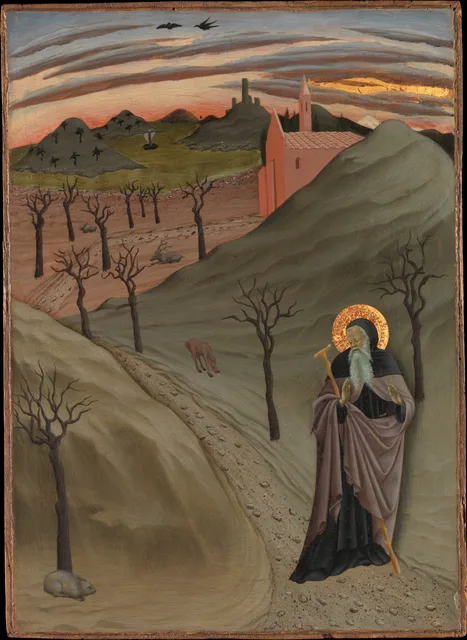 Saint Anthony the Abbot in the WildernessSano di Pietroca. 1440
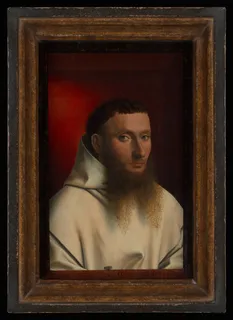 Portrait of a CarthusianPetrus Christus1446
Too good to keep to yourself
This painting,
for someone who comes to mind
They open it at full size
and see every brushstroke.
About this work
- Artist
- Lorenzo Monaco · 1370–1425
- Date
- ca. 1420
- Medium
- Metalpoint, touches of brush and brown wash, heightened with white (partially oxidized in the figure at the lower left), on reddish violet prepared paper. Some lines retraced in pen and brown ink at a later date.
- Size
- 24.9 × 18.5 cm
- Culture
- Italian, Florence
- Collection
- The Metropolitan Museum of Art
- Image
- Original long edge 3824px · shown at 2560px
- Original
- View on the museum's website ↗