 Pyeongye
Artwork · 15th century · Giovanni di Paolo
LeoTurn on Magnifier at the lower right and move slowly across the painting.
Full screen opens it edge to edge.Tap the painting to fill the screen.
Spread two fingers to look closer.
The Creation of the World and the Expulsion from Paradise
Giovanni di Paolo1445Tempera and gold on wood46.4 × 52.1 cm
At a glance
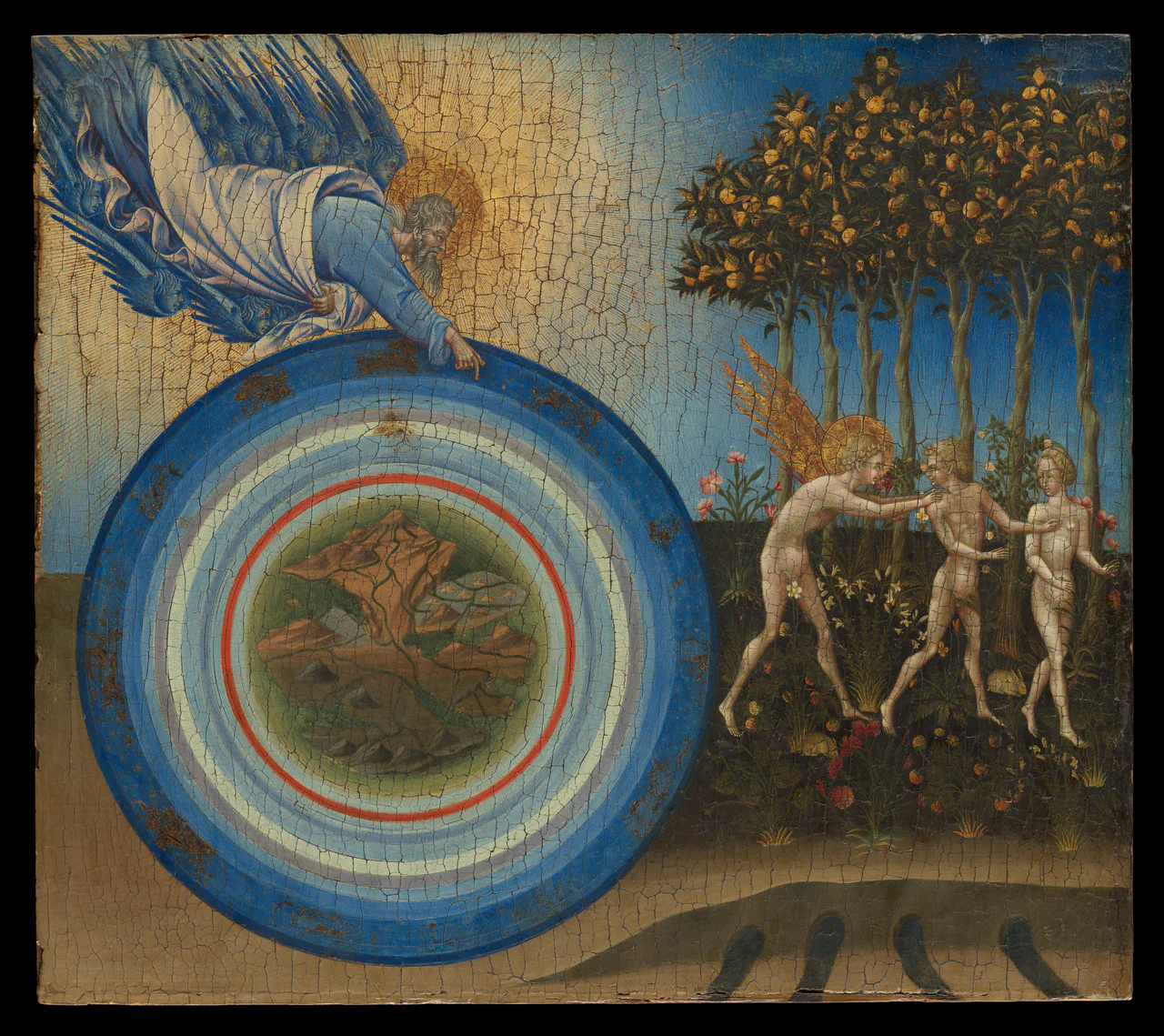
- On the left, God swoops down and points at a round, ringed world. On the right, an angel pushes Adam and Eve out of Paradise.
- Giovanni di Paolo of Siena painted it in 1445, in tempera and gold on a wooden panel.
- The start of the world and the loss of Paradise sit side by side on one panel about 52 cm wide.
Reading the picture
4 places to look closer
Tap a number on the painting to jump to its note, or a close-up to see that spot in the whole picture.
Start at the top left. God arrives in a rush of blue, his robe billowing behind him. Look closely at the blue wings that carry him. Small faces peer out between the feathers. He is borne along by a crowd of winged angels.
Now drop into the center of the great disk. Brown mountains rise from green land, and dark rivers branch across it like veins. Around this little world run rings of blue and white, with one thin band of red. It is the old picture of the cosmos: the earth in the middle, wrapped in water, air, fire and the layered heavens.
Cross to the right, and the story has already moved on. An angel with golden wings and a halo shoves Adam by the shoulder. Adam turns his head and looks the angel in the face. Under their feet, Paradise is thick with lilies and red flowers. Look down near Adam's feet and you will find a rabbit crouching in the grass.
Go to the bottom right edge. Four dark green streams pour down out of the garden. Genesis says a river flowed out of Eden and split into four. The painter turned those four rivers into these teardrop shapes.
When it was painted
In 1445 Giovanni di Paolo was in his late forties. Born in Siena, he worked there all his life. That year he finished a large altarpiece for the church of San Domenico in his home city. Today it is known as the Guelfi Altarpiece.
This small panel sat in the altarpiece's predella, the strip of little story scenes that runs beneath the main picture. Another panel from the same predella showed Paradise, where the blessed greet one another in a flowering garden.
Over the centuries the altarpiece was broken up. Its large central panel is now in the Uffizi in Florence. The Paradise panel entered the Metropolitan Museum in 1906. This one arrived about seventy years later, in 1975, with the collection of the banker Robert Lehman. Two pieces of one altar took separate roads and met again in New York.
Giovanni di Paolo was also a gifted book painter. He made a long series of illustrations for the Paradiso, the last part of Dante's Divine Comedy, and that manuscript is now in the British Library in London. The Metropolitan Museum links this panel to Dante's poem.
Now look again at the great circle on the left. In the middle of all those rings sits a small patch of land. On the right, Adam and Eve are being driven out toward that very world. The place God points to with one finger is about to become the place where they must live.
The painter
Giovanni di Paolo
1398–1482
When painting this, the artist was about 47 years old
All paintings by Giovanni di Paolo →
Questions to think about
- Look for itCan you find exactly where God's fingertip touches the great circle?
- Why?Why would the painter put the making of the world and the loss of Paradise on the same small panel?
- What about you?Adam is being pushed out, yet he looks back at the angel. After we do something we cannot undo, what do we find ourselves looking back at?
Same period
Painted around the same time,
somewhere else
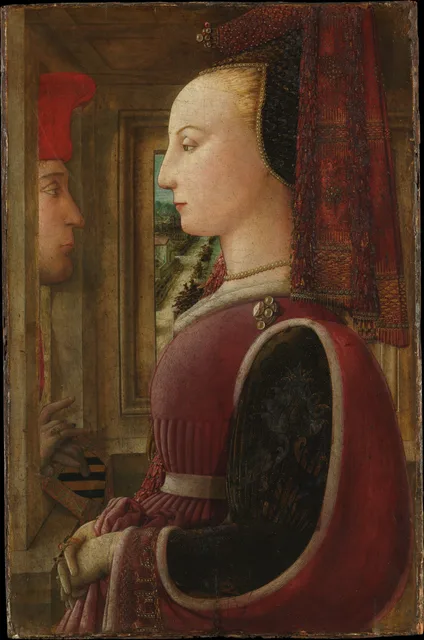 Portrait of a Woman with a Man at a CasementFra Filippo Lippica. 1440
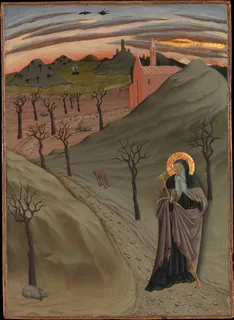 Saint Anthony the Abbot in the WildernessSano di Pietroca. 1440
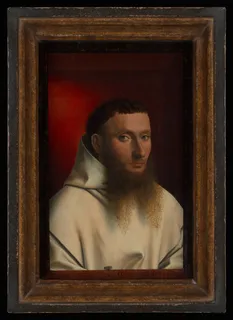 Portrait of a CarthusianPetrus Christus1446
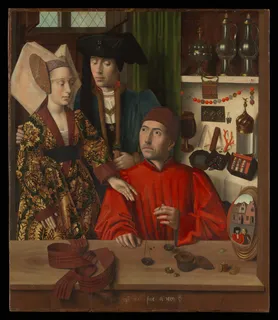 A Goldsmith in his ShopPetrus Christus1449
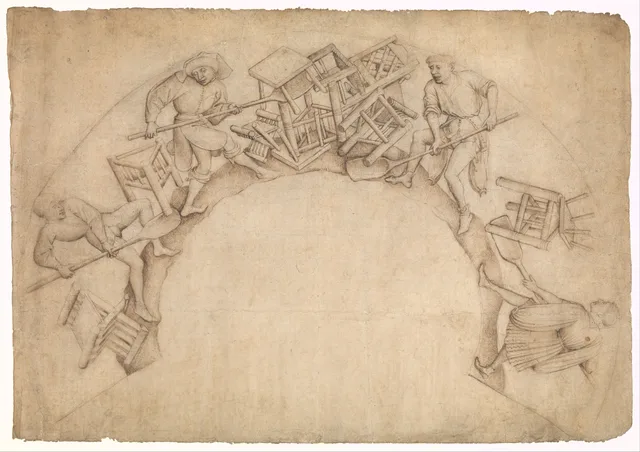 Men Shoveling Chairs (Scupstoel)Vranke van der Stockt1444–50
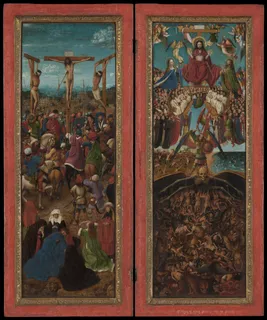 The Crucifixion; The Last JudgmentJan van Eyckca. 1436–38
Too good to keep to yourself
This painting,
for someone who comes to mind
They open it at full size
and see every brushstroke.
About this work
- Artist
- Giovanni di Paolo · 1398–1482
- Date
- 1445
- Medium
- Tempera and gold on wood
- Size
- 46.4 × 52.1 cm
- Collection
- The Metropolitan Museum of Art
- Image
- Original long edge 4000px · shown at 2560px
- Original
- View on the museum's website ↗