 Pyeongye
Artwork · 19th century · Berthe Morisot
LeoTurn on Magnifier at the lower right and move slowly across the painting.
Full screen opens it edge to edge.Tap the painting to fill the screen.
Spread two fingers to look closer.
At a glance
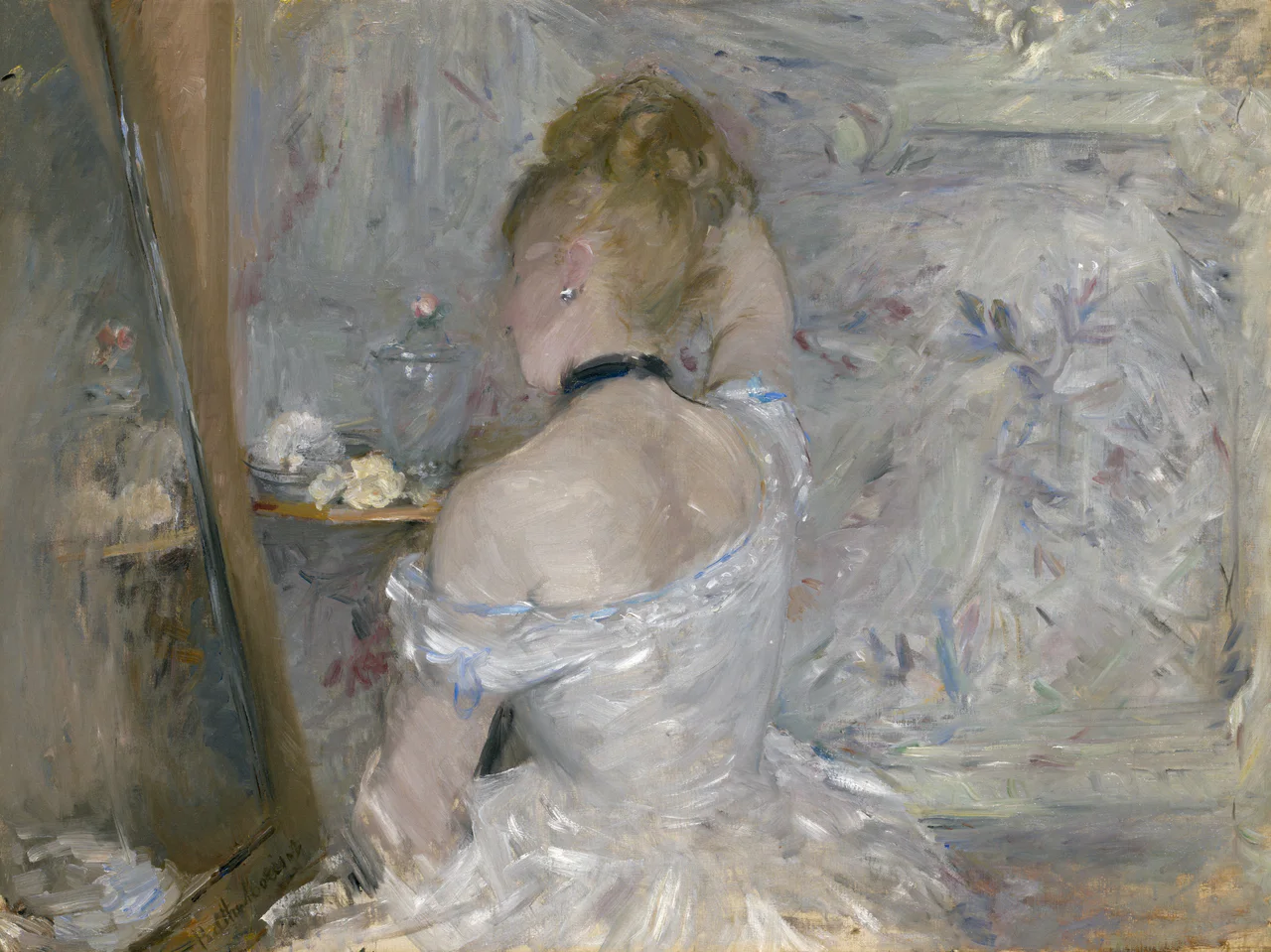
- A young woman sits with her back to us at a dressing table, her white gown slipped down off her shoulders.
- Berthe Morisot, a French Impressionist, painted it in oil sometime between 1875 and 1880.
- It hung in the fifth Impressionist exhibition in 1880, and the artist hid her signature at the foot of the mirror.
Reading the picture
5 places to look closer
Tap a number on the painting to jump to its note, or a close-up to see that spot in the whole picture.
Zoom in on her ear. A single dab of white paint catches the light on the lobe, and a black ribbon circles her neck. The museum reads this as the moment after a ball, earrings and velvet ribbon still on. We barely see her face, only the curve of a cheek.
Now look at the dressing table. There is a glass jar with a pink rose on its lid, something white and fluffy like a powder puff, and pale yellow flowers. The glass is just gray paint with a few flicks of white. Up close it is only brushwork. Step back and it turns into a clear jar.
Look into the tall mirror on the left. All you can make out is a dot of red and a few soft white shapes. The woman's face is not reflected anywhere. Painters of the time often used a woman at her mirror as a sign of vanity. Morisot simply leaves the face out.
Zoom in on the bottom edge of the mirror frame. Dark, slanting letters run across the brown paint. They spell the artist's name. The museum suggests, carefully, that this may hint the woman stands in for Morisot herself.
Look at the wall on the right. Strokes of lavender, blue and pink scatter like feathers. They stand for a flowered wallpaper and bedspread, yet not one flower is drawn exactly. Quick, light touches are enough to fill the room with soft air.
When it was painted
In the spring of 1880, the Impressionists opened their fifth group exhibition in Paris. Morisot, then thirty-nine, sent this picture. She had been part of the group since its first show in 1874, and she took part in seven of their eight exhibitions.
She missed only one. At the end of 1874 she married Eugène Manet, the younger brother of the painter Édouard Manet. In November 1878 their daughter Julie was born, and Morisot sat out the 1879 show. Eugène backed her career and helped her keep painting.
The doors were not wide open for her. France's official art school did not admit women in those years, so Morisot trained with private teachers, and the landscape painter Camille Corot gave her advice. Her sister Edma, who studied with her, stopped painting after she married. Berthe kept going.
At the 1880 show her work was warmly praised. A woman at her toilette was a subject many male painters of the day had tried. The Art Institute of Chicago describes Morisot's version as intimate but not sexualized, a scene seen through a woman's eyes.
The painting entered the Art Institute in 1924. In 2018 and 2019 it traveled in a major Morisot retrospective shown in North America and in Paris.
Look again at the name along the mirror. The woman has no face here, but the painter made sure her own name stayed in the picture.
Questions to think about
- Look for itWhat on the dressing table might that red spot in the mirror be?
- Why?Why do you think Morisot turned the woman away from us instead of showing her face?
- What about you?Morisot skipped one exhibition the year her daughter was born, then came back. How well do workplaces today leave room for people to return after having a child?
Same period
Painted around the same time,
somewhere else
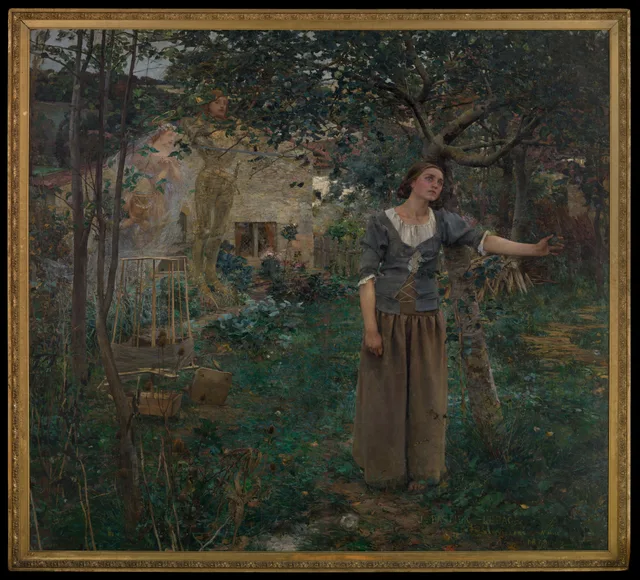 Joan of ArcJules Bastien-Lepage1879
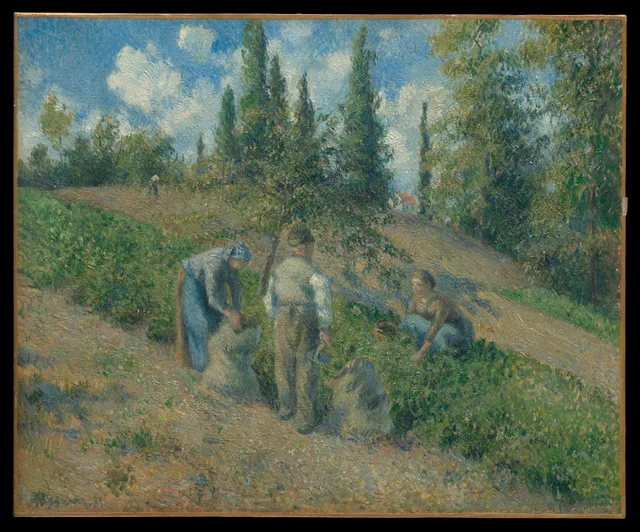 The Harvest, Pontoise (La Récolte, Pontoise)Camille Pissarro1881
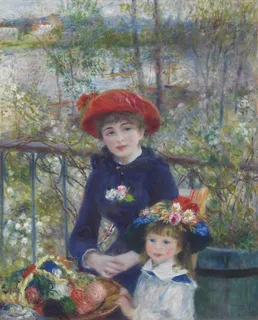 Two Sisters (On the Terrace)Auguste Renoir1881
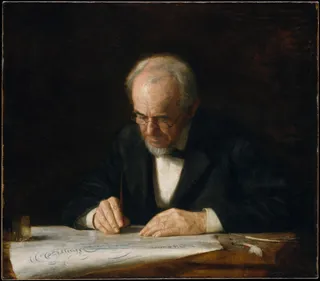 The Writing MasterThomas Eakins1882
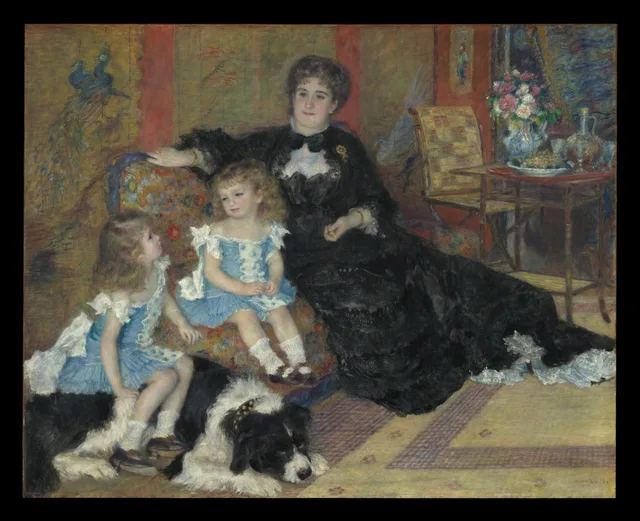 Madame Georges Charpentier (Marguerite-Louise Lemonnier, 1848–1904) and Her Children, Georgette-Berthe (1872–1945) and Paul-Emile-Charles (1875–1895)Auguste Renoir1878
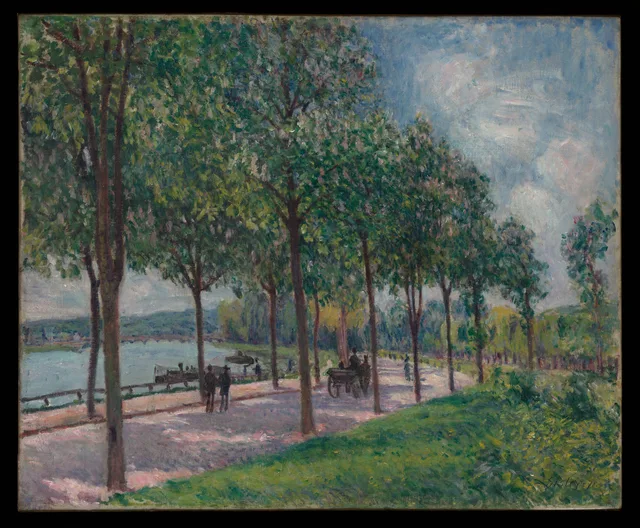 Allée of Chestnut TreesAlfred Sisley1878
Too good to keep to yourself
This painting,
for someone who comes to mind
They open it at full size
and see every brushstroke.
About this work
- Artist
- Berthe Morisot · 1841–1895
- Date
- 1875–80
- Medium
- Oil on canvas
- Size
- 60.3 × 80.4 cm
- Culture
- France
- Collection
- The Art Institute of Chicago
- Image
- Original long edge 4946px · shown at 2560px
- Original
- View on the museum's website ↗