 Pyeongye
Artwork · 19th century · Thomas Eakins
LeoTurn on Magnifier at the lower right and move slowly across the painting.
Full screen opens it edge to edge.Tap the painting to fill the screen.
Spread two fingers to look closer.
At a glance
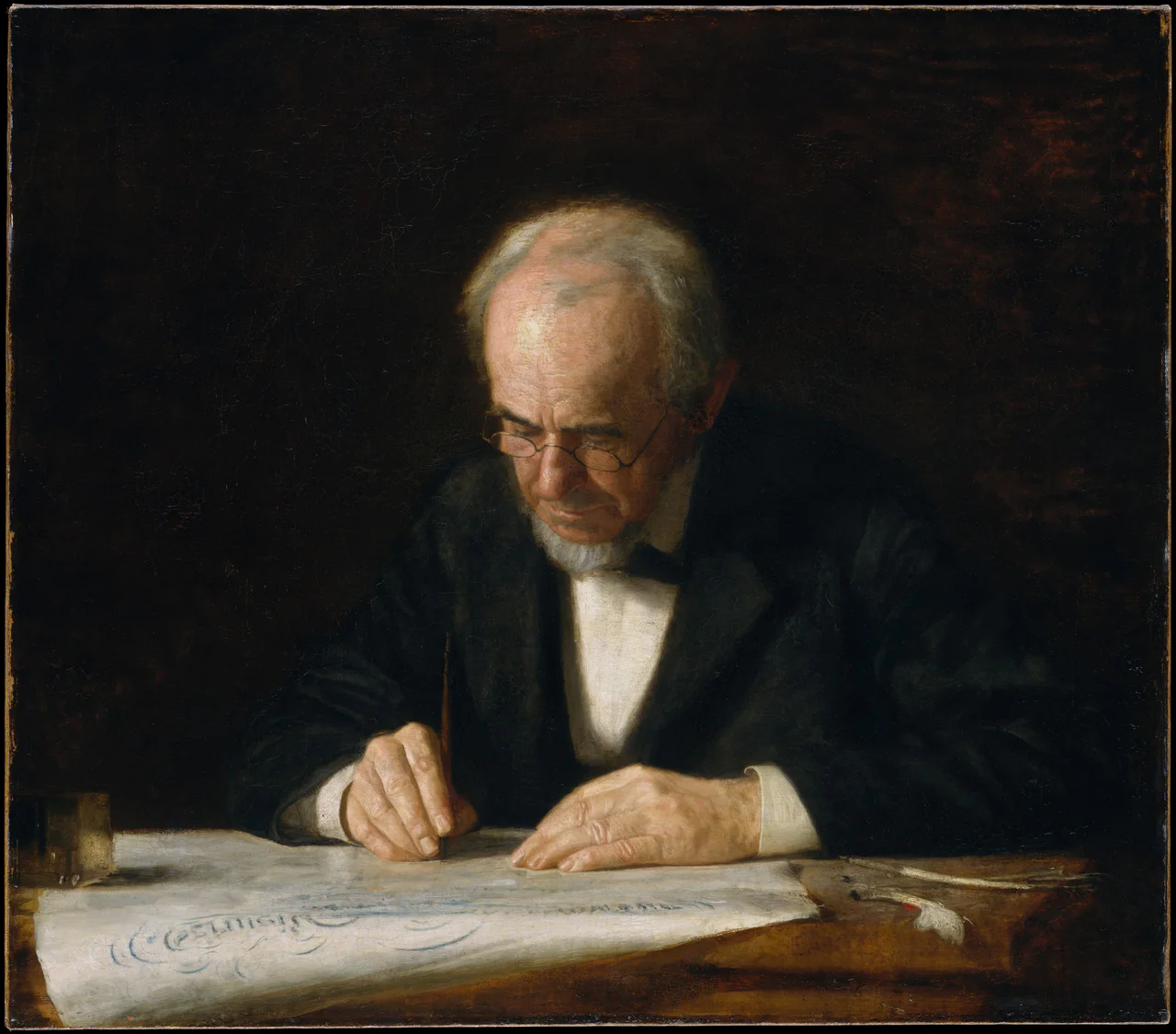
- An old man with white hair and wire glasses bends over a large sheet of paper in a dark room, pen in hand.
- Thomas Eakins painted it in 1882. The man is the artist's father, Benjamin Eakins.
- It catches a professional penman in the middle of his work, with the light gathered on his head, his hands, and the page.
Reading the picture
4 places to look closer
Tap a number on the painting to jump to its note, or a close-up to see that spot in the whole picture.
Start with the head. Light pools on the bald dome of his forehead, and Eakins has modeled the wrinkles one by one. Behind the round wire glasses, his eyes are nearly closed as he looks down. He has no idea anyone is watching him.
Now zoom in on the hands. His right hand holds a thin pen, the tip pressed right against the paper. His left hand lies flat, fingers spread, keeping the sheet still. You can see the knuckles, the ruddy skin, and the white shirt cuff. These are hands that have done this job for a long time.
Look at the lower left corner of the sheet. There are letters in bluish ink, wrapped in looping flourishes. From where we stand, the writing is upside down, because the page faces the writer, not us. The museum describes him copying a document in an old-fashioned copperplate script.
Move to the far right end of the table. Something that looks like a white feather and a long stick lie in the shadows, with one small spot of red between them. The farther you get from the man, the looser and faster the brushwork becomes. Eakins kept the sharp detail for the places he wanted you to look.
When it was painted
In 1882, Thomas Eakins was thirty-eight and living in Philadelphia. That year he became director of the schools of the Pennsylvania Academy of the Fine Arts. It was also a year of loss at home. His younger sister Margaret died in 1882.
The man in the picture, Benjamin Eakins, was a writing master. He taught the old copperplate style of handwriting in Philadelphia schools. He also engrossed documents, writing out deeds, diplomas, and other papers in a fine formal hand. The Metropolitan Museum suggests that Thomas probably got his first drawing lessons from him.
Benjamin helped his son in another way, too. He invested his money wisely, and that gave Thomas financial security for the rest of his life. Eakins could paint what he wanted without depending on sales.
The picture went on to a big stage. At the 1893 world's fair in Chicago, Eakins showed ten paintings, and The Writing Master was one of them. Benjamin Eakins died in 1899.
Thomas Eakins died in 1916. The next year, the Metropolitan Museum held a large memorial exhibition of his work, and in 1917 this painting entered the museum's collection. Look again at the tip of that pen. The hand the museum sees as the painter's first teacher is still at work, finishing one more careful stroke.
The painter
Thomas Eakins
1844–1916
When painting this, the artist was about 38 years old
All paintings by Thomas Eakins →More by the same painter
Questions to think about
- Look for itFind the three brightest spots in the painting. How do they lead your eye from one to the next?
- Why?Why do you think Eakins painted his father bent over his work, instead of looking out at us?
- What about you?Hardly anyone writes official documents by hand anymore. Is there a hand skill that machines now do for us that you wish people still learned?
Same period
Painted around the same time,
somewhere else
Too good to keep to yourself
This painting,
for someone who comes to mind
They open it at full size
and see every brushstroke.
About this work
- Artist
- Thomas Eakins · 1844–1916
- Date
- 1882
- Medium
- Oil on canvas
- Size
- 76.2 × 87 cm
- Culture
- American
- Collection
- The Metropolitan Museum of Art
- Image
- Original long edge 3793px · shown at 2560px
- Original
- View on the museum's website ↗