 Pyeongye
Artwork · 19th century · Jules Bastien-Lepage
LeoTurn on Magnifier at the lower right and move slowly across the painting.
Full screen opens it edge to edge.Tap the painting to fill the screen.
Spread two fingers to look closer.
At a glance
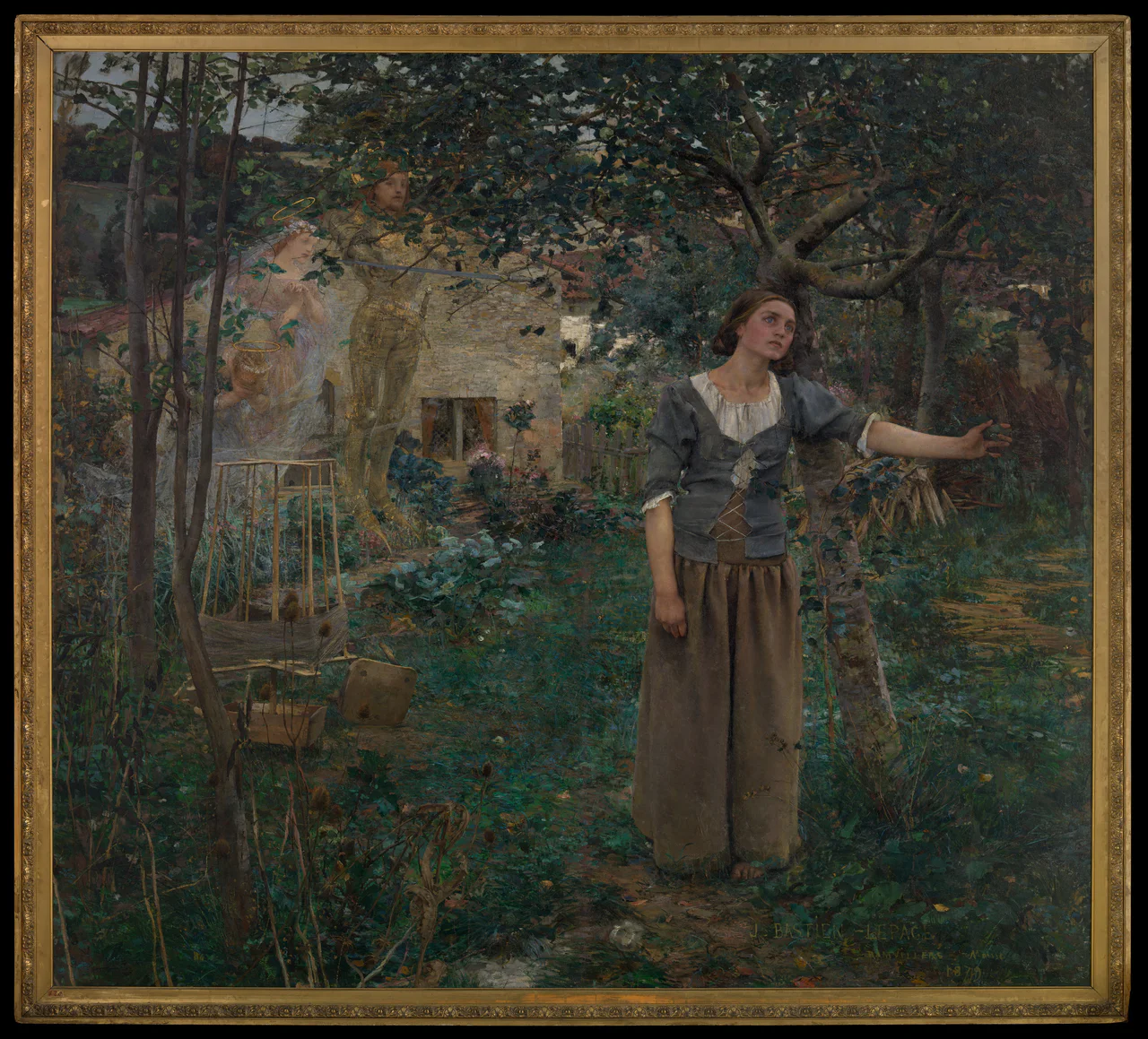
- Joan of Arc, a country girl working in a garden, has just jumped to her feet as see-through saints appear among the trees behind her.
- Jules Bastien-Lepage painted it in 1879, on a canvas about 2.5 meters high and 2.8 meters wide.
- The tipped-over stool and her bare feet look solid enough to touch, yet the saints right beside her are half transparent.
Reading the picture
5 places to look closer
Tap a number on the painting to jump to its note, or a close-up to see that spot in the whole picture.
Zoom in on Joan's face. Her pale blue eyes are wide open, but they are not fixed on anything. Her lips are pressed shut and her cheeks are slightly flushed. This is the face of someone frozen in place by a sound.
Follow her outstretched left arm. Her hand pushes into the leaves and closes around them. It could be a hand grabbing something so she will not fall, or a hand that reached out before she knew it.
Now look into the trees at upper left. A woman with a gold ring over her head holds her hands together. Beside her, a man in armor holds a long sword across his body. Below them is one more figure with a gold ring. You can see the wall of the house through their bodies. At her trial, Joan said she heard the voices of Saint Michael, Saint Catherine, and Saint Margaret.
Go down to the lower left. Next to a wooden frame strung with thread, a square stool lies upside down. It looks as if Joan knocked it over when she stood up all at once. In front of it, dry stalks with round, spiky heads poke up from the ground.
Check the grass at lower right. The painter's name, the village name Damvillers, and the year 1879 are faintly written among the weeds. Damvillers was the painter's hometown.
When it was painted
In 1879 Jules Bastien-Lepage was not in Paris. He was home in Damvillers, a village in Lorraine, in eastern France, working on this enormous canvas. For the setting he drew on the garden of his own family's house. Joan's village, Domremy, lies in the same region, so for him she was a legend and a local girl at once.
He had trained in Paris at the École des Beaux-Arts under Alexandre Cabanel. He competed for the Prix de Rome, the prize young painters there hoped for, and did not win it. So he turned to the fields and farm people he had grown up with. His Haymaking, shown at the Salon of 1878, made his name.
The war had touched him too. When France and Prussia went to war in 1870, he joined up and was wounded. France lost, and in 1871 it handed over Alsace and part of Lorraine. In the years that followed, Joan, the country girl from Lorraine who set out to save France, became a name the hurt nation called on again and again.
The painting went on view at the Paris Salon of 1880. Critics praised Joan's face and pose, but many felt the see-through saints clashed with such a realistic garden. After the Salon, the American businessman Erwin Davis bought it, and in 1889 he gave it to the Metropolitan Museum. The painter did not live to see that. He died in 1884, at thirty-six.
Now look again. Every leaf and weed seems taken from a real garden, and only the saints are as thin as glass. The very contrast that bothered those critics is what sends your eye straight back to Joan's face.
The painter
Jules Bastien-Lepage
1848–1884
When painting this, the artist was about 31 years old
All paintings by Jules Bastien-Lepage →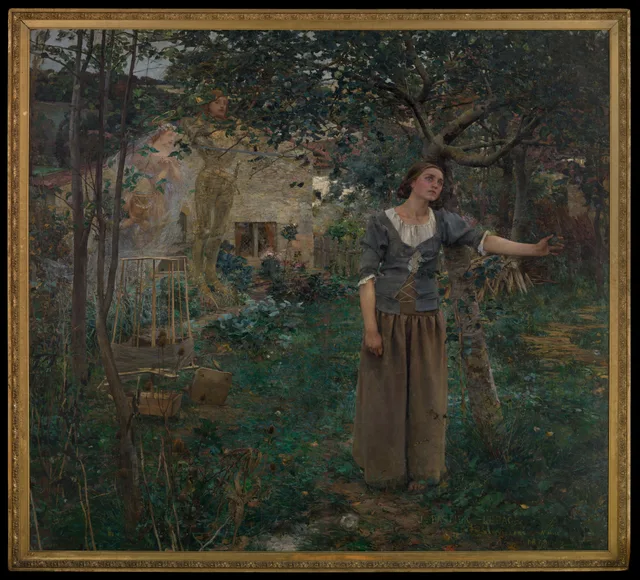
Questions to think about
- Look for itHow many see-through figures and gold rings can you find behind Joan?
- Why?Why do you think the painter chose this quiet moment in the garden instead of Joan on the battlefield?
- What about you?In hard times, people bring old heroes back to life. Do we sometimes reshape historical figures to fit our own goals today?
Same period
Painted around the same time,
somewhere else
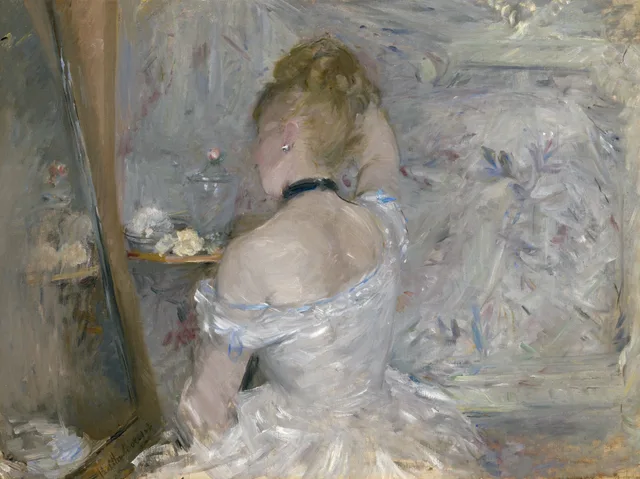 Woman at Her ToiletteBerthe Morisot1875–80
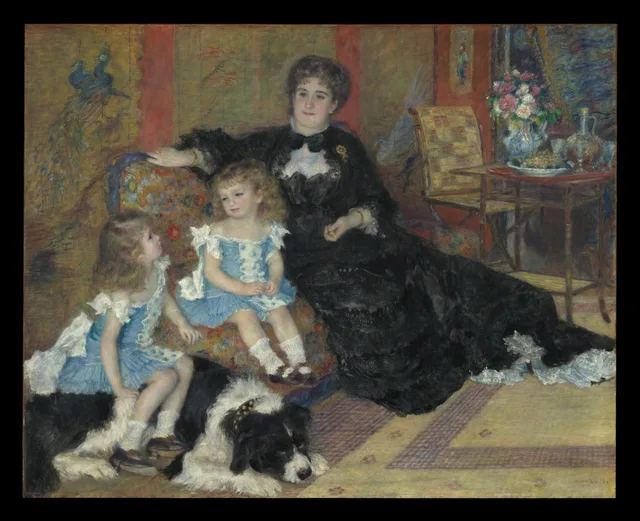 Madame Georges Charpentier (Marguerite-Louise Lemonnier, 1848–1904) and Her Children, Georgette-Berthe (1872–1945) and Paul-Emile-Charles (1875–1895)Auguste Renoir1878
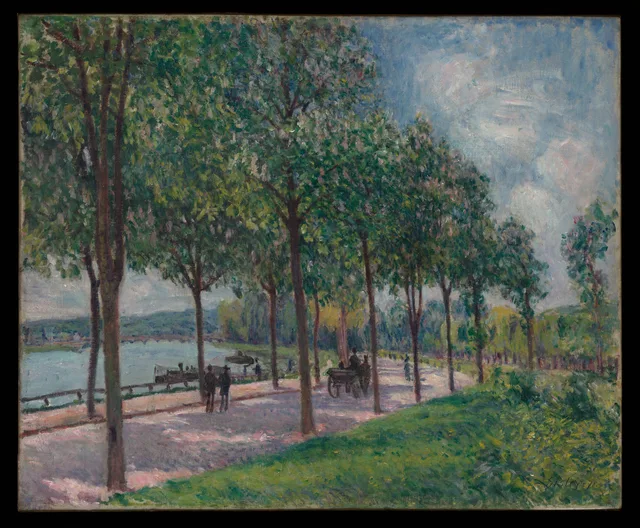 Allée of Chestnut TreesAlfred Sisley1878
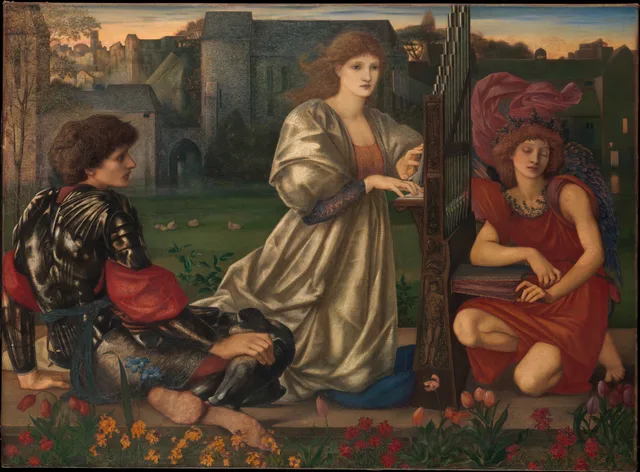 The Love SongSir Edward Burne-Jones1868–77
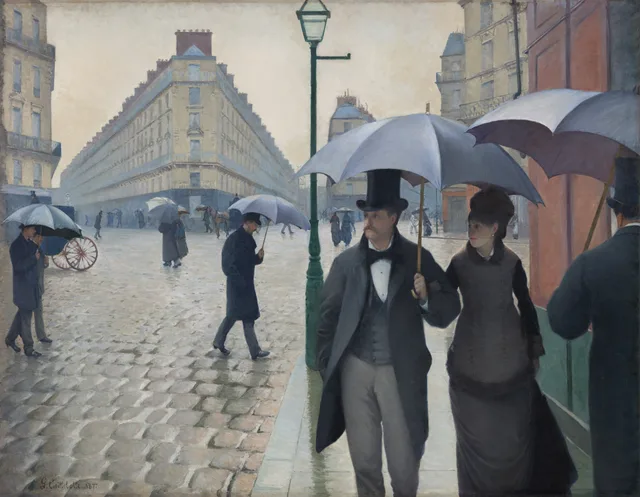 Paris Street; Rainy DayGustave Caillebotte1877
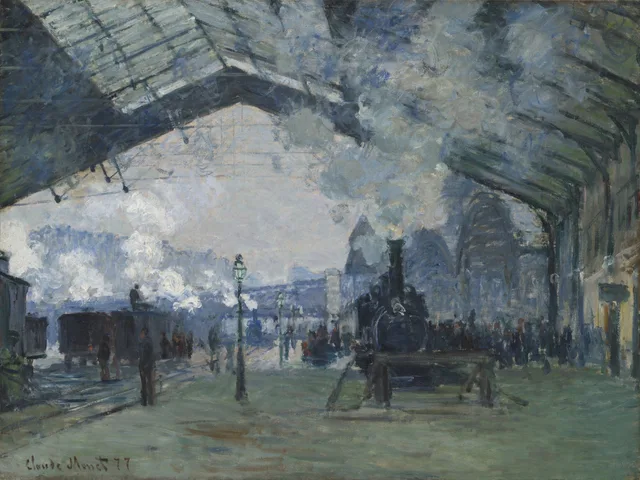 Arrival of the Normandy Train, Gare Saint-LazareClaude Monet1877
Too good to keep to yourself
This painting,
for someone who comes to mind
They open it at full size
and see every brushstroke.
About this work
- Artist
- Jules Bastien-Lepage · 1848–1884
- Date
- 1879
- Medium
- Oil on canvas
- Size
- 254 × 279.4 cm
- Collection
- The Metropolitan Museum of Art
- Image
- Original long edge 4000px · shown at 2560px
- Original
- View on the museum's website ↗