 Pyeongye
Artwork · 15th century · Giovanni di Paolo
LeoTurn on Magnifier at the lower right and move slowly across the painting.
Full screen opens it edge to edge.Tap the painting to fill the screen.
Spread two fingers to look closer.
At a glance
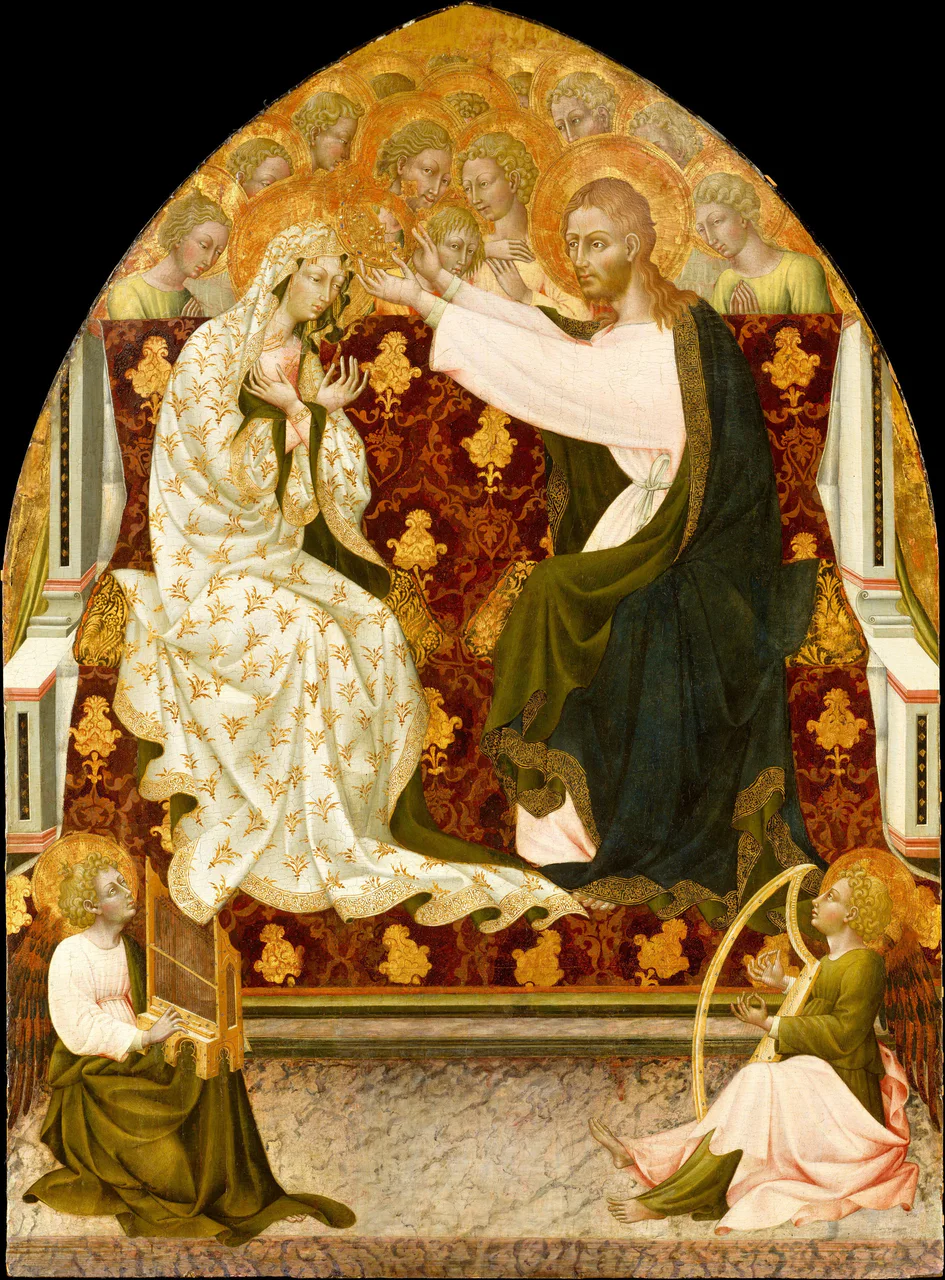
- Christ places a crown on the head of his mother, Mary, as they sit side by side on a throne in heaven.
- Giovanni di Paolo, a painter of Siena, made it around 1455 in tempera on wood, over a ground of gold.
- The pointed panel is nearly six feet tall, packed with gold and deep red patterns, with two angel musicians seated at the bottom.
Reading the picture
5 places to look closer
Tap a number on the painting to jump to its note, or a close-up to see that spot in the whole picture.
Start at the center, with Christ's fingertips. The crown is gold, studded with small red and blue jewels. He pinches it delicately, just about to lower it onto Mary's head. Mary folds her hands at her chest and bows.
Now look up into the pointed top. Angels are stacked there, row behind row. In the back row you can barely see more than the tops of their curly heads. Their gold halos overlap so much that the whole sky seems made of gold.
Get close to Mary's white robe. Small gold sprigs, like little leaves, are spread evenly across it. Over them runs a web of fine cracks. These come from layers of old paint drying and splitting over the centuries.
At the lower left, an angel rests a small organ on one knee and presses its keys. Thin pipes stand in rows inside a gold case. The angel lifts its face to watch the scene above, and its wings are made of reddish brown feathers.
At the lower right, another angel hugs a harp and plucks the strings. A pale pink robe spills out across the marble floor, and a bare foot peeks out. Together, the two angels supply the music for the coronation.
When it was painted
Siena, around 1455. Giovanni di Paolo was in his mid-fifties. He had been born in this city and worked here for nearly his whole life, painting altarpieces for its churches and religious orders since the 1420s.
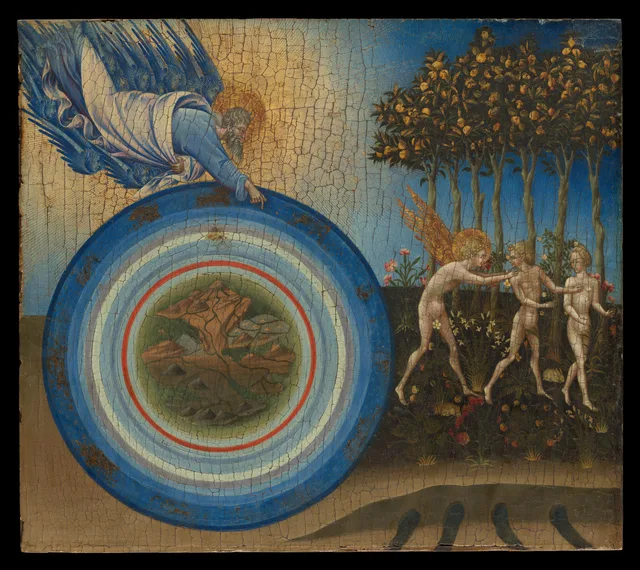
About ten years before, 1445 had been a full year. He painted a large altarpiece for the church of San Domenico in Siena, and one of the small scenes from its base, a panel of Paradise, now hangs in the Met along with this picture. That same year he painted a Coronation of the Virgin altarpiece for the Sienese church of Sant'Andrea. Here he was coming back to that subject.
In the 1440s he also painted the pictures for a manuscript of Dante's Paradiso, the heaven section of the Divine Comedy. The book is now in the British Library in London, its pages lined with his visions of the heavens. Painting the sky above was familiar ground for him.
The Met suggests that a row of small scenes from the life of the Virgin may once have run beneath this big panel. Only the main panel survives today.
Giovanni kept working for decades. In 1458 a Sienese man became Pope Pius II, and he rebuilt his home village as a new town called Pienza. In 1463 Giovanni di Paolo painted an altarpiece for its new cathedral. He died in Siena in 1482, past the age of eighty. This panel later belonged to the Lehman family collection in New York and came to the Met in 1975.
Now look at the red cloth hanging behind the two figures. Gold flowers bloom across it in neat rows. A painter who had decorated his city's altars for decades set even this heavenly coronation in front of a cloth this splendid.
Questions to think about
- Look for itHow many angels' faces can you count in the top part of the picture?
- Why?Why do you think Giovanni di Paolo filled the sky with gold instead of painting it blue?
- What about you?When we honor someone today, at a graduation or an awards night, how much music and decoration is right, and when does it become too much?
Same period
Painted around the same time,
somewhere else
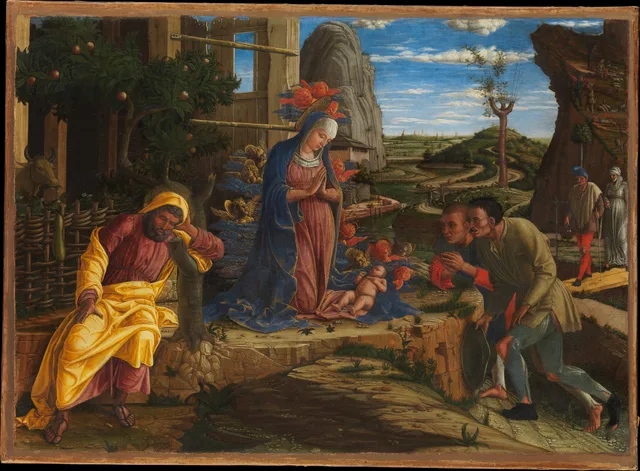 The Adoration of the ShepherdsAndrea Mantegnashortly after 1450
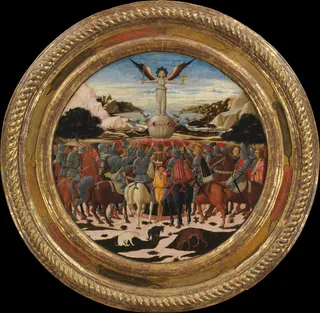 The Triumph of Fame; (reverse) Impresa of the Medici Family and Arms of the Medici and Tornabuoni FamiliesGiovanni di ser Giovanni Guidica. 1449
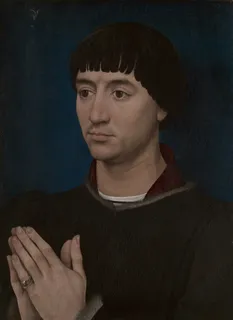 Portrait of Jean Gros (recto); Coat of Arms of Jean Gros (verso)Rogier van der Weyden1460–64
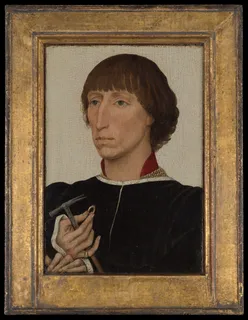 Francesco d'Este (born ca. 1429, died after 1486)Rogier van der Weydenca. 1460
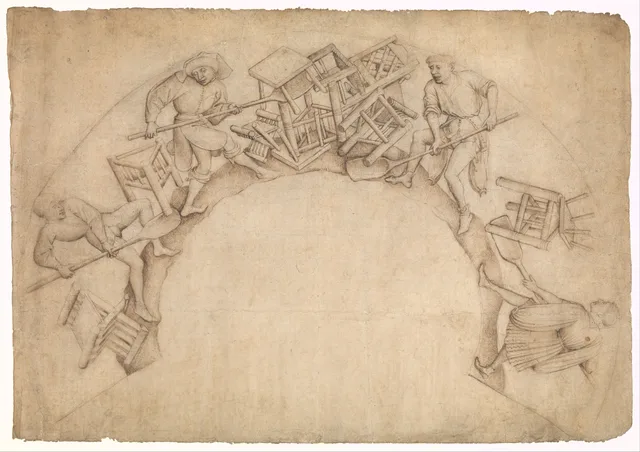 Men Shoveling Chairs (Scupstoel)Vranke van der Stockt1444–50
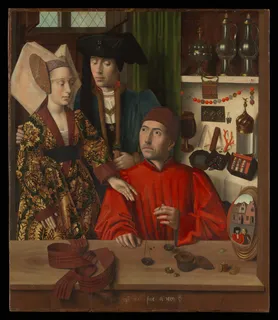 A Goldsmith in his ShopPetrus Christus1449
Too good to keep to yourself
This painting,
for someone who comes to mind
They open it at full size
and see every brushstroke.
About this work
- Artist
- Giovanni di Paolo · 1398–1482
- Date
- ca. 1455
- Medium
- Tempera on wood, gold ground
- Size
- 179.4 × 131.4 cm
- Collection
- The Metropolitan Museum of Art
- Image
- Original long edge 3722px · shown at 2560px
- Original
- View on the museum's website ↗