 Pyeongye
Artwork · 15th century · Giovanni di Paolo
LeoTurn on Magnifier at the lower right and move slowly across the painting.
Full screen opens it edge to edge.Tap the painting to fill the screen.
Spread two fingers to look closer.
The Annunciation to Zacharias; (verso) The Angel of the Annunciation
Giovanni di Paoloca. 1455–60Tempera and gold on wood75.9 × 43.2 cm
At a glance
- An old priest, Zacharias, is burning incense in the Temple when an angel appears and tells him he will have a son.
- Giovanni di Paolo of Siena painted it around 1455 to 1460, in tempera and gold on wood.
- A dream Temple stacked with domes fills the pointed panel, and the back of the panel holds another painted angel.
Reading the picture
4 places to look closer
Tap a number on the painting to jump to its note, or a close-up to see that spot in the whole picture.
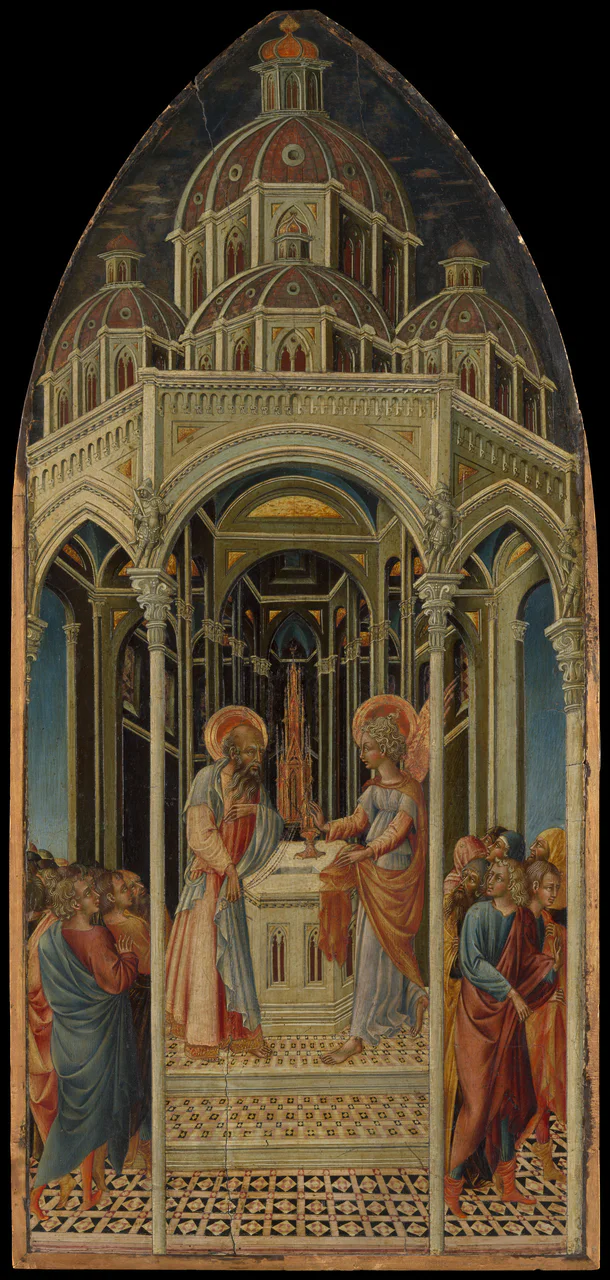
Begin at the very top. Red domes rise in three tiers, the big ones pierced with round windows. Below them run rows of tall, pointed windows. No one ever built this Temple. The painter invented it, one dome on top of another.
Now go down to the altar in the middle. Zacharias, with his long beard, lays a hand on his chest and looks at the angel. From his other hand hang the long chains of a censer, the swinging pot used for burning incense. The curly-haired angel reaches toward a golden vessel on the altar.
Look outside the columns on the left. A group of young men tilt their heads back and stare in the same direction. The one in the blue cloak lifts his hand halfway. They have no idea what is happening inside. They are simply waiting.
More people crowd in on the right. A bearded old man glances toward the Temple, and a young man with blond curls turns his head the same way. The ones at the back lift their faces upward. Everyone is packed shoulder to shoulder.
When it was painted
Around 1455, Giovanni di Paolo was nearing sixty. He had been painting altarpieces in Siena for decades. Now he took on a long cycle that told the life of John the Baptist in twelve scenes. This panel is the very first of them.
The story comes from the Gospel of Luke. Zacharias, an old priest, and his wife Elizabeth had no children. While he was burning incense in the Temple, the angel Gabriel appeared and told him they would have a son. That son would become John the Baptist.
The Metropolitan Museum thinks the twelve panels most likely formed the two movable wings of a cupboard that held a statue or a relic of Saint John. The back of this panel is painted too, with the angel of the Annunciation.
Later the cycle was broken up. Six of the scenes are now in the Art Institute of Chicago. This opening scene came to the Metropolitan Museum in 1975, with the collection of the banker Robert Lehman.
Around the same years, Giovanni di Paolo took part in another big project. Pope Pius II rebuilt his home village as a new town called Pienza and gave it a cathedral. Giovanni di Paolo was one of the Sienese painters who made altarpieces for it.
Now look again at the people outside the columns. Luke says that when Zacharias stayed inside the Temple too long, the people waiting outside began to wonder what had happened. A story told across twelve scenes begins right here, with a crowd that cannot see what we can.
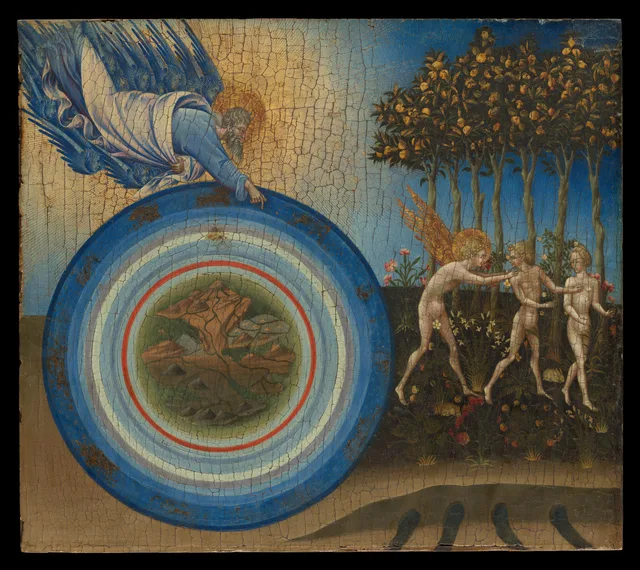
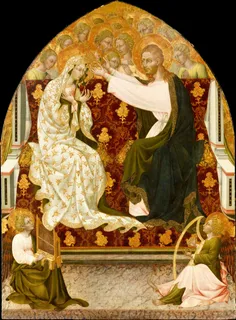
More by the same painter
Questions to think about
- Look for itCan you follow the censer chains from Zacharias's hand all the way down?
- Why?Why do you think the painter gave so much room to the crowd outside, instead of to the two figures inside?
- What about you?Zacharias lost his voice because he could not believe good news. If something you had hoped for over many years suddenly came true, would you feel joy first, or doubt?
Same period
Painted around the same time,
somewhere else
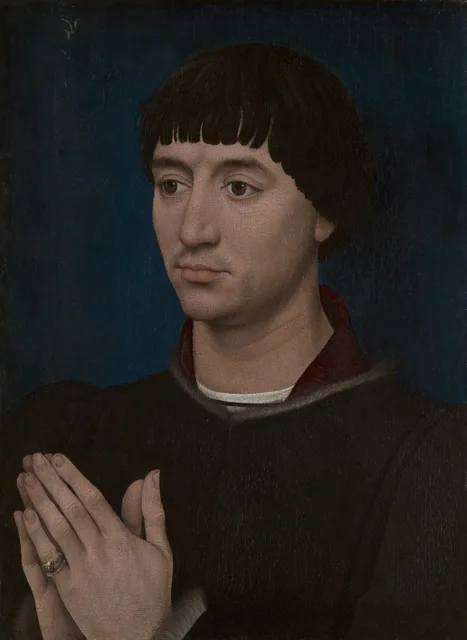 Portrait of Jean Gros (recto); Coat of Arms of Jean Gros (verso)Rogier van der Weyden1460–64
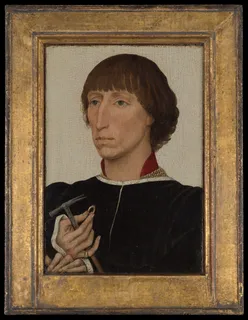 Francesco d'Este (born ca. 1429, died after 1486)Rogier van der Weydenca. 1460
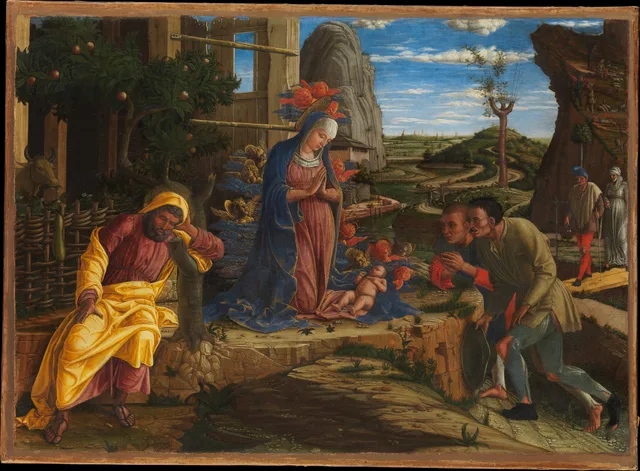 The Adoration of the ShepherdsAndrea Mantegnashortly after 1450
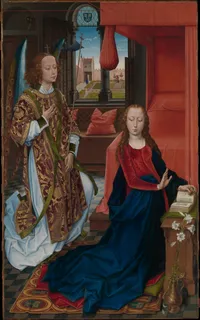 The AnnunciationHans Memlingca. 1465–70
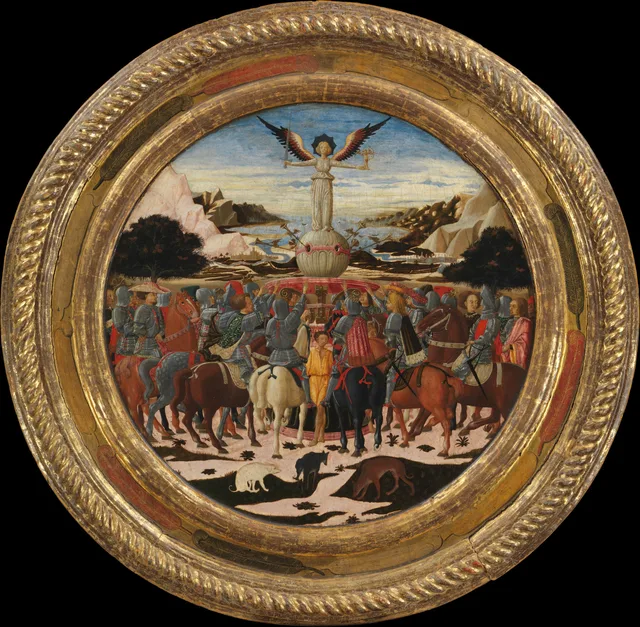 The Triumph of Fame; (reverse) Impresa of the Medici Family and Arms of the Medici and Tornabuoni FamiliesGiovanni di ser Giovanni Guidica. 1449
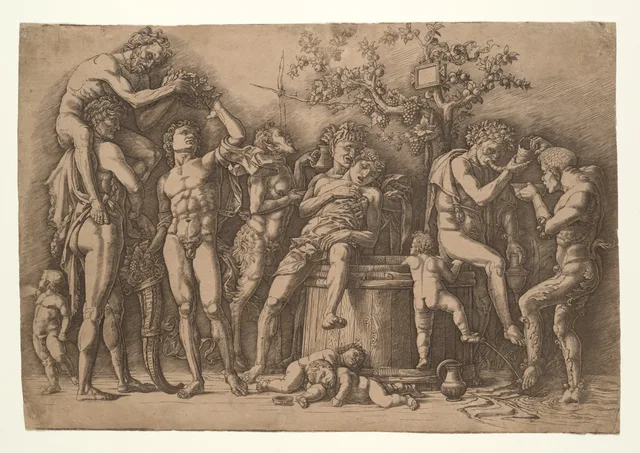 Bacchanal with a Wine VatAndrea MantegnaBefore 1475
Too good to keep to yourself
This painting,
for someone who comes to mind
They open it at full size
and see every brushstroke.
About this work
- Artist
- Giovanni di Paolo · 1398–1482
- Date
- ca. 1455–60
- Medium
- Tempera and gold on wood
- Size
- 75.9 × 43.2 cm
- Collection
- The Metropolitan Museum of Art
- Image
- Original long edge 4000px · shown at 2560px
- Original
- View on the museum's website ↗