Pyeongye
Painters · 15th century
Giovanni di Paolo
1398–1482
A painter who lived past eighty and filled the churches of his native Siena, and even a king's book of Paradise, with gold.
Scenes from a life
The life of Giovanni di Paolo,
scene by scene
- 1427Siena
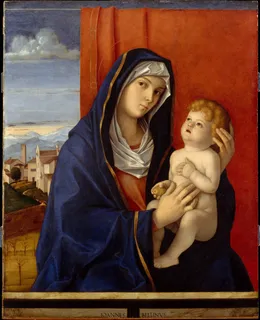
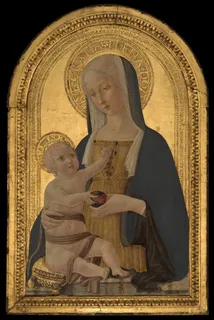
A new altarpiece goes up in the chapel of the Branchini family in the church of San Domenico, Siena. The family had ordered it, and the central panel of the Virgin carries the painter's name and the year: Giovanni di Paolo. Only a year earlier he had signed and dated another altarpiece in the same church, the Pecci altarpiece.
Over the centuries the Branchini altarpiece was broken up and scattered. For a long time only the central Madonna was known to belong to it. Then in 2009 scholars in Europe linked other panels to it. In 2016 the Getty Museum in Los Angeles brought several of the scattered pieces back together for an exhibition. The Madonna itself now hangs in the Norton Simon Museum in Pasadena.
- 1445Siena
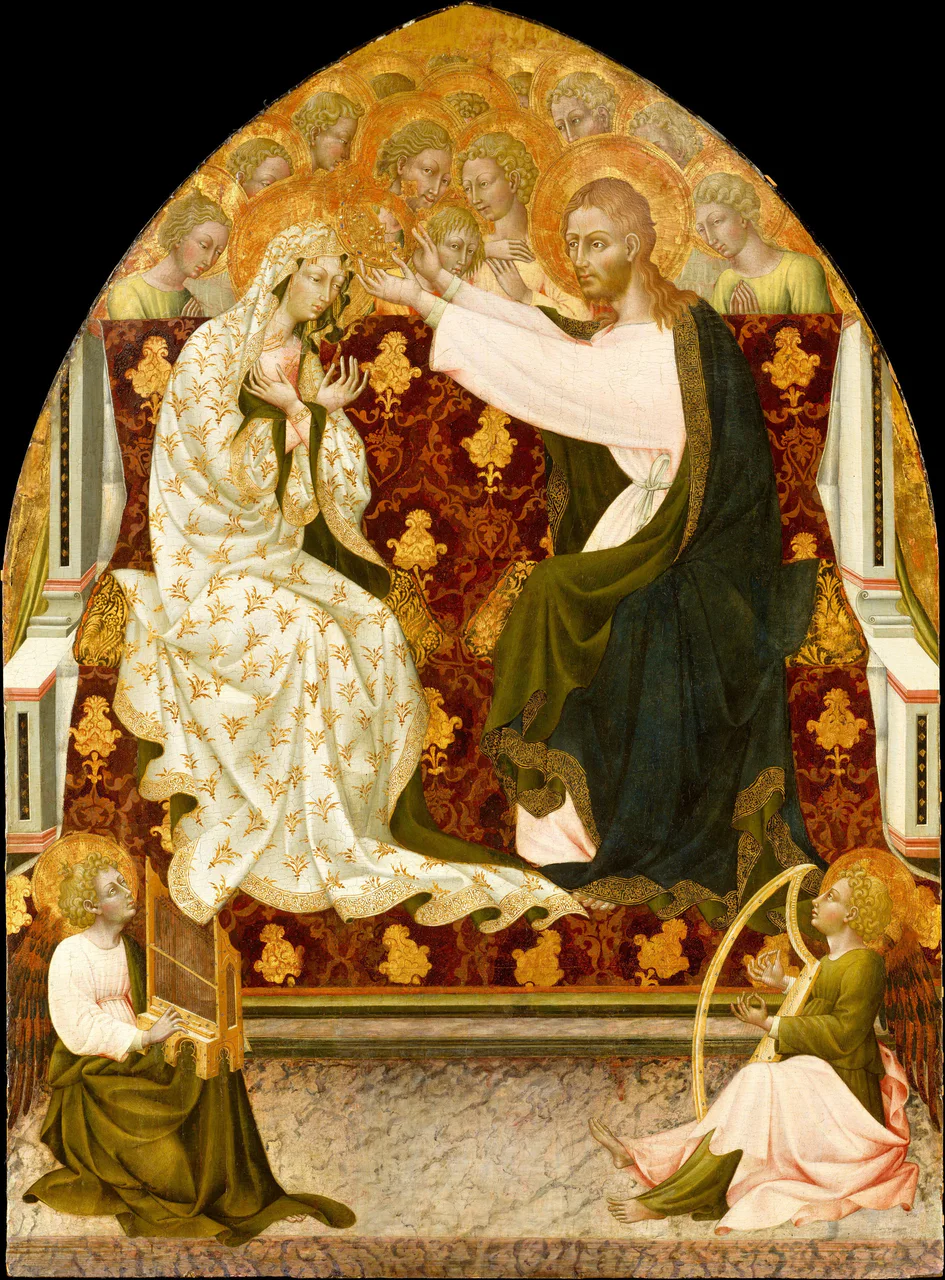
Now in his late forties, Giovanni sets up yet another large altarpiece in San Domenico, his fourth for that church. The same year he also painted a Coronation of the Virgin for the Sienese church of Sant'Andrea. It was a busy year.
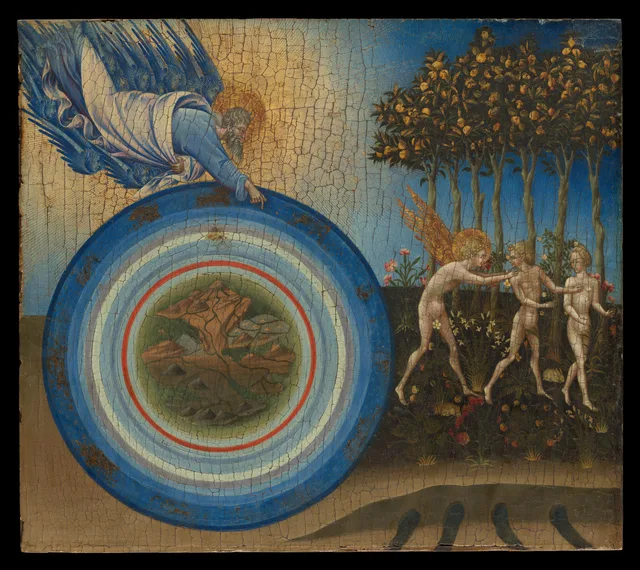
Along the bottom of the new altarpiece ran a row of small story panels. One of them is The Creation of the World and the Expulsion from Paradise. Look at the upper left. God, in blue, sweeps in and points with one finger at a huge round world. On the right, an angel with golden wings pushes Adam by the shoulder out of the garden.
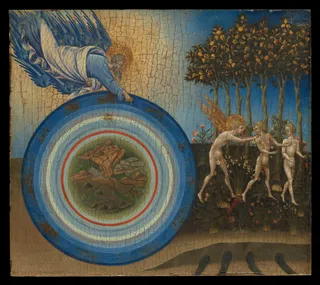 Painted around this timeThe Creation of the World and the Expulsion from Paradise
- 1444–50Siena
A large book is passing through the hands of Sienese painters. It is a manuscript copy of Dante's Divine Comedy. Other artists illustrated Hell and Purgatory. Giovanni di Paolo took Paradise.
The book is known as the Divine Comedy of Alfonso V, king of Aragon and Naples. It changed hands many times over the centuries. In 1901 the English collector Henry Yates Thompson bought it, and in 1941 it entered the British Museum. Today it is in the British Library in London.
- 1462Pienza
Pope Pius II rebuilds the country village where he was born as a brand-new town, and names it Pienza, after himself. For the new cathedral he orders one altarpiece each from four Sienese painters: Giovanni di Paolo, Sano di Pietro, Vecchietta and Matteo di Giovanni.
In September 1462 the pope issued a bull to protect the building. No one was to bury the dead inside, except in the place set aside for it, and no one was to change the bright color of the walls. In his memoirs Pius called the church a house of glass. The white walls were left bare, with only the Sienese altarpieces standing against them.
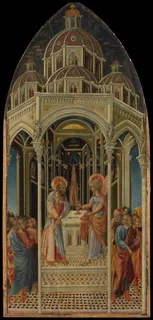
A few years before, Giovanni had painted the life of Saint John the Baptist in twelve scenes. In the first, an angel appears to the old priest Zacharias inside a temple stacked with red domes.
Painted around this timeThe Annunciation to Zacharias; (verso) The Angel of the Annunciation - 1482Siena
On 29 January 1482, Giovanni di Paolo, now past eighty, dictates his will. He died that March. He had spent more than half a century covering the altars of Siena in gold, yet after his death his name slipped out of sight for a long time.
In 1937 the English art historian John Pope-Hennessy published a book on him. Using the notes of a seventeenth-century Sienese writer as a clue, Pope-Hennessy was the first to propose that a group of scattered small panels came from an altarpiece in the Guelfi family chapel in San Domenico. The Creation of the World is one of them.
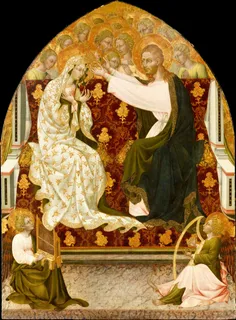
In the Coronation of the Virgin, Christ lifts a jeweled gold crown with his fingertips, about to set it on Mary's head. The panel belonged to the banker Robert Lehman and came to the Metropolitan Museum of Art with the rest of his collection in 1975.
 Painted around this timeCoronation of the Virgin
People around them
- The Branchini familyin 1427 they commissioned Giovanni's altarpiece for their chapel in San Domenico.
- Alfonso Vking of Aragon and Naples, whose name is attached to the Divine Comedy manuscript Giovanni illustrated.
- Pius IIthe pope who founded Pienza and gave Giovanni one of the altarpieces for its new cathedral.
- Sano di Pietroa Sienese painter of the same generation who also painted an altarpiece for Pienza cathedral.
Works