 Pyeongye
Artwork · 19th century · Tara
LeoTurn on Magnifier at the lower right and move slowly across the painting.
Full screen opens it edge to edge.Tap the painting to fill the screen.
Spread two fingers to look closer.
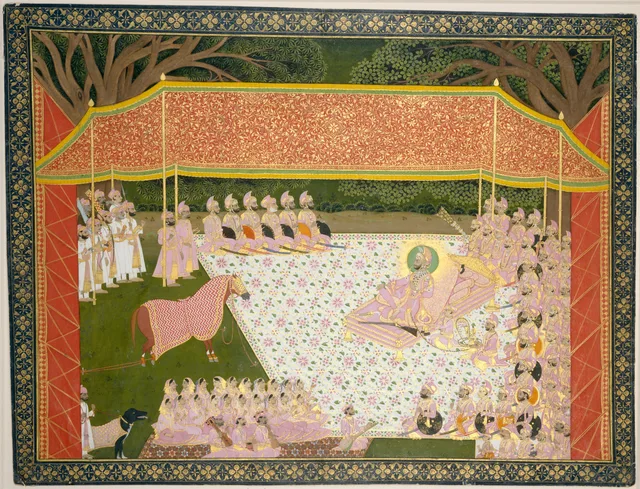
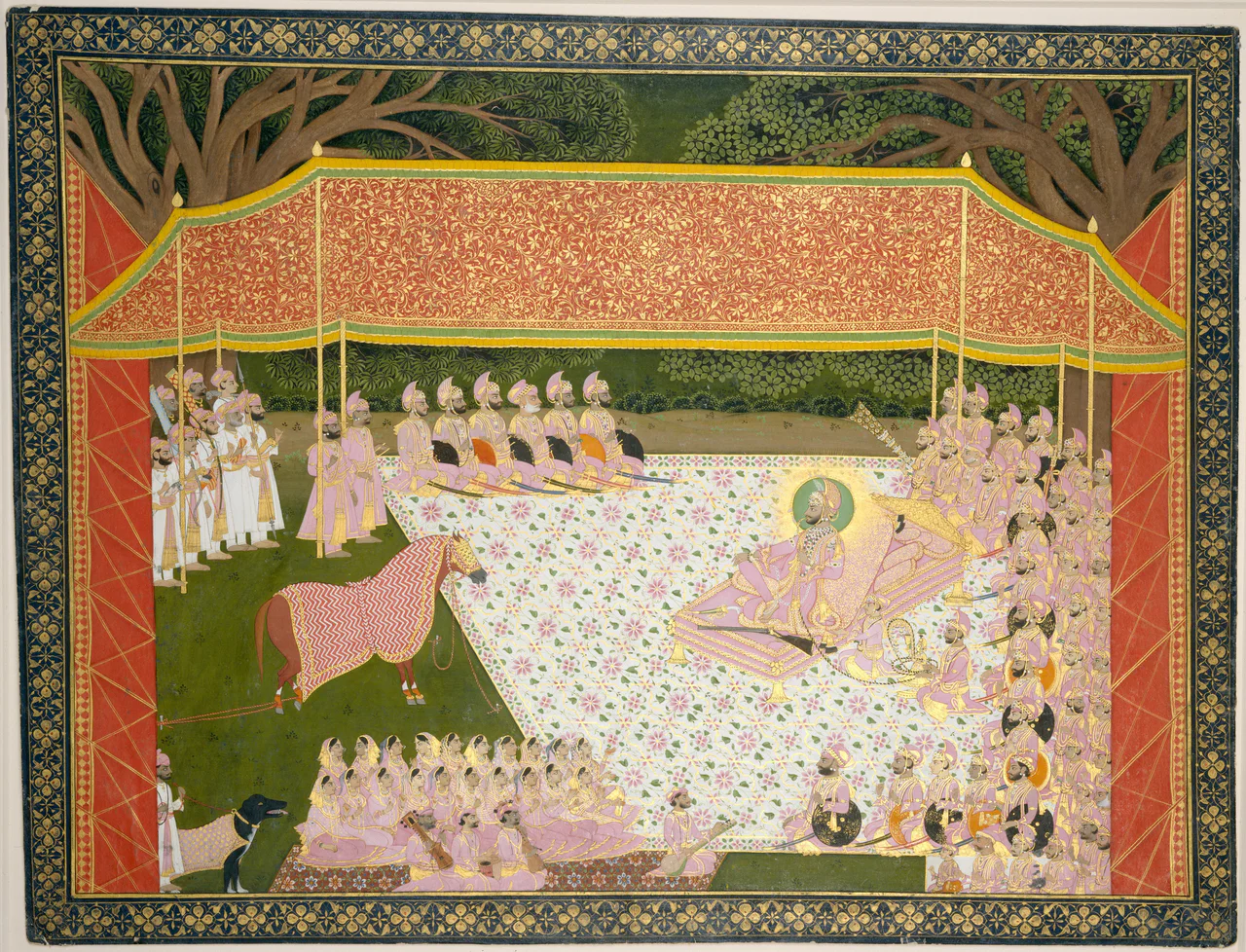
Maharana Sarup Singh Inspects a Prize Stallion
Tara1845–46Opaque watercolor, ink, and gold on paper42.5 × 57.8 cm
At a glance
- Maharana Sarup Singh, ruler of Mewar in western India, sits under a great canopy and inspects a prize stallion in front of his court and musicians.
- Tara, a painter at the Mewar court, made it in 1845–46 with opaque watercolor, ink, and gold on paper.
- On a large sheet nearly 58 centimeters wide, he carefully packed in the people and animals of the scene, right down to a dog.
Reading the picture
4 places to look closer
Tap a number on the painting to jump to its note, or a close-up to see that spot in the whole picture.
Find the ruler, right of center. Behind his head is a green disc with golden rays spreading out. In Mewar painting, this halo marks the king. He sits in profile, holding the pipe of a hookah to his lips, with a long gun lying in front of his knees.
Zoom in on the horse at the left. It wears a red and white zigzag blanket and a gold ornament over its face. Look at its legs. Ropes are tied to its front and back feet and pulled out to either side. This valuable animal is being held still so it cannot bolt.
Now the women along the bottom. Dressed in pink with gold veils, they sit in two rows, clapping or raising their hands. In front of them, men hold a drum and stringed instruments. These are the singers and players performing for the king.
Check the lower left corner. A black dog wears a pink coat dotted with gold and a gold collar. A servant in white holds its leash. The painter did not leave out even this dog with its tongue hanging out.
When it was painted
In the 1840s, in Udaipur, the city of lakes, the leading painter in the workshop of the Mewar court was a man named Tara. The Metropolitan Museum describes him as the leading artist of Maharana Sarup Singh's studio. He made his name by recording the big events of the ruler's life, inside the palace and out across the kingdom.
Sarup Singh came to the throne in 1842 and ruled until 1861. This painting was made three or four years into his reign. Around the same time, in 1844–45, Tara also painted the maharana hunting at Haridas ki Magri. That picture is now in the National Gallery of Victoria in Australia.
Turn this sheet over and there is writing on the back. It names the ruler, the horse, and the leading courtiers who were there. So the museum reads the painting as a record of one real occasion, and suggests it may have been the maharana's birthday.
Tara trained his two sons, Shivalal and Mohanlal, as painters. From around 1858, works appear that Tara and Shivalal made together. Shivalal later took over his father's place as chief painter of the Mewar court.
By then the camera had reached Udaipur too. Mohanlal turned to photography. Shivalal worked with the new medium as a painter, coloring photographic prints by hand. This painting came to the Metropolitan Museum in 2001 through the Cynthia Hazen Polsky and Leon B. Polsky Fund.
Now look at the horse on the left again. Its name is written on the back of the sheet. Before cameras came to the court, Tara set down that one animal on that one day, right down to each line of its zigzag blanket.
Questions to think about
- Look for itHow many people holding musical instruments can you find?
- Why?Why do you think Tara placed the king off to the right, while the horse and the wide carpet take up so much space on the left?
- What about you?Compare this painting with the photos we take on our phones to remember an event; what is the same, and what is different?
Same period
Painted around the same time,
somewhere else
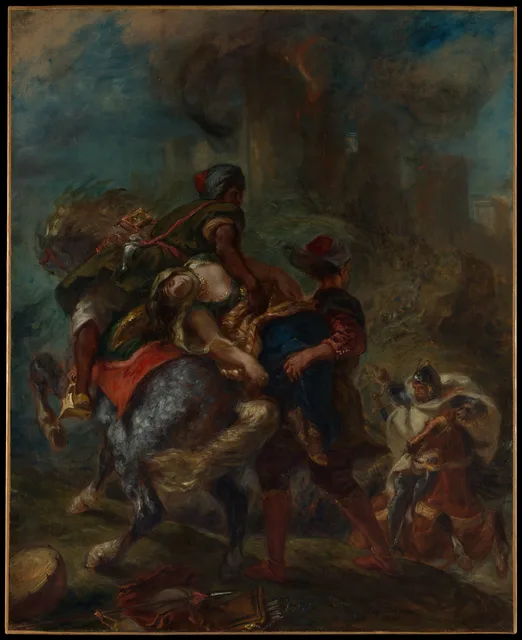 The Abduction of RebeccaEugène Delacroix1846
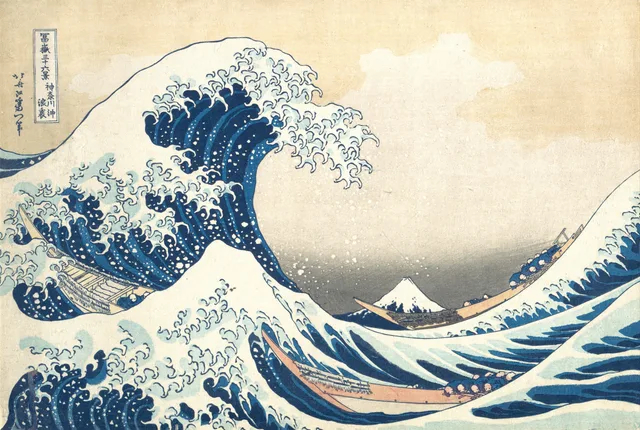 Under the Wave off Kanagawa (Kanagawa oki nami ura), also known as The Great Wave, from the series Thirty-six Views of Mount Fuji (Fugaku sanjūrokkei)Katsushika Hokusaica. 1830–32
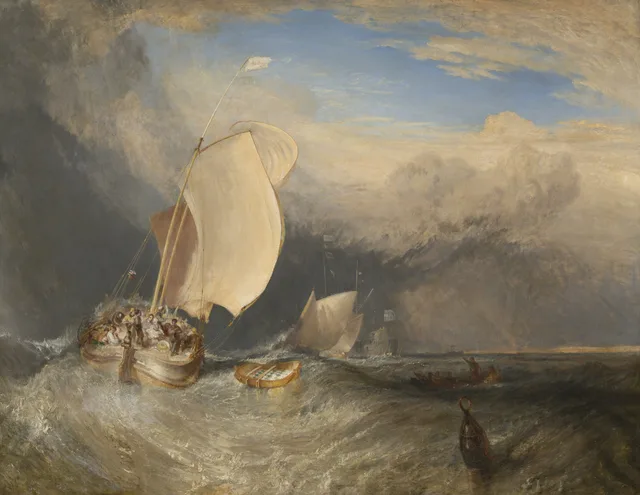 Fishing Boats with Hucksters Bargaining for FishJoseph Mallord William Turner1837–38
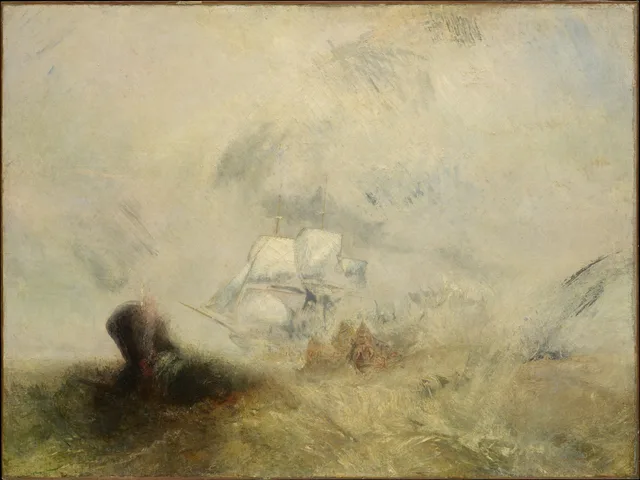 WhalersJoseph Mallord William Turnerca. 1845
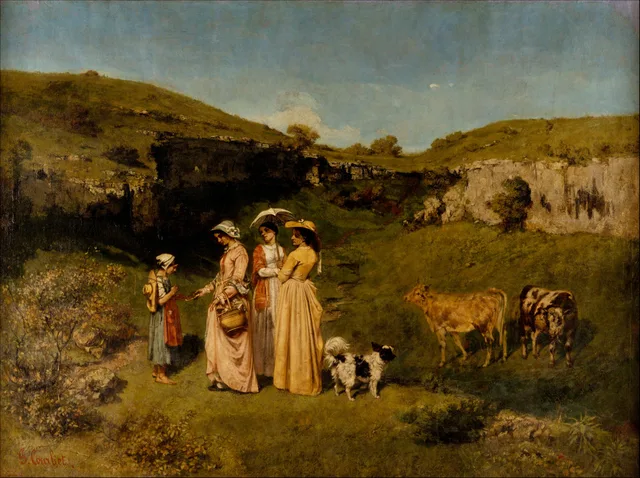 Young Ladies of the VillageGustave Courbet1851–52
 Madame Félix GalloisJean Auguste Dominique Ingres1852
Too good to keep to yourself
This painting,
for someone who comes to mind
They open it at full size
and see every brushstroke.
About this work
- Artist
- Tara · 1836–1870
- Date
- 1845–46
- Medium
- Opaque watercolor, ink, and gold on paper
- Size
- 42.5 × 57.8 cm
- Culture
- Western India, Rajasthan, Mewar
- Collection
- The Metropolitan Museum of Art
- Image
- Original long edge 4000px · shown at 2560px
- Original
- View on the museum's website ↗