 Pyeongye
Artwork · 19th century · Joseph Mallord William Turner
LeoTurn on Magnifier at the lower right and move slowly across the painting.
Full screen opens it edge to edge.Tap the painting to fill the screen.
Spread two fingers to look closer.
At a glance
- A whale and a whaling crew locked in struggle, somewhere in a hazy sea.
- Painted by Joseph Mallord William Turner around 1845, when he was about seventy.
- Whale, ship and sailors all dissolve into mist and spray. This is a painting you read by searching for what is there.
Reading the picture
5 places to look closer
Tap a number on the painting to jump to its note, or a close-up to see that spot in the whole picture.
Start with the dark mass at the lower left. It is the body of a whale rising out of the water. A white spout shoots up near its head, and red paint bleeds across the lower part of its body. Turner gave the whale no clear outline, only darkness and spray.
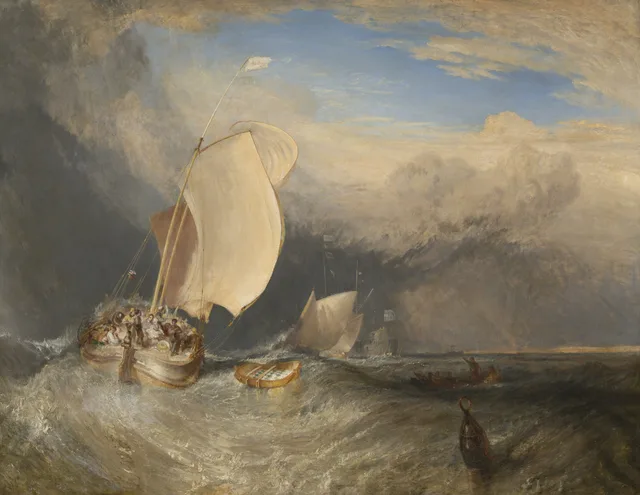
Move to the center and a large sailing ship appears. The white sails are built up with thick paint, and fine cracks now spread over them like a spider's web. The masts are just a few thin lines. The ship seems to fade in and out of the fog.
Zoom in on the small boat below the big ship. Heads and bodies are stacked together in brown and red lines. Two pointed shapes rise above the boat; they could be sails or oars. Up close, each person is only a few quick strokes.
Look at the spray on the right. Dark gray brushstrokes slash across on a diagonal. Below them, the paint is rough and raised, like water bursting into foam. Every stroke rushes from the upper right toward the lower left.
Zoom in on the upper sky. Pale gray is rubbed at a slant across a cream-colored ground. Is it cloud, spray or rain? It is hard to say. Sky and sea are joined by the same colors and the same strokes.
When it was painted
London, 1845. At the Royal Academy's annual exhibition, a seventy-year-old Turner hung a picture of whale hunters. He had entered the Academy's schools at fourteen and had been showing on these walls ever since. This time the reviews were mixed.
Turner's guide to this world was a book: Thomas Beale's Natural History of the Sperm Whale, written by a man who had gone to sea as a whaling ship's surgeon. Turner pointed visitors to Beale in the exhibition catalogue entries for his whaling pictures.
In those years whale oil lit lamps and greased machines. One of Turner's keenest collectors, Elhanan Bicknell, had made his money in the whale oil trade. Bicknell did take this canvas, but he sent it back after discovering that parts had been done in watercolor rather than oil.
Turner showed four whaling pictures at the Academy in 1845 and 1846. The other three stayed with him and are now at Tate in London, among the works he left to the nation. This one was bought by The Metropolitan Museum of Art in 1896, and in 2016 the Met brought all four together for the first time.
Turner died in December 1851 in Chelsea, London. That same year, Herman Melville published his whaling novel Moby-Dick.
Look again at the dark whale at the lower left. It never made it onto the walls of the whale oil merchant who might have owned it. Today it meets visitors in a museum in New York instead.
More by the same painter
Questions to think about
- Look for itCan you find the whale, the big ship and the small boat?
- Why?Why do you think Turner left the whale and the sailors blurred in the mist instead of painting them sharply?
- What about you?People once hunted whales to light their lamps; who or what pays the price for the energy and things we use today?
Same period
Painted around the same time,
somewhere else
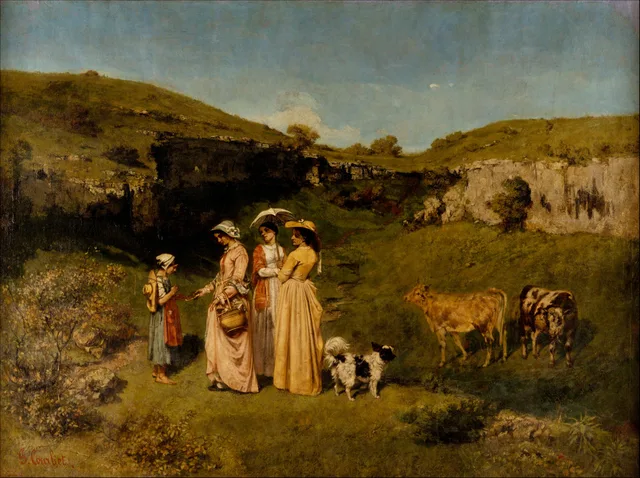 Young Ladies of the VillageGustave Courbet1851–52
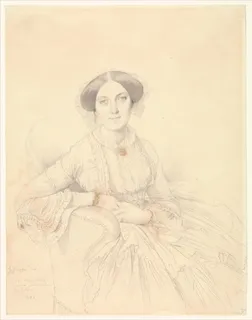 Madame Félix GalloisJean Auguste Dominique Ingres1852
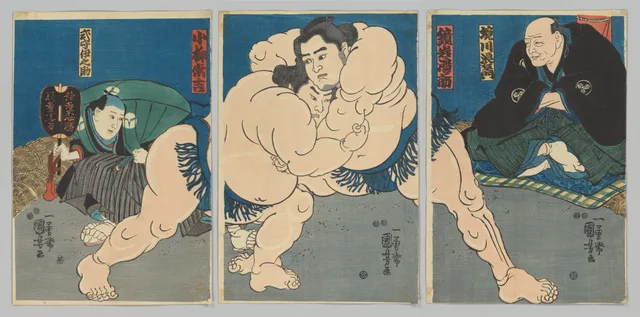 Sumo Wrestlers Kagamiiwa Hamanosuke and Koyanagi Tsunekichi, with Judge Sakaigawa Namiemon and Referee Shikimori KiichirōUtagawa Kuniyoshi1847–52 (Kōka 4–Kaei 5)
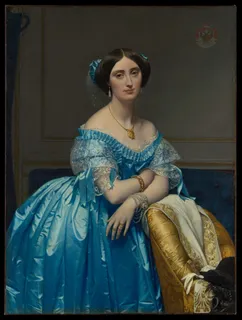 Joséphine-Éléonore-Marie-Pauline de Galard de Brassac de Béarn (1825–1860), Princesse de BroglieJean Auguste Dominique Ingres1851–53
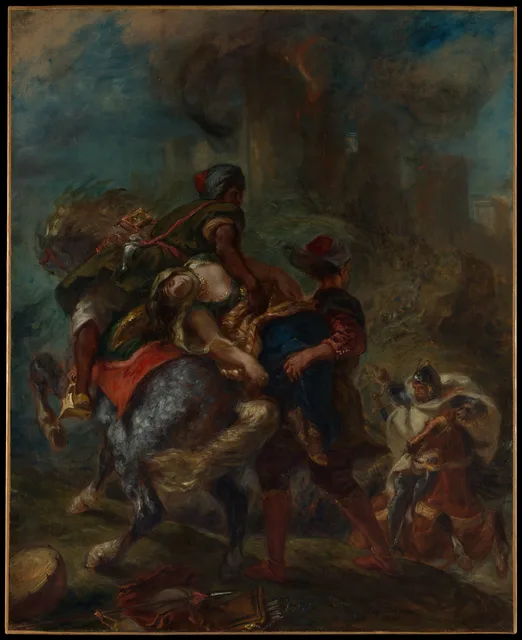 The Abduction of RebeccaEugène Delacroix1846
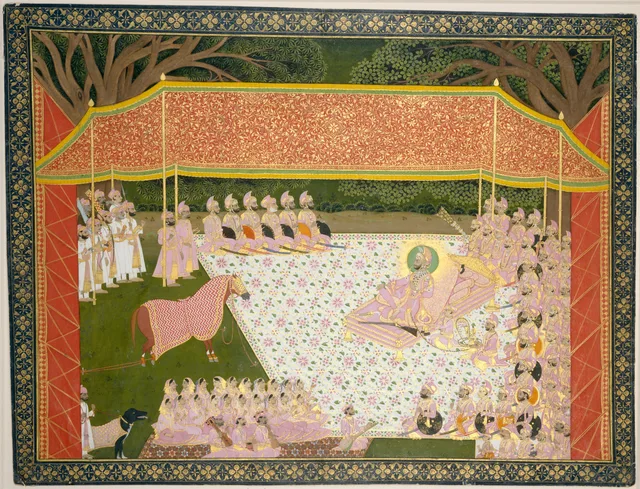 Maharana Sarup Singh Inspects a Prize StallionTara1845–46
Too good to keep to yourself
This painting,
for someone who comes to mind
They open it at full size
and see every brushstroke.
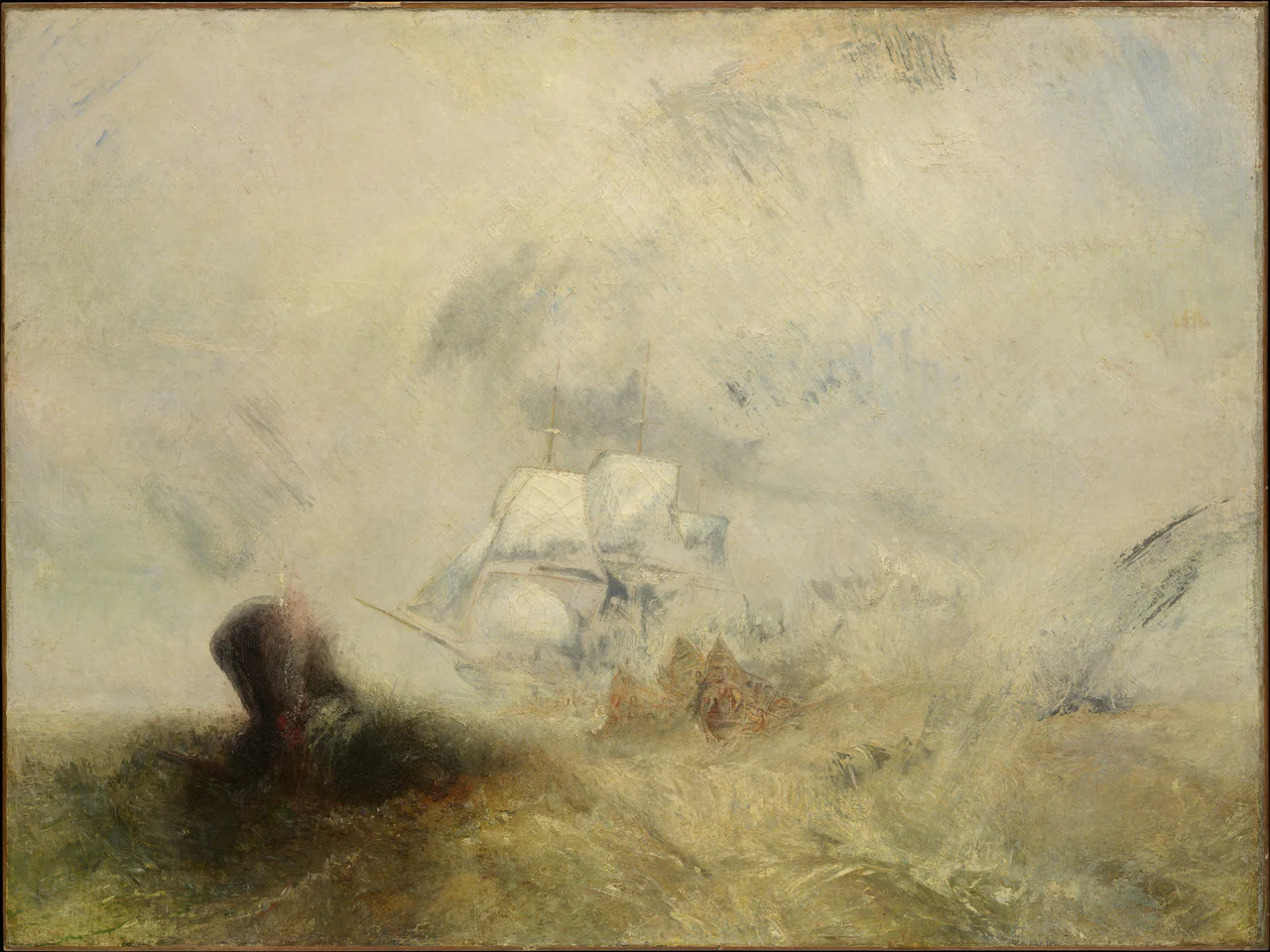
About this work
- Artist
- Joseph Mallord William Turner · 1775–1851
- Date
- ca. 1845
- Medium
- Oil on canvas
- Size
- 91.8 × 122.6 cm
- Collection
- The Metropolitan Museum of Art
- Image
- Original long edge 3958px · shown at 2560px
- Original
- View on the museum's website ↗