Pyeongye
Painters · 15th century
Jan van Eyck
1390–1441
A court painter to the Duke of Burgundy who settled in Bruges and built up thin layers of oil paint until a single hair or a pearl looked close enough to touch.
Scenes from a life
The life of Jan van Eyck,
scene by scene
- 1422The Hague
The first clear trace of Jan van Eyck is a payment record. John of Bavaria, who ruled Holland from The Hague, hired a painter named Jan and his assistants to decorate his palace, and the accounts list them from 1422 to 1424. Where Jan was born and who taught him, nobody knows. He simply walks into the record already a master.
- 1425Lille
John of Bavaria died early in 1425. Within months Jan had a far grander employer: Philip the Good, Duke of Burgundy, who made him court painter and a member of his household. The duke paid him a yearly salary. The court accounts also mention secret journeys Jan made on the duke's business, which tells you he was trusted with more than brushes.
- 1428Portugal
In 1428 a Burgundian embassy sailed for Portugal. Philip wanted to marry Isabella, daughter of the Portuguese king, and Jan was on board. His job was to paint her likeness and send it home so the duke could see the bride. Picture it: no photographs, so the painter's eye was the duke's eye. Those portraits are lost, but the wedding took place in 1430.
- 1432Ghent
In 1432 a huge folding altarpiece was unveiled in a church in Ghent. Today we call it the Ghent Altarpiece. A Latin verse on its frame says Hubert van Eyck began it and his brother Jan finished it. The verse calls Hubert the greater painter and Jan the second in art. Hubert had died in 1426, so Jan carried the work to the end.
- 1434Bruges
By now Jan had bought a house in Bruges and settled there for good. In 1434 he finished the portrait of the merchant Giovanni Arnolfini and a woman standing beside him. On the back wall, above a round mirror, he wrote in Latin that Jan van Eyck was here, 1434. It reads less like a signature than like a witness signing his name.
- 1436Bruges
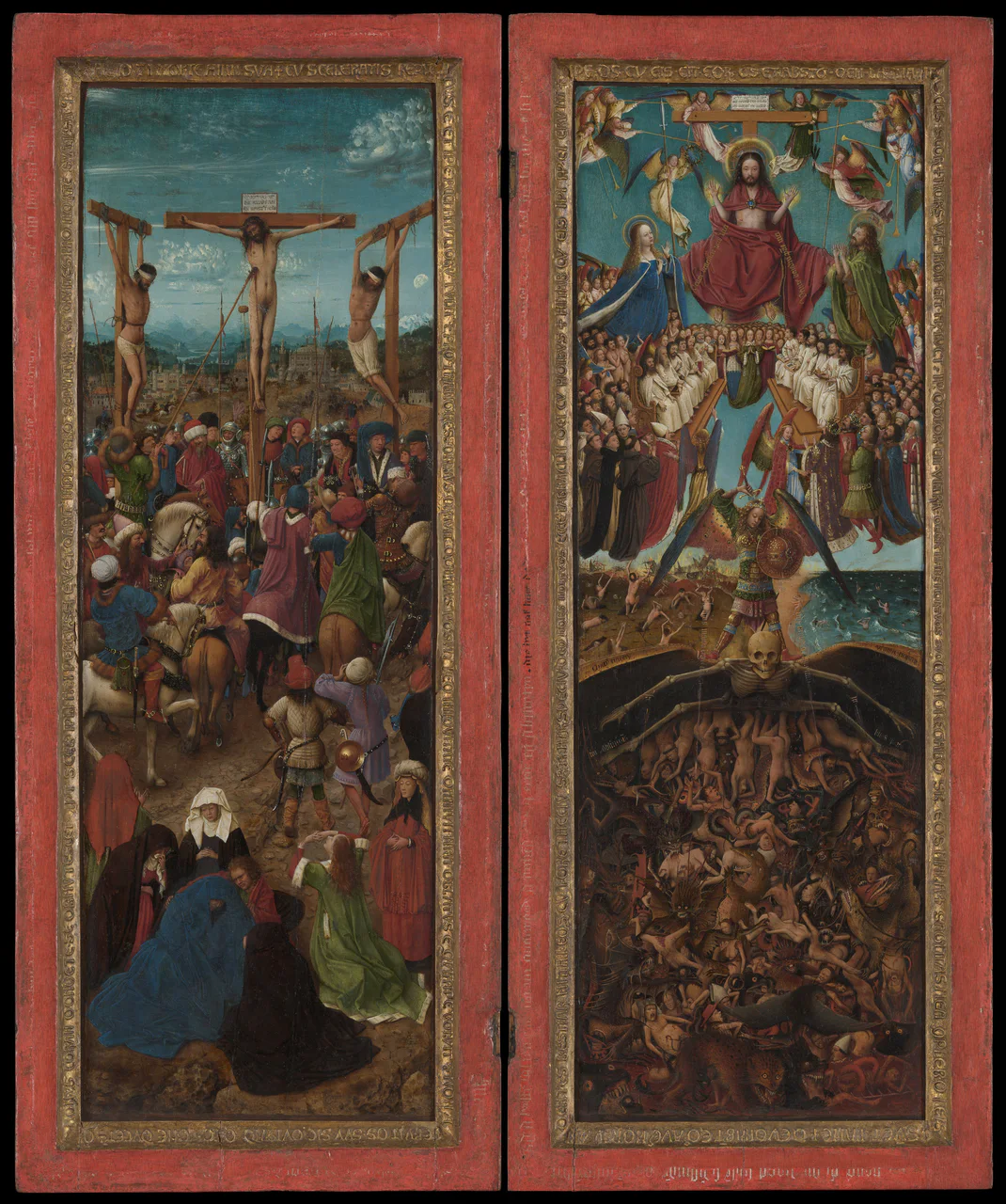
In 1436 he finished a painting of the Virgin and Child with the canon Joris van der Paele kneeling beside them. The small two-panel Crucifixion and Last Judgment on this site dates from these same years. Look at the bottom of the left panel: the Virgin, wrapped in blue, folds to the ground among the mourners. On the right, a skeleton spreads its dark wings over the damned, and an armored angel with a sword and shield stands above it. Each panel is only about 56 centimeters tall, yet each holds dozens of people.
 Painted around this timeThe Crucifixion; The Last Judgment
- 1439Bruges
Jan painted his wife, Margaret. The inscription on the frame is written as if she were speaking. It says her husband Johannes completed her on 17 June 1439, when she was thirty-three. It ends with the motto he liked to put on his frames.
- 1441Bruges
Jan died in Bruges in the summer of 1441 and was buried at the church of Saint Donatian. That church was later torn down and is gone. He did not invent oil paint, whatever the old legend says. What he did was push the method of thin, glassy layers further and more patiently than almost anyone around him, so that light seems to sink into his pictures and come back out.
In their own words
ALS ICH CAN
"As I can." Jan wrote these words on the frames of several paintings. The word for "I" in the motto, ich, sounds a lot like his own name, Eyck, so the motto works as a modest phrase and a quiet signature at the same time.
People around them
- Hubert van EyckJan's older brother, named on the Ghent Altarpiece frame as the one who began it.
- Philip the Goodthe Duke of Burgundy, who kept Jan as court painter from 1425 until his death.
- Isabella of Portugalthe duke's bride, whose likeness Jan traveled to Portugal to paint.
- Margaret van EyckJan's wife, whose portrait he finished in 1439.
- Joris van der Paelea canon in Bruges who appears kneeling in the painting Jan finished in 1436.
Works
Paintings by
Jan van Eyck on Pyeongye
More paintings by this artist will be added.