 Pyeongye
Artwork · 16th century · Paolo Veronese
LeoTurn on Magnifier at the lower right and move slowly across the painting.
Full screen opens it edge to edge.Tap the painting to fill the screen.
Spread two fingers to look closer.
At a glance
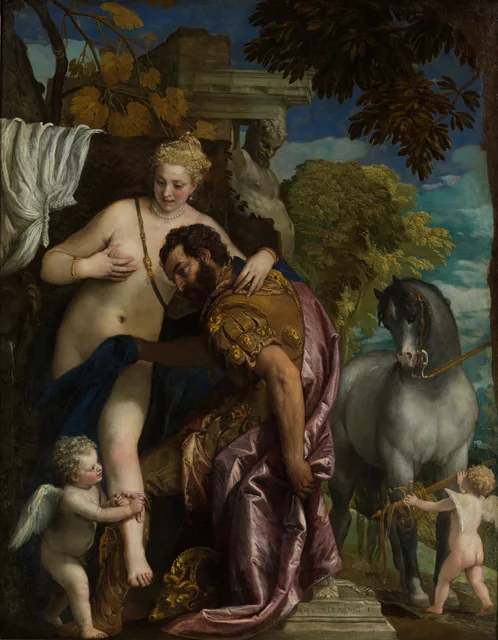
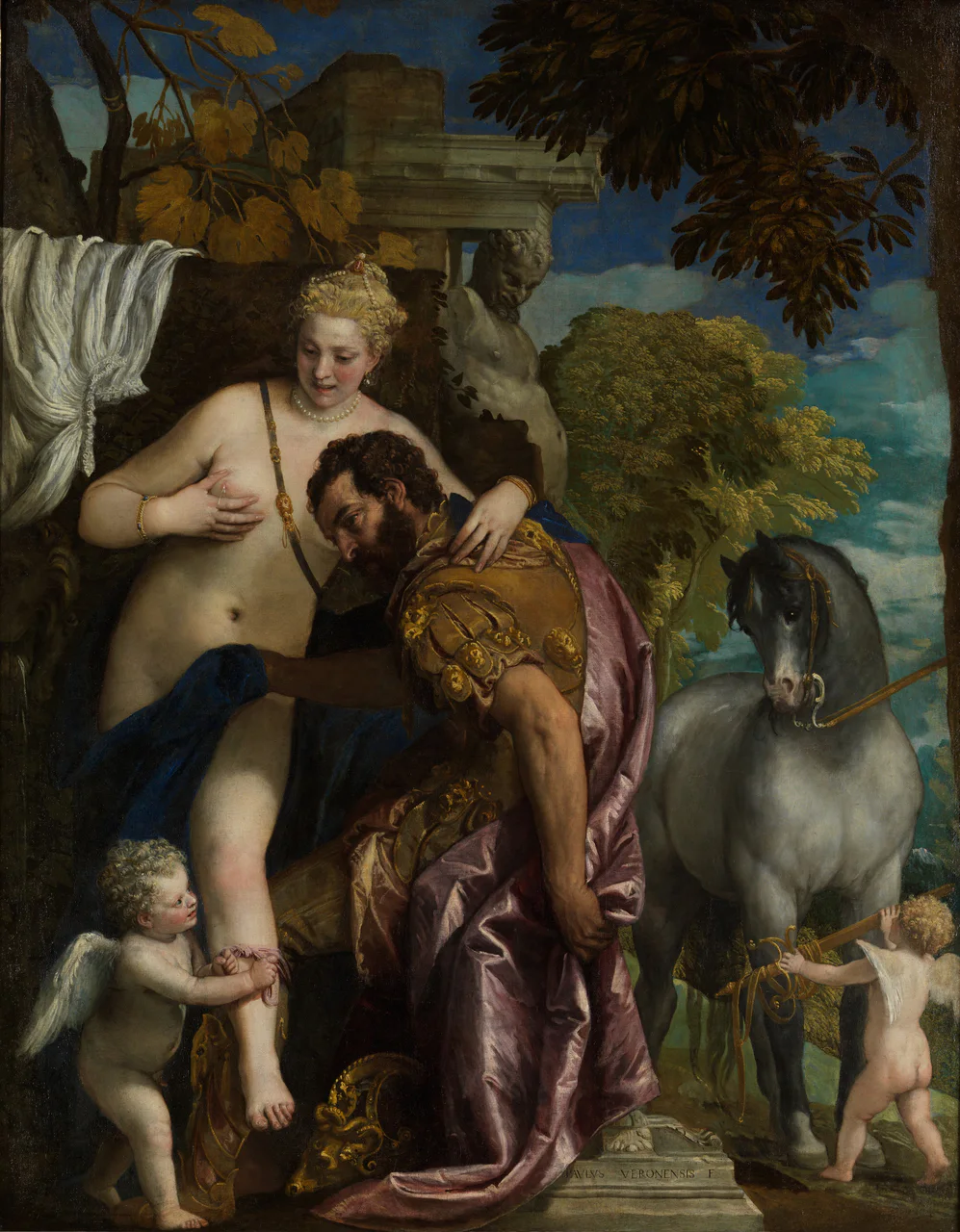
- Mars, the god of war, kneels beside Venus, the goddess of love, while two baby Cupids keep busy around them.
- Paolo Veronese, who worked in Venice, painted it in the 1570s.
- The canvas is more than two meters tall and full of Venetian color: gilded armor, shimmering pink silk, and a dappled gray horse.
Reading the picture
5 places to look closer
Tap a number on the painting to jump to its note, or a close-up to see that spot in the whole picture.
Zoom in on the little Cupid at the lower left. He is wrapping a pink ribbon around Venus's leg and pulling it tight. The loose end trails toward Mars beside her. The title says the two are united by love, and this is the small pair of hands doing the uniting.
Now go to the lower right. A second Cupid grips Mars's sword, with its gold hilt and dangling straps, in both hands and plants himself in front of the gray horse. The war god's horse and weapon are both held in check by a child.
Look up at the stone statue in the middle, above the couple. A bearded face bends down as if peeking at them. It is only carved stone, yet it has an expression, like a spectator who has stumbled on a secret meeting.
Zoom in on Mars's pink cloak. His big hand grips a fistful of it. Every fold flashes with white highlights, and the shadows sink into deep purple. With a few quick strokes Veronese makes you almost hear the silk rustle.
Look at the stone base at the lower right. Carved into it are the words PAVLVS VERONENSIS F. It is Veronese's signature in Latin, meaning Paolo of Verona made this.
When it was painted
By the 1570s Veronese was past forty. The son of a stonecutter in Verona, he had come to Venice as a young man, and his nickname simply means the man from Verona. By now he ran a workshop with his brother Benedetto, turning out vast canvases for church ceilings and monastery dining halls.
In the summer of 1573 one of those canvases got him into trouble. It was a huge Last Supper for the refectory of the friars at Santi Giovanni e Paolo. The Inquisition called him in and asked why a holy scene was full of dogs, a jester, and German soldiers. Veronese answered, in effect, that painters take the same liberties as poets and madmen.
The tribunal gave him three months to correct the picture. He barely touched it. Instead he renamed it The Feast in the House of Levi and left the crowd exactly where it was.
This painting, from the same decade, is myth rather than scripture, and no record says for certain who ordered it. The Metropolitan Museum suggests it may have been commissioned by the Holy Roman Emperor Maximilian II. What is certain is that by 1621 it hung in Prague Castle, in the collection of his son, Emperor Rudolf II.
Rudolf was famous for filling his palace with paintings and curiosities. Later the picture passed through the hands of collectors in several countries before the Met bought it in 1910. The museum reads it as a story of love taming the rough force of war.
Look once more at Venus's left hand. It rests lightly on Mars's gilded shoulder. Under that small weight, the god of war bows his head.
Questions to think about
- Look for itCan you spot the jewelry shining at Venus's neck and wrist?
- Why?Why do you think Veronese showed the fearsome god of war being held back by babies?
- What about you?In this picture, love ties up the sword of war. What do you think actually has the power to stop a fight or a war today?
Same period
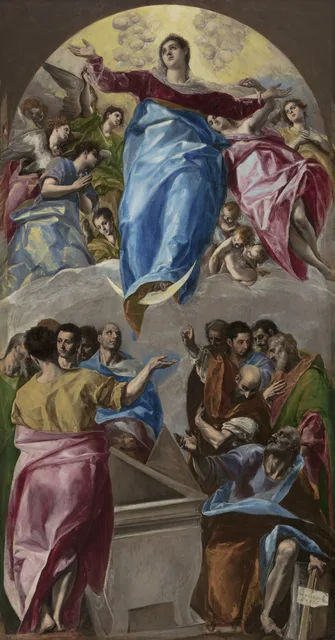
Painted around the same time,
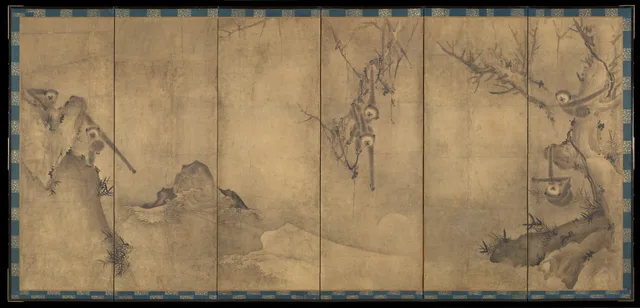
somewhere else
Too good to keep to yourself
This painting,
for someone who comes to mind
They open it at full size
and see every brushstroke.
About this work
- Artist
- Paolo Veronese · 1528–1588
- Date
- 1570s
- Medium
- Oil on canvas
- Size
- 205.7 × 161 cm
- Collection
- The Metropolitan Museum of Art
- Image
- Original long edge 4000px · shown at 2560px
- Original
- View on the museum's website ↗